Side by side
Common ivy or Virginia creeper? How to tell them apart
Hedera helix · Parthenocissus
You can tell a common ivy by its evergreen, glossy, lobed leaves and its clinging roots; a Virginia creeper loses its leaves, turns bright red in autumn and climbs with tendrils tipped with sticky pads.
In winter it is simple: green is ivy, bare stems are Virginia creeper. Look too at how they climb: ivy with countless short rootlets along the stem, Virginia creeper with branched tendrils ending in small suckers.


| Common ivy | Virginia creeper | |
|---|---|---|
| Leaves | Alternate, leathery and glossy dark green; 3–5-lobed on climbing stems, diamond-shaped and unlobed on the flowering shoots at the top. | Alternate; in true Virginia creeper palmately compound with 5 leaflets, in Boston ivy three-lobed and glossy. |
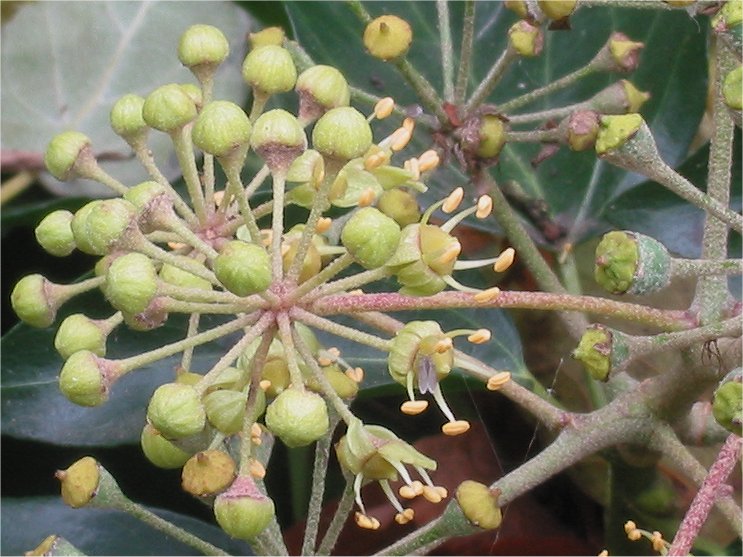
| Flowering | Rounded umbels of small yellowish-green flowers in September–November: a late nectar feast for insects (September–November). | Inconspicuous green flowers in summer, loved by bees (June–July). |
| Fruit | Bluish-black berries in late winter; poisonous to people, loved by birds. | Bluish-black berries with a waxy bloom; not edible. |
| Bark | Stems with countless short aerial roots that it uses to cling on. | Tendrils with tiny suckers (adhesive pads) that let it climb walls. |
| Shape and height | Climber, climbs to 20–30 m | Climber, climbs to 15–20 m |
| Site | Sun to shade, any garden soil, dry to wet | Sun to shade, any garden soil, normal |
| Native to Belgium | Yes | No, naturalised |
| Good for bees, butterflies and birds | Yes, for bees, butterflies and birds | Yes, for bees and birds |
| Poisonous to people and pets | Yes, take care with children and pets | Not known to be poisonous |
| Pruning months | March–April and August–September | November–March |
The best feature in each season
- Spring
- The Virginia creeper comes into leaf with fresh, often reddish leaves, hand-shaped with five leaflets on the five-leaved species. Ivy stays dark green.
- Summer
- The Virginia creeper flowers in June–July with inconspicuous green flowers that bees love; ivy is only forming its flower buds then.
- Autumn
- The Virginia creeper turns bright red and drops its leaves. Ivy is just flowering, from September to November, with round heads of yellowish-green flowers: a late nectar feast for bees, hoverflies and butterflies.
- Winter
- Ivy stays green and carries blue-black berries in late winter, food for blackbirds and wood pigeons. The Virginia creeper stands bare, with bloomy blue-black berries.
Where do they grow?
Ivy is native and grows in woods, on trees, walls and old buildings. The Virginia creeper comes from North America and East Asia and has naturalised; you mostly see it on house fronts, walls and fences.
Which one for your garden?
- For wildlife, ivy is outstanding: evergreen shelter and a nesting place, late flowers for insects and berries in late winter. A healthy tree does not suffer from it, because ivy is not a parasite.
- Virginia creeper covers a wall quickly and keeps it cool in summer, and bees love its little flowers. Ivy berries and leaves are poisonous to children, dogs and cats; Virginia creeper berries are not edible.
Did you know? Ivy has two kinds of leaves: lobed on the climbing shoots, and diamond-shaped without lobes on the flowering shoots at the top.
Read on
- Plant profile: Common ivy
- Plant profile: Virginia creeper
- Common ivy: when and how to prune
- Virginia creeper: when and how to prune
- Identification key: the question that separates them
Also looks like
- Lesser periwinkle or common ivy
- Climbing hydrangea or common ivy
- Common ivy or star jasmine
- Common ivy or Japanese aralia
- Grapevine or Virginia creeper