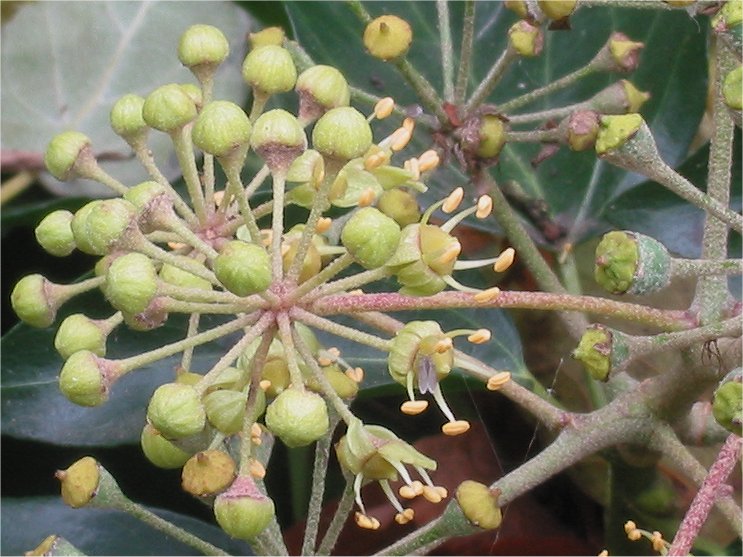
Photo: Rasbak, CC BY-SA 3.0 · source

Pruning guide · Climber
Ivy: when and how to prune
Hedera helix
Prune ivy in March–April or in late summer, in August–September: keep gutters, windows and joints clear, and leave the flowering shoots at the top in place.
Ivy climbs walls, fences and trees with its aerial roots, and needs no support. So you don’t prune it for the plant’s sake, but to keep it in its place: away from gutters, roof tiles, windows and timber cladding. It helps to know its two kinds of shoots. The climbing shoots, with lobed leaves, grow against the wall; at the top, where it gets light, it forms bushy shoots without aerial roots and with diamond-shaped leaves. Only these flower and bear berries.
| Pruning months | March–April and August–September |
|---|---|
| Nesting season (15 March–15 August) | Take care in March–April and August |
| Flowering | September–November |
| Good for bees, butterflies and birds | Yes, for bees, butterflies and birds |
| Native to Belgium | Yes |
| Poisonous to people and pets | Yes, take care with children and pets |
Ivy: when to prune it?
Prune in early spring, in March–April, ideally in the first half of March: blackbirds, wrens and dunnocks nest early in dense ivy. In April, look carefully first.
The second chance is late summer, in August–September, once the young have fledged. Ideally wait until after 15 August, and in September only cut the climbing shoots: the flower buds at the top are then opening.
Leave ivy completely alone in May–July, at the height of the nesting season, and spare the flowering shoots during the late flowering in September–November.
What else to prune in those months? March · April · August · September
Ivy: how to prune it?
- Wear gloves and long sleeves: the berries and leaves are poisonous, and the sap can irritate the skin.
- Along windows, gutters, roof tiles, joints and timber cladding, cut it well back, by about 30–50 cm, so it can’t reach them for a while.
- Never tear ivy off a wall by force: the aerial roots will take loose mortar and render with them. Cut the stems at the base, let them die off for a few weeks, then pull them away and brush off the remains.
- Trim an ivy-covered wall every year with shears, so the layer doesn’t become too thick and heavy and come away from the wall.
- Spare the bushy, flowering shoots at the top: they hold the flowers for insects and the berries for birds. Only cut them if they really are in the way.
- Ivy can grow freely in a healthy tree: it is not a parasite and does the tree no harm. Only if it completely smothers a small tree do you keep it out of the crown.
How much to cut, and how often?
- Along a house wall, twice a year, in March–April and August–September, each time cutting back whatever creeps towards windows, gutters and roof.
- An ivy-covered wall or ivy on a fence: one trim a year is enough.
- As ground cover under trees: hardly ever. Just trim the edges where it spreads over a path or into a border.
What does it mean for wildlife?
- Ivy is a first-rate plant for nests: blackbirds, wrens, dunnocks and woodpigeons breed in it from March. So pruning in March–April and in August falls in the nesting season (15 March–15 August): look carefully first, as disturbing an active nest is against the law.
- The flowering in September–November is one of the last big sources of nectar of the year, for honeybees, wasps, hoverflies and butterflies such as the red admiral. The ivy bee only flies in that period and collects almost nothing but ivy pollen.
- The berries ripen in late winter, when there is little other food: woodpigeons, blackbirds, thrushes and blackcaps love them. Cutting off the flowering shoots takes that food away from them.
- The holly blue lays its eggs on ivy flower buds in summer, and brimstones overwinter among the evergreen leaves. So always leave a good part of the ivy untouched.
Common mistakes
- Cutting off the flowering shoots at the top every year, so there are no more flowers or berries.
- Tearing ivy off a wall by force, so mortar and render come away with it.
- Letting it creep into gutters, under roof tiles or behind timber cladding.
- Pruning in the nesting season without checking for nests first.
- Pruning without gloves, so the sap irritates the skin.
Caution: First check that no birds are nesting: blackbirds and wrens nest in ivy from March onwards. Wear gloves: the sap can irritate the skin. Ivy is poisonous: wear gloves and keep clippings away from children, pets and livestock.
Nearby: related pruning guides
Similar to: Difference from Virginia creeper · Difference from lesser periwinkle · Difference from climbing hydrangea · Difference from star jasmine · Difference from Japanese aralia