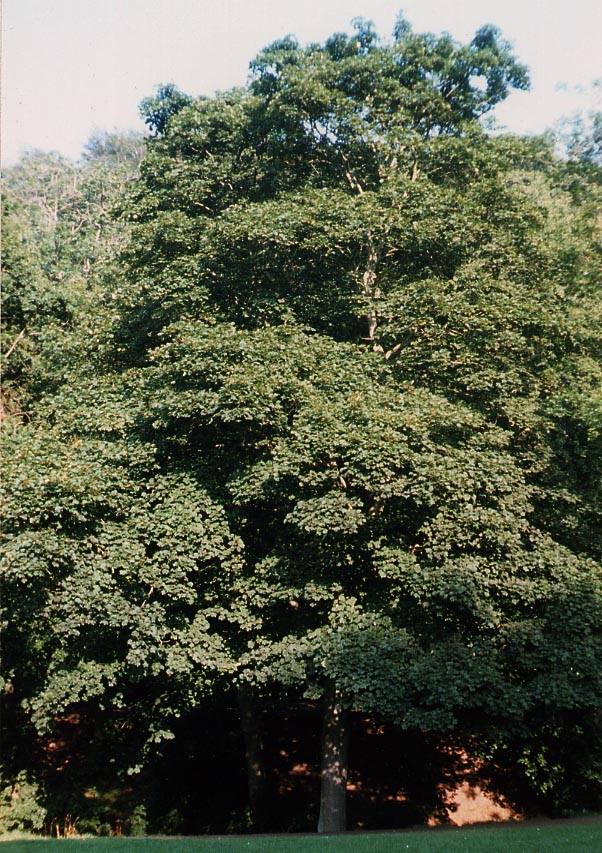
Photo: MPF, CC BY-SA 3.0 · source

Broadleaf tree · Soapberry family (Sapindaceae)
Sycamore
Acer pseudoplatanus · also: Sycamore maple
Sycamore is one of the most common trees in our region. It originally comes from the mountains of central and southern Europe, but it is naturalised everywhere. It grows 25–35 m tall, with a broad, dense crown, large five-lobed leaves and hanging clusters of yellow-green flowers. It is extremely tough, tolerates wind and sea air and seeds itself everywhere with its ‘helicopters’. Be aware: seeds and seedlings are poisonous to horses. With a crown up to 18 m wide it is too big for an ordinary garden: its place is in a park, a hedgerow or a windbreak.
Caution: Seeds and seedlings contain hypoglycin A, which causes atypical myopathy in horses: a muscle disease that is often fatal, especially in autumn and spring. Don’t plant it near a horse paddock and keep horses away from fallen seed and seedlings.
Light
Sun or partial shade
preferably some sun
Moisture
Normal
no wet feet
Legal basis
Any garden soil
any pH
Hardiness
Throughout Belgium
no protection needed
Size
25–35 m
tall
Flowering
May
| Pruning months | July–October |
|---|---|
| Height | 25–35 m |
| Native to Belgium | No, naturalised |
| Good for bees, butterflies and birds | Yes, for bees and birds |
| Poisonous to people and pets | Not known to be poisonous |
| Flowering | May |
Identify
Sycamore: how do you recognise it?
- Habit
- Large tree of 25–35 m with a broad, domed, dense crown.
- Leaf
- Opposite, 10–20 cm, with 5 coarsely and irregularly toothed lobes; underside grey-green. Leaf stalk often red, without milky sap.
- Bark
- Grey, flaking in plates on older trees. Buds green.
- Flower
- Yellow-green flowers in hanging clusters, appearing with the leaves.
- Fruit
- Winged fruits with wings at an acute to right angle.
- Difference from Norway maple
- Norway maple has long, pointed teeth on the lobes and milky sap in the leaf stalk.
- Difference from London plane
- London plane has alternate leaves.
Flowering: May · Pruning: July–October
Identify by feature: Palmate leaves · Opposite leaves · Hanging flower clusters · Winged seeds · Peeling bark
Looks like it, but isn’t
- Norway maple Acer platanoides: long, pointed teeth on the lobes, and milky sap. Difference from Norway maple
- London plane Platanus × hispanica: leaves are alternate. Difference from London plane
In your garden
Why grow it?
- Extremely tough: tolerates wind, sea air and almost any soil, which makes it a good tree for a windbreak.
- Flowers for bees in April–May.
- Grows fast and gives plenty of shade in a park or a large garden.
- Highly prized wood, for violin backs, furniture and chopping boards.
Sycamore: where does it grow best?
- Sun to partial shade; young trees tolerate a lot of shade.
- Almost any soil, preferably moist and fertile; not ground that stays under water for long.
- Tolerates wind and sea air: suitable for a windbreak on the coast or in open country.
- Allow for a crown up to 18 m wide: only for a park, a large garden, a hedgerow or a windbreak, and never next to a horse paddock.
- Light
- Sun or partial shade
- Legal basis
- Any garden soil
- Moisture
- Normal
- Size
- 30 m tall, 18 m wide
- Hardiness
- Throughout Belgium, no protection needed
Goes well with
Good and bad companions
Goes well with
- Tolerate the shade under this tree: oregon grape, rhododendron, oleaster, japanese skimmia, garden privet, camellia, laurustinus, box-leaved honeysuckle
Best kept away from
- Sun-loving plants get too little light under the dense crown: english lavender, heather, butterfly bush, blackthorn, highbush blueberry, sea buckthorn, japanese rose, broom
Maintenance
Sycamore: when and how to plant it?
- Plant from November to March, bare-root or with a root ball.
- Don’t plant it near a field or paddock with horses, not even just over the fence: the seeds blow a long way.
- In a windbreak or hedgerow: space the trees widely and fill in with native shrubs.
- Put a stake on the windward side and water generously after planting.
Care
- Watering
- In dry spells during the first year; after that it copes.
- Feeding
- Not needed.
- Seedlings
- Pull up seedlings in the garden in good time: they come up everywhere and are deeply rooted after a few years.
- Horses
- If sycamores grow near a paddock, gather the seeds in autumn, remove the seedlings in spring and provide extra hay when grass is short.
Tip: Want a maple in a small garden? Choose the slow, small ‘Brilliantissimum’ with salmon-pink young leaves – but that too is a sycamore: not near horses.
Sycamore: when to prune it?
Pruning months: July–October.
When: In summer or early autumn (July–October).
How:
- Prune little; train a young tree on a single central leader.
- Pull up seedlings in the garden in good time, as they come up everywhere.
- Cut large branches in three steps, just outside the branch collar.
Caution: Don’t prune in late winter or spring: it bleeds heavily then. Do you see a black, sooty layer under loose bark (sooty bark disease)? Don’t saw it yourself: the spores are harmful to the lungs.
Propagation
- Sowing
- Usually not needed: it seeds itself everywhere. If you still want to sow, sow the winged fruits outdoors in autumn.
- Grafting
- Ornamental forms such as ‘Brilliantissimum’, with salmon-pink young leaves, are grafted; that is a job for the nursery.
Sycamore: how does it get through the winter?
Hardy throughout Belgium: no protection needed.
- Fully hardy, even in open, windy places.
- In winter you recognise it by its fat green buds and, on older trees, the flaking bark.
Diseases and pests
- Tar spot: Large black spots on the leaves in late summer. Harmless; rake up the leaves in autumn.
- Sooty bark disease: After hot, dry summers, branches die back, the bark comes loose and underneath is a black, sooty layer of spores. The spores are harmful to the lungs: have the tree felled by a professional wearing protective equipment.
- Aphids and honeydew: Sticky drops on cars, benches and the patio under the tree. A nuisance but harmless.
- Seedlings: Hundreds of seedlings in borders, hedges and between paving slabs. Pull them up while young.
Through the year
- March: Last month for planting.
- April: Flowers in hanging clusters with the leaves; seedlings come up: remove them near horse paddocks.
- May: Weed out seedlings in the garden and near paddocks.
- July: Summer pruning: the right time for maples.
- August: Summer pruning; tar spots on the leaves.
- September: Pruning still possible; the ‘helicopters’ ripen.
- October: Seeds blow away: keep horses away from fallen seed. Last month for pruning.
- November: Planting season starts; clear up leaves with tar spot.
Use
What can you use it for?
- Wood
- Highly prized wood: violin backs (flamed maple), furniture and chopping boards.
- Food and drink
- The spring sap can be boiled down to syrup, though it is less sweet than that of the sugar maple.
- For wildlife
- Flowers for bees.
Caution: Seeds and seedlings are poisonous to horses (atypical myopathy). Don’t plant it near horse paddocks.
Good for wildlife
- Bees
- Nectar and pollen for honeybees and wild bees.
- Ladybirds
- Aphids on the plant are food for ladybirds and their larvae.
- Birds
- Berries, seeds or insects as food, or a place to nest.
You and this species
Did you know?
- Seeds itself everywhere: the ‘helicopters’ float far away on the wind.
- Flamed sycamore wood is prized for the backs of violins.
- The spring sap can be boiled down to syrup, though it is less sweet than that of the sugar maple.
- The name pseudoplatanus means ‘false plane’, after the leaf.
- Its English name, sycamore, arose from confusion with the sycomore fig of the Bible (Ficus sycomorus); pseudoplatanus means ‘false plane’.
- The black spots often seen on the leaves in late summer are tar spot, a harmless fungus that is sensitive to sulphur dioxide pollution.