Photo: Kurt Stüber [1], CC BY-SA 3.0 · source

Shrub · Cashew family (Anacardiaceae)
Smoke-tree
Cotinus coggygria · also: Smoke bush, Cotinus
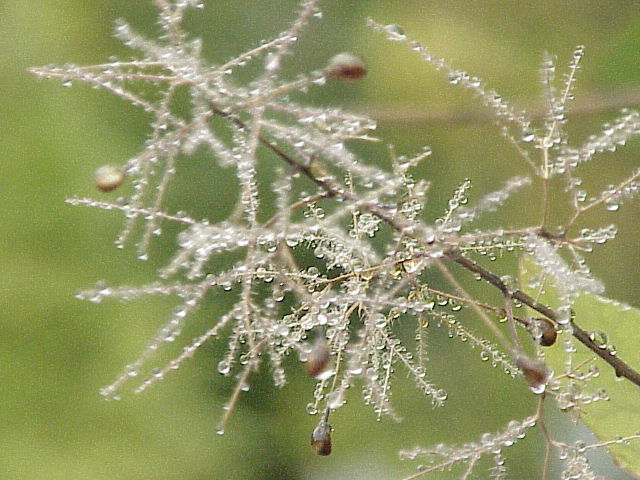
The smoke-tree is a broad shrub or small tree of 3–5 m from southern Europe and Asia. It owes its name to the cloud-like plumes that float above the leaves from July to September: the stalks of the faded flowers grow into pink or grey hairs, like a puff of smoke or a wig. The purple forms give colour from spring to autumn, and late in the season the leaves blaze orange and red. It wants full sun and dry, free-draining soil.
Light
Full sun
warm and bright
Moisture
Dry
tolerates drought
Legal basis
Any garden soil
any pH
Hardiness
Throughout Belgium
no protection needed
Size
3–5 m
tall
Flowering
June–July
| Pruning months | March |
|---|---|
| Height | 3–5 m |
| Native to Belgium | No, planted |
| Poisonous to people and pets | Not known to be poisonous |
| Flowering | June–July |
Identify
Smoke-tree: how do you recognise it?
- Habit
- Broad, rounded shrub or small tree of 3–5 m, often multi-stemmed.
- Leaf
- Alternate, 4–8 cm, round to oval, untoothed and hairless, on a long stalk; green or dark purple, with fiery autumn colour.
- Bark
- Greyish-brown; crushed twigs smell resinous.
- Flower
- Tiny, yellowish-green flowers in large, loose clusters in June–July.
- Smoke and fruit
- The stalks of the sterile flowers grow into long, pink to grey hairs: the ‘smoke’, from July to September. Among them sit a few small drupes.
- Difference from ninebark
- Ninebark has lobed, toothed leaves and domed white flower heads.
- Difference from cherry plum ‘Nigra’
- Cherry plum ‘Nigra’ is a small tree with toothed, purple leaves and pink blossom in March.
Flowering: June–July · Pruning: March
Looks like it, but isn’t
- Ninebark Physocarpus opulifolius: lobed, toothed leaves and domed white flower heads. Difference from ninebark
- Cherry plum (Prunus cerasifera ‘Nigra’): a small tree with toothed, purple leaves and pink blossom in March.
In your garden
Why grow it?
- Colourful foliage from spring to autumn, especially in the purple forms.
- Striking ‘smoke’ in summer that lasts for weeks.
- One of the finest autumn colours in the garden: orange, red and purple.
- Tough on dry, poor soil, where many other shrubs struggle.
Smoke-tree: where does it grow best?
- Full sun: there the leaves colour best and it forms the most plumes. In shade, purple forms turn greenish.
- Any free-draining soil, including chalky, sandy or stony ground; on poor, dry soil the autumn colour is brightest.
- Avoid soil that stays wet in winter: it declines there.
- Allow 3–4 m width; lovely as a specimen in a lawn or at the back of a sunny border.
- Light
- Full sun
- Legal basis
- Any garden soil
- Moisture
- Dry
- Size
- 4 m tall, 4 m wide
- Hardiness
- Throughout Belgium, no protection needed
Goes well with
- English lavender: Both love full sun and dry soil; lavender fills the base with scent and bees.
- Broom: Yellow flowers in May next to the dark purple leaves, on the same poor, dry soil.
- Butterfly bush: Flowers in summer, just as the plumes appear, and also likes a sunny, dry spot.
- Ornamental grasses: Their airy flower heads echo the plumes, and yellow or silvery grass stands out well against purple leaves.
Good and bad companions
Best kept away from
- Do not plant under the dense crown of these trees: norway spruce, european silver fir, nordmann fir, douglas fir, yew, horse chestnut, norway maple, sycamore
Maintenance
Smoke-tree: when and how to plant it?
- Plant from a pot in autumn or spring, not in frost or drought.
- Loosen the soil well; manure or lots of compost is not needed: on rich soil it grows more lushly and colours less.
- Plant at the same depth as in the pot and firm the soil well.
- Water in dry spells during the first year; after that it looks after itself.
Care
- Watering
- In dry spells during the first year; rarely needed after that, as it copes well with drought.
- Feeding
- Not needed; too much feeding gives long shoots and duller autumn colour.
- Shape
- Let it grow freely: that way it keeps its natural, broad shape and produces the most plumes.
- Dead branches
- Cut out suddenly wilted or dead branches well into healthy wood (see verticillium wilt under problems).
Tip: Purple forms such as ‘Royal Purple’ colour darkest in full sun; the yellow-leaved ‘Golden Spirit’ lights up a sunny border and turns orange in autumn. Pick a few plumes in August: they dry beautifully for a dried arrangement.
Smoke-tree: when to prune it?
Pruning months: March.
When: End of winter (March).
How:
- For the plumes, let it grow freely: only remove dead, damaged or crossing branches.
- If you mainly want large, richly coloured leaves, cut the branches back to 2–3 buds every spring: you get large leaves, but no plumes.
- Reduce an oversized shrub gradually: every year, saw a few of the oldest branches off at the base.
Caution: Hard pruning costs you that summer’s plumes, as the flower clusters form on last year’s wood. So choose between plumes and large leaves.
Propagation
- Layering
- In spring, bend a low branch down to the ground, nick the underside lightly and cover it with soil; after a year you can sever it and replant it.
- Softwood cuttings
- In June–July, take soft cuttings of 10 cm and root them under plastic; they do not always take.
Smoke-tree: how does it get through the winter?
Hardy throughout Belgium: no protection needed.
- Fully hardy.
- In winter it stands bare, with greyish-brown branches; wait until March to prune.
Diseases and pests
- Verticillium wilt: In summer whole branches suddenly wilt, and the wood beneath shows discoloured streaks. Cut them back well into healthy wood and disinfect your secateurs; do not plant another smoke-tree or a maple in the same spot.
- Powdery mildew: White coating on the leaves in late summer, especially on purple forms in a stuffy corner. Usually harmless; give it an airy, sunny spot.
- No plumes: A young shrub flowers little at first; hard pruning or overly rich soil also reduces flowering. Let it grow freely and do not feed it.
Through the year
- March: Prune: remove dead wood, or cut back hard for large leaves; planting.
- April: Leaves unfurl, deep red in the purple forms.
- June: Flowering: small yellowish-green clusters, visited by bees.
- July: The plumes appear.
- August: Plumes at their best; water young plants in dry spells.
- October: Fiery autumn colour in orange, red and purple.
- November: Plant pot-grown shrubs.
Use
What can you use it for?
- Garden and landscape
- Specimen shrub for a sunny, dry spot; the purple forms give colour from spring to autumn.
- For wildlife
- Bees visit the small flowers.
You and this species
Did you know?
- Its wood once yielded a yellow dye for wool, leather and silk.
- It belongs to the same family as the pistachio, the cashew and the mango.
- The ‘smoke’ is not made of flowers, but of the lengthened stalks of sterile flowers.