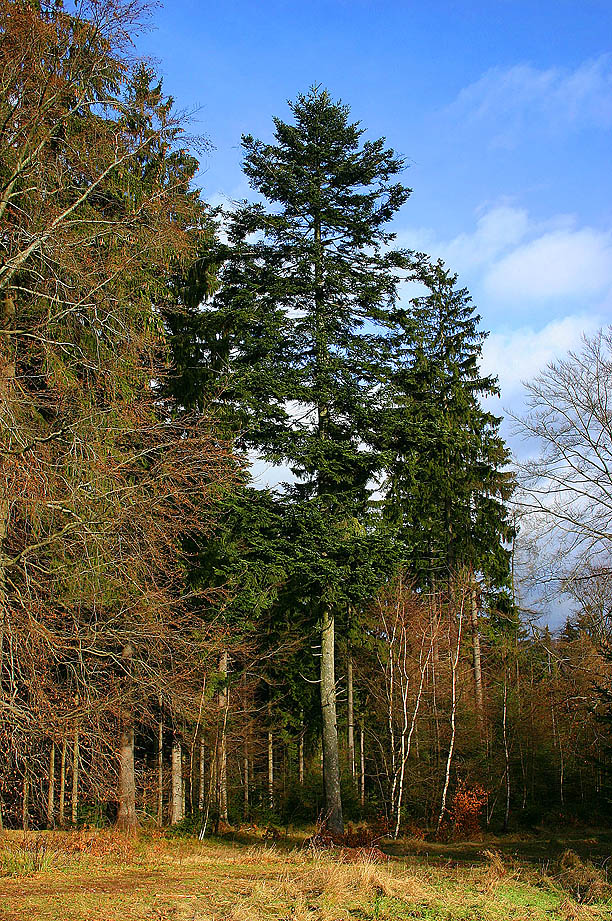
Photo: Thomas Dreger, Suhl, CC BY-SA 3.0 · source

Conifer · Pine family (Pinaceae)
European silver fir
Abies alba · also: Silver fir
The European silver fir is the fir of the medium-height mountain ranges, such as the Vosges and the Black Forest. It has flat, soft needles arranged like a comb, with two white stripes underneath, and upright cones that break up on the tree. The trunk stays smooth and silver-grey for a long time. It grows 30–50 m tall, tolerates a lot of shade and likes a cool, moist climate. It is rarely planted here: it struggles with drought and late frosts. It is too big for a garden; in a large park or woodland it can work.
Light
Partial shade or shade
tolerates little sun
Moisture
Normal
no wet feet
Legal basis
Any garden soil
any pH
Hardiness
Throughout Belgium
no protection needed
Size
30–50 m
tall
| Pruning months | August–September |
|---|---|
| Height | 30–50 m |
| Native to Belgium | No, planted |
| Good for bees, butterflies and birds | Little |
| Poisonous to people and pets | Not known to be poisonous |
Identify
European silver fir: how do you recognise it?
- Habit
- Tree of 30–50 m with a straight trunk and a regular, conical crown about 8 m wide; old trees develop a flattened top.
- Needles
- 1.5–3 cm, flat and soft with a blunt or notched tip; two white stripes underneath. They are arranged in two rows to the sides (comb-like). The base is widened like a little sucker and leaves a round scar on a smooth twig.
- Bark
- Smooth and silver-grey, in small plates on old trees.
- Cones
- Upright, 10–15 cm, at the top of the crown; they break up on the tree and only the central spike remains.
- Difference from Nordmann fir
- Nordmann fir has more densely packed, glossy needles that cover the top of the twig.
- Difference from Douglas fir
- Douglas fir has pointed brown buds, a citrus scent and hanging cones.
Harvest and fruit: January–December · Pruning: August–September
Identify by feature: Soft needles
Looks like it, but isn’t
- Nordmann fir Abies nordmanniana: more densely packed, glossy needles that cover the top of the twig. Difference from Nordmann fir
- Douglas fir Pseudotsuga menziesii: pointed brown buds, a citrus scent and hanging cones. Difference from Douglas fir
In your garden
Why grow it?
- Tolerates a lot of shade: one of the few conifers that grows up beneath other trees.
- Soft needles that don’t prick, with two silvery-white stripes underneath.
- A smooth, silver-grey trunk and a stately, regular shape.
- Upright cones like candles at the top of the crown.
European silver fir: where does it grow best?
- Partial shade to shade; young trees like to grow up under other trees.
- Moisture-retentive, deep soil, acid or chalky; no dry sand and no waterlogging.
- A cool, sheltered spot with moist air, out of the wind and not in a hollow where late frosts linger.
- Allow for 30–50 m in height and a crown of about 8 m: only for a park, a wood or a very large garden.
- Light
- Partial shade or shade
- Legal basis
- Any garden soil
- Moisture
- Normal
- Size
- 40 m tall, 8 m wide
- Hardiness
- Throughout Belgium, no protection needed
Goes well with
- Beech: In the mountain forests of the Vosges, beech and silver fir grow together; in a park they make a fine pair too.
- Holly: Evergreen and shade-tolerant, for the understorey.
- Norway spruce: Together with beech and silver fir, one of the classic trees of the European mountain forest.
- Hazel: A native shrub for the light edge.
Good and bad companions
Goes well with
- Like the acid soil under this tree: heather, rhododendron, japanese skimmia, raspberry, highbush blueberry, witch hazel, broom, gorse
- Tolerate the shade under this tree: oregon grape, rhododendron, oleaster, japanese skimmia, garden privet, camellia, laurustinus, box-leaved honeysuckle
Best kept away from
- Sun-loving plants get too little light under the dense crown: english lavender, heather, butterfly bush, blackthorn, highbush blueberry, sea buckthorn, japanese rose, broom
Maintenance
European silver fir: when and how to plant it?
- Plant in October–November or in March–April, when the ground isn’t frozen.
- Choose a young plant and preferably set it in the partial shade of other trees.
- Plant at the same depth as before and cover the soil with leaf mould or wood chips.
- Protect young silver firs from deer: they love eating the buds and leaders.
- Water after planting and in every dry summer during the first few years.
Care
- Watering
- In the first few years, during every dry spell; it can’t tolerate drying out.
- Feeding
- Not needed; a layer of leaf mould keeps the soil moist.
- Protection
- A guard or tree shelter against deer until the leader is out of their reach.
- Shade
- Keep the sheltering trees around a young silver fir: it grows up best in their shade.
Tip: Plant a silver fir in the light shade of existing trees: it grows better there than in full sun.
European silver fir: when to prune it?
Pruning months: August–September.
When: Dead, diseased and broken branches can be removed at any time of year. If pruning is needed, do it in August–September.
How:
- Don’t prune; a tree that has lost its top never looks good again.
- Only remove branches back to the trunk, just outside the branch collar.
- If the top has broken off, let one side branch from the topmost whorl become the new leader: tie it upright to a cane.
Caution: Never cut a silver fir back into bare wood: no new buds will form there.
Propagation
- Sowing
- The cones break up on the tree: pick them in September just before they fall apart. Sow the seeds in spring after 1–2 months cold and moist; they soon lose their ability to germinate.
- Seedlings
- Seedlings grow very slowly in the first few years and need shade.
European silver fir: how does it get through the winter?
Hardy throughout Belgium: no protection needed.
- Hardy; only the young shoots are sensitive to late frosts in spring.
- Wet snow can break branches; shake young trees.
Diseases and pests
- Late frost: Young shoots that turn brown and shrivel in spring. Avoid frost hollows; the tree usually sprouts again.
- Woolly aphid: White, woolly tufts on bark and twigs, sometimes with distorted shoots. On young trees, wash them off with water if you like.
- Drought: Browning needles and a thin crown in dry summers. Water young trees and mulch.
- Browsing: Deer nibble the buds and leaders of young silver firs. Protect them with a guard or tree shelter.
Through the year
- March: Planting season; protect young trees from deer.
- April: Last month for planting.
- May: New growth: watch out for late frost.
- July: Water in dry spells.
- August: Remove any branches that must go, back to the trunk.
- September: Last month for pruning; pick cones before they break up.
- October: Planting season starts.
- November: Plant; mulch the soil.
Use
What can you use it for?
- Wood
- Light construction timber, low in resin.
- Also used for
- Also used as a Christmas tree.
Edible and useful
- Young shoots (May–June)
- The young, soft shoots in May and early June. They are milder and sweeter than those of Norway spruce. In the Vosges and the Black Forest they have long been made into syrup and liqueur.
- Needles (January–December)
- Needles and twigs all year round, for tea or a fragrant bath.
- Storing
- Shoots keep for a few days in the fridge, or for months in the freezer. Dried needles keep for a few months in a closed jar.
Caution: Silver fir has flat needles and so resembles yew, which is deadly poisonous. You can tell silver fir by the two white stripes under each needle, its upright cones and the resinous, citrusy smell of a crushed needle; yew needles are plain pale green underneath with no white stripes, and yew has red berries. If in doubt, do not pick. Take only a few shoots per branch and never the leading shoot. Stop using the bath if your skin becomes irritated. Pick well away from busy roads and sprayed fields, and never eat anything you have not identified with certainty.
Eating and using is at your own risk: see the terms of use.
Recipes
- Fir-tip liqueur (Liqueur · ± 0.7 litre · 20 min + 6 weeks)
- Fragrant fir-needle bath (Skin and body care · 1 bath · 30 min)
- Panna cotta with silver fir tips (Dish · 4 small glasses · 20 min + 30 min infusing + 4 hrs setting)
- Mustard with silver fir tips (Other · ± 2 small jars of 150 ml · 15 min + 12 hrs soaking + 2 days maturing)
You and this species
Did you know?
- Naturally a tree of medium-height mountain ranges such as the Vosges and the Black Forest.
- You almost never find a whole silver fir cone on the ground, because they break up on the tree. A whole cone on the ground usually comes from a spruce or a pine.
- Its light, low-resin wood was widely used for construction.
- Silver fir is very shade-tolerant: young trees can wait for decades beneath older ones until a gap opens up.
- In the 1970s and 80s a striking number of silver firs died back in central Europe. Sulphur dioxide pollution, to which the species is very sensitive, played a major part.