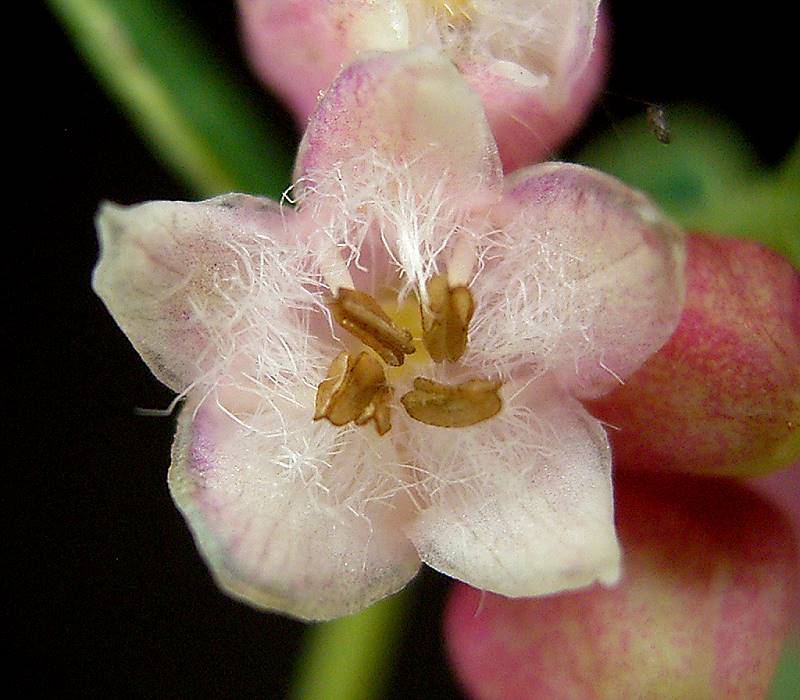
Photo: Frank Vincentz, CC BY-SA 3.0 · source

Shrub · Honeysuckle family (Caprifoliaceae)
Snowberry
Symphoricarpos albus · also: Common snowberry
Snowberry is a low, dense shrub of 1–2 m from North America that has long been naturalised here. It stands out for its white, spongy berries, which hang on the bare twigs well into winter. All summer it carries small pink bells that are busy with bees and bumblebees. It grows in sun and deep shade, on any soil, and puts up with almost anything. The downside: it spreads by suckers, escapes into woods and verges, and the berries are poisonous.
Caution: The berries are poisonous: if eaten they cause vomiting and stomach ache, especially in young children. Dogs and cats can also fall ill from them. The shrub produces lots of suckers and runs wild: don’t plant it in or near the wild.
Light
Sun to shade
not fussy
Moisture
Dry to wet
not fussy
Legal basis
Any garden soil
any pH
Hardiness
Throughout Belgium
no protection needed
Size
1–2 m
tall
Flowering
June–September
| Pruning months | February–March |
|---|---|
| Height | 1–2 m |
| Native to Belgium | No, naturalised |
| Good for bees, butterflies and birds | Yes, for bees |
| Poisonous to people and pets | Yes, take care with children and pets |
| Flowering | June–September |
Identify
Snowberry: how do you recognise it?
- Habit
- Dense, low shrub of 1–2 m with thin, arching branches; spreads by suckers.
- Leaf
- Opposite, 2–5 cm, round to oval, untoothed (sometimes lobed on vigorous shoots), blue-green.
- Bark
- Thin, brown twigs that peel in strips.
- Flower
- Small pink bells from June to September, busy with bees and bumblebees.
- Fruit
- White, spongy berries (1–1.5 cm) that hang on into winter; poisonous.
- Difference from Chenault coralberry
- That one (Symphoricarpos × chenaultii) has smaller, pink to red berries.
- Difference from wild privet
- Wild privet has narrower leaves, white panicles and black berries.
Flowering: June–September · Pruning: February–March
Looks like it, but isn’t
- Chenault coralberry (Symphoricarpos × chenaultii): smaller, pink to red berries.
- Wild privet Ligustrum vulgare: narrower leaves, white panicles and black berries. Difference from wild privet
In your garden
Why grow it?
- Grows where almost nothing else will: in deep shade, under trees, on dry or wet soil.
- Pink bells from June to September, good for bees and bumblebees all summer.
- White berries that hang on the bare twigs into winter.
- Tough and dense: its roots hold a bank or an awkward corner together.
Snowberry: where does it grow best?
- Sun, partial shade or deep shade: it tolerates everything.
- Any soil, dry or moist, acid or chalky.
- Allow 2 m width, and more: its suckers push further out every year.
- Not next to a border, and not in or near the wild: there it spreads and runs wild.
- Light
- Sun to shade
- Legal basis
- Any garden soil
- Moisture
- Dry to wet
- Size
- 1.5 m tall, 2 m wide
- Hardiness
- Throughout Belgium, no protection needed
Goes well with
- Holly: Evergreen and shade-tolerant: together a dense border under trees.
- Common ivy: Covers the ground in the deep shade where snowberry grows.
- Lesser periwinkle: Evergreen ground cover with small blue flowers in spring.
Good and bad companions
Goes well with
- Tolerates shade and suits planting under large trees such as: ginkgo, box elder, ash, honey locust, field maple, silver maple
Maintenance
Snowberry: when and how to plant it?
- Choose a native shrub for the same spot instead: wild privet, holly or hazel don’t spread like this.
- If you still plant a snowberry, do so from November to March, bare-root or from a pot.
- Put a sturdy root barrier around the planting spot: it keeps the suckers in.
- Don’t plant it where young children play: the berries are poisonous.
Care
- Watering
- Only in dry spells during the first year; never needed after that.
- Feeding
- Not needed: it grows on any soil.
- Suckers
- Every year, spade off the suckers that stray outside their spot; the younger they are, the easier.
- Prunings
- Never dump spaded-off suckers or prunings in the countryside or at a woodland edge: they take root easily.
Tip: Looking for a tough shrub for shade? Choose wild privet, holly or hazel: native, at least as robust, and they don’t run riot. If you already have a snowberry, keep it inside a root barrier.
Snowberry: when to prune it?
Pruning months: February–March.
When: End of winter.
How:
- Every year, cut the oldest stems off at ground level: the shrub stays young and dense.
- Spade off suckers that spread too far, roots and all.
- An overgrown shrub can be cut back to just above the ground; it will regrow.
Caution: Don’t leave spaded-off suckers lying on the ground: they readily root again.
Propagation
- Suckers
- A rooted sucker takes easily, but usually you have too much snowberry rather than too little. Don’t propagate it for spots near the wild.
Snowberry: how does it get through the winter?
Hardy throughout Belgium: no protection needed.
- Fully hardy.
- The white berries hang on well into winter; birds eat few of them.
Diseases and pests
- Spreading: Suckers pop up metres away, even among other plants. Spade them off every year or put in a root barrier.
- Running wild: Through garden waste and suckers it turns up in woods and on verges, where it forms dense thickets and crowds out the native undergrowth.
- Hard to get rid of: Cutting alone doesn’t help: dig the shrub out with as much root as possible and keep removing new shoots for a few years.
Through the year
- February: Pruning: remove the oldest stems, spade off suckers.
- March: Last month for pruning and planting.
- May: New suckers: spade them off while young.
- June: Flowering starts: pink bells for bees and bumblebees.
- August: Flowers and the first white berries at the same time.
- September: White berries; flowering comes to an end.
- November: Planting and spading off suckers.
- December: White berries on the bare twigs.
Use
What can you use it for?
- Garden and landscape
- Tough, low shrub for shade and difficult spots; white berries in winter.
- For wildlife
- The small flowers are good for bees and bumblebees all summer long.
Caution: The berries are poisonous. Produces lots of suckers.
Good for wildlife
- Bees
- Nectar and pollen for honeybees and wild bees.
- Bumblebees
- Nectar and pollen for bumblebees, also from deep flowers and early in spring.
You and this species
Did you know?
- Children love stamping on them to hear them pop, hence their Dutch nickname ‘knalbessen’ (popping berries). They are poisonous to eat.
- In Europe it used to be widely planted as game cover in shooting woods; that is how it ran wild.
- Symphoricarpos means ‘fruits borne together’: the berries sit in tight little clusters.
- Symphoricarpos comes from the Greek symphorein, ‘to bear together’, and karpos, ‘fruit’: the berries sit packed together in clusters.
- Snowberry comes from North America. In Europe it was widely planted as cover for game birds such as pheasants.