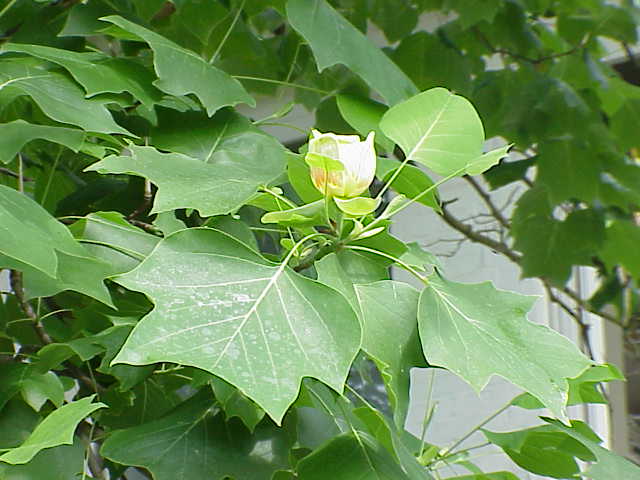
Photo: Kurt Stüber [1], CC BY-SA 3.0 · source

Broadleaf tree · Magnolia family (Magnoliaceae)
Tulip tree
Liriodendron tulipifera · also: Tulip poplar
The tulip tree comes from eastern North America, where it is one of the tallest broadleaved trees. Here it grows 25–40 m tall, with a straight trunk and a tall, oval crown. Its leaf is unique: four lobes and a squarely cut-off tip, like a T-shirt. In June it bears tulip-shaped, greenish-yellow flowers with an orange band, and in autumn it turns golden yellow. It is a magnificent park tree, but only for a large garden or a park.
Light
Full sun
warm and bright
Moisture
Normal
no wet feet
Legal basis
Any garden soil
any pH
Hardiness
Throughout Belgium
no protection needed
Size
25–40 m
tall
Flowering
June
| Pruning months | November–March |
|---|---|
| Height | 25–40 m |
| Native to Belgium | No, planted |
| Good for bees, butterflies and birds | Yes, for bees |
| Poisonous to people and pets | Not known to be poisonous |
| Flowering | June |
Identify
Tulip tree: how do you recognise it?
- Habit
- Large tree of 25–40 m with a straight, continuous trunk and a conical to oval crown; fast-growing.
- Leaf
- Alternate, 10–20 cm, with 4 (sometimes 6) lobes and a squarely cut-off or notched tip. Long leaf stalk. Autumn colour golden yellow.
- Bark
- Grey, with a regular network of shallow furrows.
- Flower
- Tulip-shaped, greenish-yellow flowers with an orange band, in June, often high in the crown.
- Fruit
- Upright, cone-shaped fruits made up of winged nutlets.
Flowering: June · Pruning: November–March
Identify by feature: Lobed leaves (like an oak) · Winged seeds
In your garden
Why grow it?
- A unique leaf you recognise at once, with golden-yellow autumn colour.
- Tulip-shaped flowers in June, rich in nectar for bees.
- A stately, fast-growing specimen tree for a park or a large garden.
- Needs little pruning.
Tulip tree: where does it grow best?
- Full sun; in shade it grows poorly and hardly flowers.
- Deep, fertile soil that doesn’t dry out; no waterlogging.
- Allow for a crown 15 m wide and a height of up to 35 m: only for a large garden, a park or an avenue, well away from buildings.
- For a smaller garden there is the columnar form ‘Fastigiatum’, which still grows tall but stays much narrower.
- Light
- Full sun
- Legal basis
- Any garden soil
- Moisture
- Normal
- Size
- 35 m tall, 15 m wide
- Hardiness
- Throughout Belgium, no protection needed
Goes well with
- Sweetgum: Another North American park tree: red and purple autumn colours next to the golden yellow of the tulip tree.
- Red maple: Also from eastern North America, with a fiery red autumn colour.
- Snowy mespilus: A small tree for the edge, with blossom in April and red autumn colour.
- Snowdrop: Flowers in February under the still-bare crown.
Good and bad companions
Goes well with
- Tolerate the shade under this tree: oregon grape, rhododendron, oleaster, japanese skimmia, garden privet, camellia, laurustinus, box-leaved honeysuckle
Maintenance
Tulip tree: when and how to plant it?
- Plant in spring (March–April) or in autumn, root-balled or container-grown: its fleshy roots don’t like being moved.
- Choose a young, small tree: it establishes best.
- Dig a generous planting hole, loosen the bottom and set the root ball at the same depth as before.
- Put a stake on the windward side and tie the trunk loosely; remove stake and tie after 2–3 years.
- Water generously after planting and during dry spells in the first few years.
Care
- Watering
- In dry spells during the first few years; even older trees drop yellow leaves early in dry summers.
- Feeding
- Not needed; a layer of compost or leaf mulch over the planting spot helps a young tree get going.
- Under the tree
- Keep the ground around a young tree free of grass and cover it with mulch.
- Patience
- A young tulip tree only starts flowering after a good number of years.
Tip: No room for a giant? Choose the columnar form ‘Fastigiatum’: the same leaves and the same flowers, on a much narrower tree.
Tulip tree: when to prune it?
Pruning months: November–March.
When: Dead, diseased and broken branches can be removed at any time of year. If pruning is needed, do it during winter dormancy (November–March).
How:
- Needs little pruning; leave the leader in place.
- On a young tree, remove competing leaders so that a single straight trunk remains.
- If necessary, raise the crown by removing a few of the lowest branches at a time, never many at once.
Caution: Cut large branches in three steps, just outside the branch collar: large pruning wounds heal slowly.
Propagation
- Sowing
- Sow the winged nutlets outdoors in a seed tray in autumn; they germinate in spring. Much of the seed is empty, so sow generously.
- Grafting
- Varieties such as the columnar form are grafted; that is a job for the nursery.
Tulip tree: how does it get through the winter?
Hardy throughout Belgium: no protection needed.
- Fully hardy.
- In winter the upright fruit cones stay on the bare branches for a long time.
Diseases and pests
- Aphids: In summer, aphids under the leaves produce sticky honeydew that drips onto cars and patios. Ladybirds deal with them; a mature tree is not troubled.
- Drought: Yellow leaves and early leaf fall in midsummer. Water young trees and mulch the ground.
- Poor establishment: A large transplanted tree sometimes struggles for years. Plant young, root-balled or container-grown.
- No flowers: Young trees don’t flower yet, and on older trees the flowers are often high in the crown, hidden among the leaves.
Through the year
- January: Formative pruning of young trees in mild weather.
- February: Remove dead branches; the fruit cones are still on the branches.
- March: Last month for formative pruning; plant root-balled or container-grown trees.
- April: Planting; the leaves unfold.
- June: Flowering: tulip-shaped flowers high in the crown.
- July: Water young trees in dry spells; watch for aphids.
- October: Golden-yellow autumn colour; collect seed for sowing.
- November: Winter pruning can begin; sowing.
- December: Formative pruning of young trees; remove dead branches.
Use
What can you use it for?
- Garden and landscape
- Magnificent specimen park tree for large gardens; golden-yellow autumn colour.
- Wood
- In North America (‘yellow poplar’) widely used for furniture and plywood.
- For wildlife
- The tulip-shaped flowers produce plenty of nectar.
Good for wildlife
- Bees
- Nectar and pollen for honeybees and wild bees.
- Bumblebees
- Nectar and pollen for bumblebees, also from deep flowers and early in spring.
You and this species
Did you know?
- Native to eastern North America, where it is one of the tallest broadleaved trees.
- In North America it is called ‘yellow poplar’, and its wood is widely used there for furniture and plywood.
- There is only one other tulip tree, the Chinese one (Liriodendron chinense); both belong to the magnolia family.
- It belongs to the magnolia family. There are only two species of tulip tree: this American one and a Chinese one.
- Native Americans hollowed out the long, straight trunks of the tulip tree to make dugout canoes.