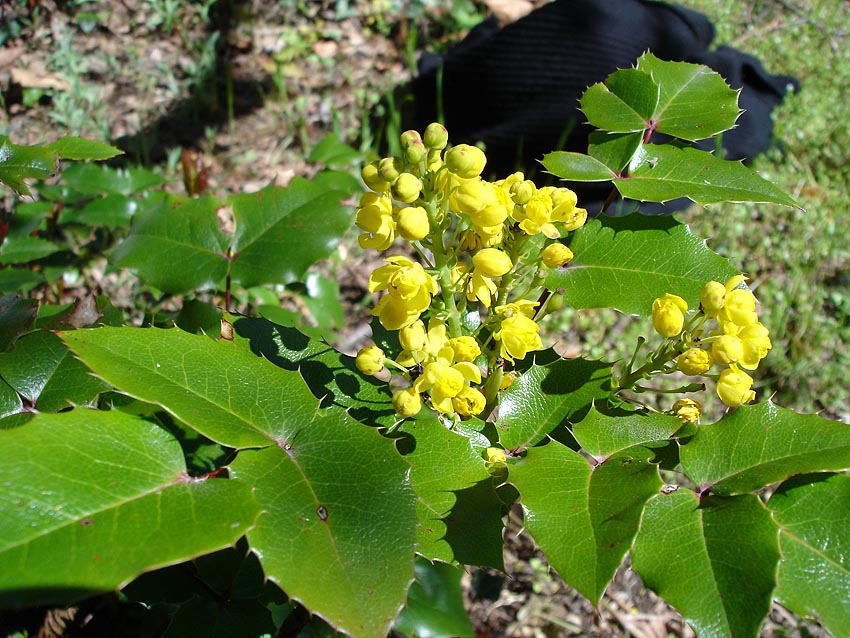
Photo: Wikimedia Commons, CC BY-SA 3.0 · source

Shrub · Barberry family (Berberidaceae)
Oregon grape
Berberis aquifolium · also: Mahonia
Oregon grape is an evergreen shrub of 1–2 m with glossy, spiny, pinnate leaves and upright clusters of fragrant yellow flowers in March–May. Bumblebee queens find their first nectar here, and in summer bluish-black berries with a waxy bloom follow, much loved by birds. It grows in sun and deep shade, on almost any soil, even under trees. Oregon grape comes from western North America and runs wild in our woodlands, spread by birds: only plant it in the garden, well away from woods and nature areas.
Caution: An exotic from North America that runs wild in woodland, spread by birds, and can form dense patches there: don’t plant it on a woodland edge or near a nature area, and never dump prunings in the countryside.
Light
Sun to shade
not fussy
Moisture
Normal
no wet feet
Legal basis
Any garden soil
any pH
Hardiness
Throughout Belgium
no protection needed
Size
1–2 m
tall
Flowering
March–May
| Pruning months | May–June |
|---|---|
| Height | 1–2 m |
| Native to Belgium | No, naturalised |
| Good for bees, butterflies and birds | Yes, for bees and birds |
| Poisonous to people and pets | Not known to be poisonous |
| Flowering | March–May |
Identify
Oregon grape: how do you recognise it?
- Habit
- Evergreen shrub of 1–2 m that slowly spreads by suckers.
- Leaf
- Alternate, pinnate with 5–9 glossy, spiny-toothed leaflets; often reddish in winter.
- Bark
- Greyish-brown; the wood is yellow.
- Flower
- Upright clusters of fragrant yellow flowers in March–May.
- Fruit
- Bluish-black berries with a waxy bloom, edible but sour.
- Difference from holly
- Holly has simple leaves and red berries.
Flowering: March–May · Harvest and fruit: July–August · Pruning: May–June
Identify by feature: Pinnate leaves · Spiny leaves · Evergreen leaves · Yellow flowers in spring · Blue berries
Looks like it, but isn’t
- Holly Ilex aquifolium: simple leaves and red berries. Difference from holly
In your garden
Why grow it?
- Evergreen and tough, even in deep shade and under trees.
- Fragrant yellow flowers in March–May: early nectar for bumblebee queens.
- Bluish-black berries for birds, and usable for jelly.
- Leaves that turn red or bronze in winter.
Oregon grape: where does it grow best?
- Sun to deep shade, even under trees; sheltered from cold, dry wind the foliage looks its best.
- Almost any soil that isn’t too wet, including the drier soil under trees.
- Allow 1–1.5 m width; a group slowly widens through its suckers.
- Not on a woodland edge or near a nature area: birds spread the seeds.
- Light
- Sun to shade
- Legal basis
- Any garden soil
- Moisture
- Normal
- Size
- 2 m tall, 1.5 m wide
- Hardiness
- Throughout Belgium, no protection needed
Goes well with
- Holly: A native, evergreen shrub for the same shady spot, with red berries in winter.
- Witch hazel: Flowers in winter, before Oregon grape: together, a long run of early flowers.
- Cornelian cherry: Small yellow flowers in February–March for the first bees, just before Oregon grape flowers.
Good and bad companions
Goes well with
- Tolerates shade and suits planting under large trees such as: ginkgo, box elder, ash, honey locust, field maple, silver maple
Maintenance
Oregon grape: when and how to plant it?
- Plant from a pot in spring (March–April) or early autumn (September–October).
- As ground cover under trees: about 3 plants per m².
- Mix some compost into the planting soil, especially under trees, where the soil is poor and dry.
- Water well after planting, and in dry spells during the first year.
Care
- Watering
- In dry spells during the first year; rarely needed after that.
- Feeding
- A little compost or leaf mould in spring.
- Seedlings
- Birds sow it around: pull up seedlings in and around the garden while they are young.
- Harvest
- Pick the berries in summer when they are bluish-black with a bloom, for a tart jelly.
Tip: If you are looking for an evergreen shrub for shade, think first of native holly. If you do plant Oregon grape, keep it well away from woods and nature areas, and pull up seedlings in good time.
Oregon grape: when to prune it?
Pruning months: May–June.
When: After flowering (May–June).
How:
- Cut long, bare stems back low down; they will sprout again from the base.
- An old, leggy group can be cut right back to 20–30 cm after flowering; it will regrow densely.
- Remove dried-out or frost-damaged leaves.
Caution: If you cut off all the flowered stems after flowering, there will be no berries that year: leave some for the birds. Wear gloves, as the leaflets are prickly.
Propagation
- Suckers
- In spring, separate a rooted sucker from the parent plant and replant it elsewhere.
- Sowing
- Sow the seeds from ripe berries outdoors in autumn; they germinate after winter.
Oregon grape: how does it get through the winter?
Hardy throughout Belgium: no protection needed.
- Fully hardy; the leaves turn red to purple in winter.
- Cold, dry wind can make the leaves dry out and turn brown; cut off unsightly leaves after winter.
Diseases and pests
- Rust: Purplish-red spots on the leaves and brown spore pustules underneath. Remove affected leaves and keep growth airy.
- Powdery mildew: White coating on young leaves in summer; usually harmless. Cut out the worst shoots.
- Running wild: Seedlings appear in hedges and woods. Pull them up young; dig out older plants with their roots and suckers.
Through the year
- March: First flowers: nectar for bumblebee queens. Planting possible.
- April: Full flower.
- May: Prune after flowering.
- June: Last month for pruning; the berries are swelling.
- August: Berries ripe: pick them for jelly or leave them for the birds.
- October: Planting; pull up seedlings in and around the garden.
- December: Red to purple winter foliage.
Use
What can you use it for?
- Garden and landscape
- Evergreen shrub for shade and under trees.
- For wildlife
- Early flowers for bumblebees; birds eat the berries.
- Food and drink
- The sour berries can be used for jelly.
Edible and useful
- Berries (July–August)
- Pick the bunches of bloomy, blue-black berries in summer when they are soft. Raw they are very sour and a little bitter; cooked with sugar they make a dark red, tangy jelly or syrup. Feel free to mix them with apple or sweeter fruit.
- Storing
- Freeze the berries as you go until you have enough. Keep jelly and syrup in clean, sealed jars and bottles.
Caution: Eat the berries in moderation and not in large amounts raw. The roots, stems and bark are high in berberine and are not for eating. Do not confuse Oregon grape with holly or other shrubs with blue-black berries: its spiny, pinnate leaves and yellow spring flowers are distinctive.
Eating and using is at your own risk: see the terms of use.
Recipes
- Oregon grape and apple jelly (Jelly · ± 3 jars · 1 hour + 3 hours draining)
- Oregon grape syrup (Syrup · ± 400 ml · 30 min + 2 hrs draining)
- Tart Oregon grape sauce for game and poultry (Dish · ± 2 jars of 200 ml · 35 min)
Good for wildlife
- Bumblebees
- Nectar and pollen for bumblebees, also from deep flowers and early in spring.
- Bees
- Nectar and pollen for honeybees and wild bees.
- Birds
- Berries, seeds or insects as food, or a place to nest.
You and this species
Did you know?
- One of the first nectar sources for bumblebee queens in spring.
- Botanists now place Oregon grape in the genus Berberis, like barberry; hence the name Berberis aquifolium.
- Indigenous peoples of North America used its yellow roots and wood to make dye.
- Mahonia is named after Bernard McMahon, an American nurseryman who raised seeds collected in western North America by the Lewis and Clark expedition.
- The yellow wood owes its colour to berberine. Native Americans used it to dye baskets and fabrics yellow, among other things.