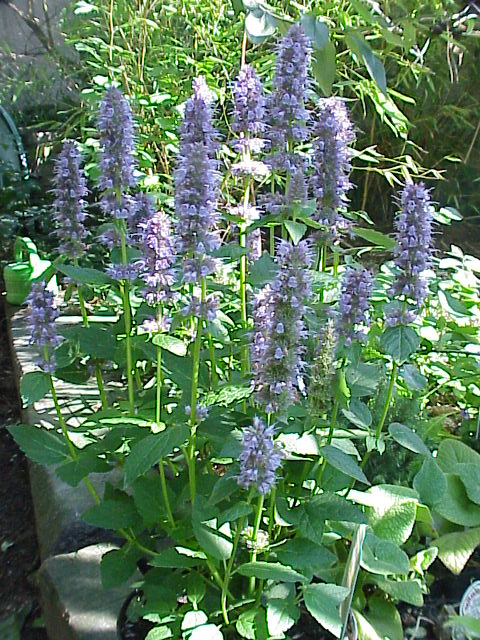
Photo: Wikimedia Commons, CC BY-SA 3.0 · source

Perennial · Lamiaceae
Anise hyssop
Agastache foeniculum
In other languages: Anijsnetel (Nederlands) · Agastache fenouil (Français)
Anise hyssop comes from North America, where it grows in prairies and open woodland, from Canada to the middle of the United States. It is an upright perennial of the mint family, with square stems and oval, toothed leaves that smell of aniseed when touched. From July to September it carries dense, lilac-blue flower spikes up to 90 cm tall, visited all day by bees and bumblebees. It is often short-lived but self-seeds readily. The well-known cultivar ‘Blue Fortune’ is a hybrid with a related species.
Light
Full sun
warm and bright
Moisture
Dry to normal
no wet feet
Legal basis
Sand or loam
any pH
Hardiness
Fully hardy
down to -25 °C
Size
0.9 m
tall, 0.45 m wide
Flowering
July–September
| Pruning months | March–April |
|---|---|
| Height | 0.9 m |
| Native to Belgium | No, planted |
| Good for bees, butterflies and birds | Yes, for bees and butterflies |
| Poisonous to people and pets | Not known to be poisonous |
| Flowering | July–September |
Identify
Anise hyssop: how do you recognise it?
- Habit
- Upright, rather stiff clump 90 cm tall and 45 cm wide, with square stems.
- Leaves
- Oval and toothed, 5–10 cm long, green with a paler, felty underside.
- Flower
- Dense spikes up to 15 cm long of small lipped flowers, from July to September.
- Colour
- Lilac-blue to lavender, with purplish bracts; there are also white forms.
- Scent
- Leaves and flowers smell of aniseed or liquorice when touched.
- Roots
- Fibrous and fairly shallow; they rot in wet, heavy soil.
Flowering: July–September · Harvest and fruit: May–September · Sowing: March–April · Plants: April–May · Pruning: March–April
In your garden
Why grow it?
- A real bee magnet: from July to September it is full of bumblebees, bees and butterflies.
- The leaves smell of aniseed and are lovely in tea or a salad.
- Tolerates sun and drought, ideal for a gravel or prairie garden.
- Flowers for a long time, into September, when many borders are winding down.
- The spent spikes stay attractive through winter.
- Often flowers in its first year if sown early indoors.
Anise hyssop: where does it grow best?
- Full sun: in shade it flowers less and the stems flop.
- Well-drained sandy or loamy soil, acid to chalky. It dislikes heavy clay.
- Dry to normal: it tolerates drought but not wet feet in winter.
- Plant 40–45 cm apart, in groups of three or more.
- Light
- Sun
- Soil type
- Sand or loam
- Acidity
- Not fussy
- Moisture
- Dry or normal
- Size
- 0.9 m tall, 0.45 m wide
- Hardiness
- Hardy (to -25 °C)
Goes well with
- Purple coneflower: Pink daisy flowers beside the lilac-blue spikes, also loved by bees.
- Purpletop vervain: Airy purple flowers in the same sun and drought.
- Yarrow: Flat heads as a contrast with the upright spikes.
- Ornamental grasses: Swaying stems for a prairie look.
- Oregano: A low, fragrant plant at the front, also full of bees.
Maintenance
Anise hyssop: when and how to plant it?
Plant in April–May.
- Sow indoors in March–April and plant out in April–May, after the last hard frost.
- On heavier soil, mix in coarse sand or fine gravel for good drainage.
- Set the plant at the same depth as in the pot, no deeper.
- Leave 40–45 cm between plants.
- Water in at planting and during dry spells for the first few weeks.
- If you mulch, use gravel rather than compost: it keeps the base dry.
Care
- Water
- Only for the first few weeks after planting. After that it is drought-tolerant.
- Feeding
- Not needed: in poor soil it stays sturdier and lives longer.
- Spent spikes
- Leave them until spring; they protect the crown and look good in winter.
- Self-seeding
- Let a few spikes set seed so young plants can replace the old ones.
- Harvesting
- Pick young leaves for tea all summer; leave enough for flowering.
Tip: Plant it in full sun on well-drained soil and leave the spent stems until spring. Let a few spikes set seed too: young plants will then replace the old ones on their own.
Anise hyssop: when to prune it?
Pruning months: March–April.
When: In late March or April, when you see new shoots at the base. Not in autumn.
How:
- Cut the old stems back to just above the new shoots at the base.
- Remove dead and weak stems completely.
- Feel free to cut stems for tea or a bouquet in summer; it does the plant no harm.
Caution: Do not prune in autumn: the old stems protect the plant against wet, cold winters.
Propagation
- Seed
- Sow indoors in March–April at 18–20 °C; barely cover the seed, as light helps germination. It germinates in 1–3 weeks; plant out in May.
- Cuttings
- In May–June, take softwood cuttings from non-flowering shoots; they root quickly in moist cutting compost.
- Seedlings
- Move self-sown seedlings with a little soil in spring.
Anise hyssop: how does it get through the winter?
Hardy to −25 °C.
- Hardy to about −25 °C, but only in well-drained soil: wet winters are more dangerous than frost.
- Leave the old stems standing as protection and prune only in spring.
- On heavy soil, plant it on a raised spot or in gravel.
- In a pot: move it under cover in winter so the compost does not get soaked.
Diseases and pests
- Winter losses: The plant does not return in spring: usually rot caused by wet soil. Improve drainage and let seedlings grow on as replacements.
- Powdery mildew: White powder on the leaves in late summer, especially in dry weather with poor air circulation. Space the plants and cut off affected leaves.
- Slugs: They eat young plants in spring. Pick them off in the evening or set a beer trap.
- Floppy stems: Too much shade or soil that is too rich. Move it to a sunnier spot and do not feed.
Through the year
- March: Sow indoors. Cut back old stems once new shoots appear.
- April: Prune to just above the new shoots. Sow indoors. Plant.
- May: Plant out after the last frost. Watch for slugs.
- June: Take softwood cuttings. Pick leaves for tea.
- July: Flowering begins. Plenty of bees and bumblebees.
- August: Full bloom. Pick flowers for tea or salad.
- September: Last flowers. Let the seed ripen.
- November: Leave the stems standing as winter protection.
Use
Edible and useful
- Flowers (July–September)
- The purple-blue flower spikes from July to September are edible and sweet: strip the florets over salad, ice cream or cakes. Leave plenty: bees and bumblebees love them.
- Leaves (May–September)
- Pick the leaves from May to September; they smell and taste sweetly of aniseed and liquorice. Lovely fresh in tea, fruit salad, with tomatoes or in a dressing, and dried as tea in winter.
- Storing
- Dry the stems with leaves and flowers in small bunches, hung upside down somewhere airy and dark. Rub off the leaves and florets once they rustle and keep them in a closed jar for up to a year. Fresh, they keep for a few days in the fridge in a damp cloth.
Caution: In normal amounts as a tea or herb, anise hyssop is safe. During pregnancy do not drink large amounts. It is a short-lived perennial: let a few spikes set seed and it will self-sow.
Eating and using is at your own risk: see the terms of use.
Recipes
- Anise hyssop tea (Tea · 1 teapot (± 750 ml) · 10 min)
- Anise hyssop shortbread biscuits (Dish · ± 30 biscuits · 30 min + 1 hr chilling)
Good for wildlife
- Bees
- Nectar and pollen for honeybees and wild bees.
- Butterflies
- Nectar for butterflies.
You and this species
Did you know?
- Despite its name, anise hyssop is neither anise, which belongs to the carrot family, nor true hyssop, although hyssop and anise hyssop are both members of the mint family.
- In North America it is known as an excellent nectar plant for honeybees.
- Indigenous peoples of North America have long used the leaves for tea and as a flavouring.