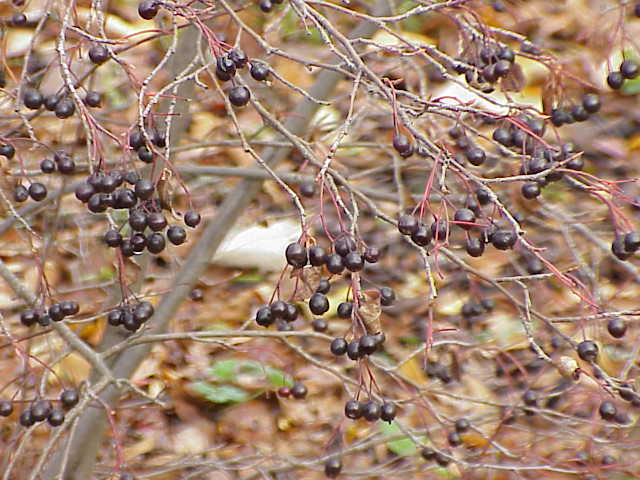
Photo: Kurt Stüber [1], CC BY-SA 3.0 · source

Shrub · Rosaceae
Purple chokeberry
Aronia × prunifolia
In other languages: Appelbes (Nederlands) · Aronia (Français)
Purple chokeberry is a tough, deciduous shrub from eastern North America, a natural hybrid between the red and the black chokeberry. It grows upright with several stems and slowly forms a clump through suckers. In May it bears clusters of white flowers with pink anthers, followed in late summer by purple-black berries and in autumn by brilliant red foliage. The berries are very astringent raw, but delicious made into juice, jam or syrup. For fruit growing, the cultivars ‘Viking’ and ‘Nero’ are often planted.
Light
Sun or partial shade
preferably some sun
Moisture
Normal to wet
must not dry out
Legal basis
Any garden soil
acid to neutral
Hardiness
Fully hardy
down to -30 °C
Size
2.5 m
tall, 1.5 m wide
Flowering
May
| Pruning months | February–March |
|---|---|
| Height | 2.5 m |
| Native to Belgium | No, planted |
| Good for bees, butterflies and birds | Yes, for bees and birds |
| Poisonous to people and pets | Not known to be poisonous |
| Flowering | May |
Identify
Purple chokeberry: how do you recognise it?
- Habit
- Upright, multi-stemmed shrub 2–2.5 m tall and 1.5 m wide; forms suckers over the years.
- Leaf
- Elliptic, 4–8 cm, finely toothed, glossy dark green; bright red to purplish red in autumn.
- Flower
- White, five-petalled flowers with pink anthers in flat clusters, in May.
- Fruit
- Round, purple-black berries of about 1 cm, ripe in August–September; astringent raw.
- Roots
- Fairly shallow and branching, with suckers from which new stems grow.
Flowering: May · Harvest and fruit: August–September · Plants: March–April and October–November · Pruning: February–March
In your garden
Why grow it?
- Three seasons of interest: white flowers in May, dark berries in summer and bright red autumn leaves.
- Edible berries for juice, jam, syrup or baking.
- Bees visit the flowers; birds eat the berries in autumn and winter.
- Very hardy and happy on wet, poor or acid soil, where many other fruit bushes struggle.
- Rarely troubled by disease and easy-going, also as an informal hedge.
Purple chokeberry: where does it grow best?
- Sun to partial shade; in sun the autumn colour and the crop are best.
- Any soil: sand, loam, clay or peat, acid to neutral. On very chalky soil the leaves may turn yellow.
- Moist to wet: it even tolerates waterlogging for a while.
- Allow 1.5 m per plant; 80–100 cm apart for an informal hedge.
- Light
- Sun and partial shade
- Soil type
- Sand, loam, clay or peat
- Acidity
- Acid or neutral
- Moisture
- Normal or wet
- Size
- 2.5 m tall, 1.5 m wide
- Hardiness
- Hardy (to -30 °C)
Goes well with
- Dogwood: Red or yellow stems in winter, and also happy on wet soil.
- Guelder rose: A native shrub with white flowers and red berries; together a bird-friendly hedge.
- Serviceberry: Flowers earlier in spring and also has edible berries and autumn colour.
- Blueberry: Another fruit bush for acid soil, with similar red autumn colour.
- Lady’s mantle: Low, fresh underplanting at the base.
Maintenance
Purple chokeberry: when and how to plant it?
Plant in March–April and October–November.
- Plant in March–April or October–November, when the ground is not frozen.
- Dig a planting hole twice as wide as the root ball and mix in some compost.
- Set a pot-grown plant at the same depth as in the pot; with bare-root plants the root collar should be just at soil level.
- Firm the soil well and water generously straight away.
- Spread a mulch of wood chips or leaf mould around the base.
Care
- Watering
- Weekly in dry spells during the first year; after that only in long dry periods.
- Feeding
- Some compost or organic fruit feed in spring is enough.
- Mulching
- A layer of mulch keeps the soil moist and the weeds down.
- Harvesting
- Pick the clusters in August–September, when the berries are fully dark and feel slightly soft. Leave it too long and the birds will take them.
- Suckers
- Dig out suckers that appear too far from the shrub, or use them for new plants.
Tip: Mix chokeberries with sweeter fruit such as apples or pears when making jam or juice: this softens the astringent taste. Do not pick too early, as half-ripe berries are even more astringent.
Purple chokeberry: when to prune it?
Pruning months: February–March.
When: In February–March, while the shrub is still dormant. No pruning is needed in the first few years.
How:
- From the fourth or fifth year, remove a few of the oldest, least productive stems at ground level each year.
- Cut out dead, diseased and crossing branches.
- Remove surplus suckers around the edge so the shrub does not get too wide.
- Never remove more than a third of the stems at once.
Caution: It fruits on older branches: shortening every branch costs you a large part of the crop.
Propagation
- Suckers
- In autumn or early spring, dig up a sucker with roots and replant it elsewhere.
- Softwood cuttings
- In June, take 10–15 cm cuttings from young shoots and put them in moist cutting compost under plastic.
- Seed
- Sow seeds from ripe berries in a pot outdoors in autumn; they need the winter cold to germinate.
Purple chokeberry: how does it get through the winter?
Hardy to −30 °C.
- Very hardy, to about −30 °C: never needs protection in Belgium.
- The berries often stay on the shrub for a long time and are a winter store for birds.
- In a large pot it can also overwinter outdoors; just make sure the pot is not standing in water when it freezes.
Diseases and pests
- Birds: Blackbirds and starlings eat the ripe berries. A net over the shrub from August protects the crop.
- Yellow leaves: Yellow leaves with green veins point to soil that is too chalky. Add leaf mould and an acid mulch.
- Aphids: On young shoots in spring. Ladybirds usually deal with them; otherwise hose them off with water.
- Too wide: Suckers make the shrub wider than planned. Dig out the suckers every year.
Through the year
- February: Prune: remove the oldest stems at ground level.
- March: Plant. Prune. Add compost.
- April: Plant. Mulch.
- May: Flowering; bees on the flowers.
- June: Take softwood cuttings. Water in dry spells.
- August: Net the shrub against birds. First berries ready to pick.
- September: Harvest and turn into juice or jam.
- October: Red autumn colour. Plant. Dig up suckers.
- November: Plant. Sow seed outdoors.
- December: Leave the remaining berries for the birds.
Use
Edible and useful
- Berries (August–September)
- Pick the clusters in August and September, when the berries are fully purplish-black and feel slightly soft; half-ripe berries are even more astringent. Do not wait too long, or the blackbirds and starlings will get them. Cut off whole clusters and strip the berries from their stalks at home. Raw, they are very astringent, as the name chokeberry suggests: better to use them processed, in juice, jam, syrup or baking, mixed with sweeter fruit such as apple or pear. Use them as you would the berries of black chokeberry.
- Storing
- Fresh berries keep for one to two weeks in the fridge. You can also freeze them in a bag for up to a year: frozen berries release their juice more easily and can go straight into muffins. Juice in sterilised bottles keeps for six months.
Caution: Raw, the berries are very astringent: eat no more than a small handful raw and process the rest. Cook, press or bake them whole and do not grind the seeds: as in many fruits of the rose family, they contain small amounts of substances that can release hydrogen cyanide. The juice leaves stubborn stains on clothes and wooden boards. Do not confuse the berries with the poisonous little black berries of privet or alder buckthorn, for example: only pick from your own shrub.
Eating and using is at your own risk: see the terms of use.
Recipes
- Chokeberry and apple juice (Sap · ± 1.2 litres · 45 min + 1 hr draining)
- Chokeberry muffins (Dish · 12 muffins · 40 min)
Good for wildlife
- Bees
- Nectar and pollen for honeybees and wild bees.
- Birds
- Berries, seeds or insects as food, or a place to nest.
You and this species
Did you know?
- The English name chokeberry refers to the astringent taste of the raw berries, which makes your mouth pucker.
- In Eastern Europe, including Poland, chokeberries are grown on a large scale for juice and as a natural food colouring.
- This chokeberry is a natural hybrid between the red chokeberry (Aronia arbutifolia) and the black chokeberry (Aronia melanocarpa).