Photo: Wikimedia Commons, Copyrighted free use · source

Fruit plant · Annonaceae
Pawpaw
Asimina triloba
In other languages: Asiminier trilobé (Français)
Pawpaw comes from the deciduous woodlands of the eastern United States and southern Canada, where it grows as a small understorey tree along rivers. Here it usually reaches 3–5 m, with large, drooping leaves that turn butter yellow in autumn. In April–May, before the leaves, nodding purple-brown flowers appear. The greenish-yellow fruits have soft, creamy flesh that tastes of banana and mango and ripen in September–October. It is a fully hardy, exotic fruit tree; well-known cultivars include ‘Sunflower’ and ‘Overleese’.
Light
Sun or partial shade
preferably some sun
Moisture
Normal
no wet feet
Legal basis
Sand or loam
acid to neutral
Hardiness
Fully hardy
down to -25 °C
Size
5 m
tall, 4 m wide
Flowering
April–May
| Pruning months | March |
|---|---|
| Height | 5 m |
| Native to Belgium | No, planted |
| Poisonous to people and pets | Not known to be poisonous |
| Flowering | April–May |
Identify
Pawpaw: how do you recognise it?
- Habit
- Small tree or large shrub with a pyramidal crown, here usually 3–5 m tall and 2–3 m wide. Sometimes produces root suckers.
- Leaves
- Large, oblong, 15–30 cm, slightly drooping; fresh green, butter yellow in autumn. They smell rather pungent when bruised.
- Flower
- Nodding, bell-shaped flowers of 3–5 cm, greenish at first then purple-brown, in April–May before the leaves.
- Fruit
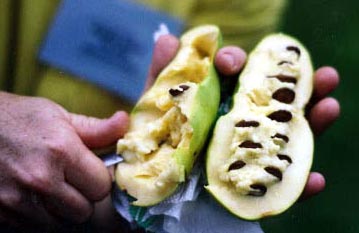
- Oblong, 5–15 cm, green to yellowish green, often in small clusters. Creamy yellow flesh with large brown seeds; the skin and seeds are not eaten.
- Roots
- A deep taproot and fleshy roots: young plants resent being moved.
Flowering: April–May · Harvest and fruit: September–October · Plants: April–May · Pruning: March
In your garden
Why grow it?
- Exotic fruit that is fully hardy: no winter protection needed.
- Creamy fruits tasting of banana and mango, almost never found in the shops.
- Large, tropical-looking leaves with superb butter-yellow autumn colour.
- Unusual purple-brown flowers in spring.
- Rarely troubled by pests or diseases: a fruit tree that needs no spraying.
Pawpaw: where does it grow best?
- Sun or partial shade. A mature tree needs sun to crop well; young plants prefer some shade for the first few years.
- Humus-rich, deep sandy or loamy soil, acid to neutral and well drained.
- Normal, moisture-retentive soil: it should not dry out in summer or be waterlogged in winter.
- Sheltered from strong winds, which damage the large leaves.
- Plant two trees 3–4 m apart for cross-pollination.
- Light
- Sun and partial shade
- Soil type
- Sand or loam
- Acidity
- Acid or neutral
- Moisture
- Normal
- Size
- 5 m tall, 4 m wide
- Hardiness
- Hardy (to -25 °C)
Goes well with
- Wild strawberry: Edible ground cover in the light shade beneath the tree.
- Hazel: Another edible tree for a forest garden or fruit corner.
- Blackcurrant: A fruit bush that also tolerates partial shade.
- Comfrey: Happy growing nearby and provides leaves for mulching.
Maintenance
Pawpaw: when and how to plant it?
Plant in April–May.
- Plant in April or May, once the soil has warmed up: it roots in best in spring.
- Buy young plants in deep pots and plant them straight into their final position.
- Dig a deep hole and mix the soil with leaf mould. Keep the root ball intact; do not damage the taproot.
- Set the plant at the same depth as in the pot and firm the soil gently.
- Water in well straight away, then weekly in dry spells during the first year.
- Mulch with leaf mould and give shade for the first two summers with shade netting or a taller neighbouring plant.
Care
- Water
- Regularly in dry spells, especially while the fruits are growing in July–August. A dry summer gives smaller fruits.
- Feeding
- In April, compost or an organic fertiliser for fruit trees. Do not overfeed young trees.
- Mulching
- A layer of leaf mould or wood chips keeps the soil cool and moist, like a woodland floor.
- Pollination
- Use a small brush to carry pollen from a flower on one tree to a flower on the other. This greatly increases the crop.
- Harvest
- Ripe fruits soften slightly, smell strongly and come away easily. They keep for only a few days, or a week or two in the fridge.
Tip: Plant two different cultivars and pollinate by hand with a brush in April–May. Give young plants some shade for the first few years, as their leaves scorch easily.
Pawpaw: when to prune it?
Pruning months: March.
When: It needs little pruning. Do it in March, before the buds break.
How:
- Remove dead, damaged and crossing branches.
- If you want a single trunk, cut away the root suckers around the base.
- Keep the natural pyramid shape: the fruits form on last year’s shoots.
- Trees that grow too tall can be shortened slightly to keep the fruit within reach.
Caution: Do not prune too hard: you would remove the flower buds, which are already on last year’s shoots.
Propagation
- Seed
- Never let the seeds dry out. Keep them moist in the fridge until spring and sow them in April in deep pots at 20–25 °C. They germinate slowly; seedlings take five to eight years to fruit.
- Grafting
- Cultivars are grafted onto a seedling in spring. This is a job for experienced gardeners, so it is better to buy a grafted plant.
Pawpaw: how does it get through the winter?
Hardy to −25 °C.
- Fully hardy, to about −25 °C: no protection needed in Belgian winters.
- A late frost in April can damage the flowers; cover a small tree with fleece when that happens.
- In autumn, leave the yellow leaves under the tree as mulch.
Diseases and pests
- No fruit: There is only one tree or pollination fails: the flowers are visited mainly by flies and beetles. Plant a second cultivar and pollinate with a brush.
- Scorched leaves: Brown patches on the leaves of young plants in full sun. Give shade for the first two years.
- Slow start: After planting it barely grows above ground for a year or two: the roots grow first. Be patient and keep watering.
- Frosted flowers: Brown, shrivelled flowers after a frost in April. Cover with fleece when frost is forecast.
Through the year
- March: Prune. Give compost.
- April: Plant. Flowering starts before the leaves. Cover against night frost.
- May: Plant. In flower. Pollinate with a brush.
- June: Shade young plants.
- July: Fruits are growing. Water in dry spells.
- August: Water in dry spells.
- September: Harvest begins: pick soft, fragrant fruits.
- October: Harvest. Butter-yellow autumn colour.
- November: Leaf fall. Leave the leaves as mulch.
Use
Edible and useful
- Fruit (September–October)
- The large green fruits ripen in September–October. They are ripe when they feel soft like a ripe avocado, smell wonderful and the skin shows yellow or dark patches. The creamy yellow flesh tastes of banana, mango and vanilla: spoon it straight from the skin, or use it in ice cream, smoothies or cake. You usually need two different plants for fruit.
- Storing
- Ripe pawpaws keep for 2 to 3 days at room temperature, a week in the fridge. The flesh without seeds can be frozen for ice cream or baking.
Caution: Only eat the flesh: the skin and the large seeds are poisonous (never crunch the seeds). Some people get stomach cramps or a rash from pawpaw: eat only a little the first time. Avoid cooking the flesh for long, as the flavour disappears.
Eating and using is at your own risk: see the terms of use.
Recipes
- No-churn pawpaw ice cream (Dish · 6 people · 15 min + 6 hrs freezing)
You and this species
Did you know?
- Pawpaw bears the largest edible fruit native to North America.
- The flowers smell faintly of yeast and are pollinated mainly by flies and beetles rather than bees.
- The caterpillars of the zebra swallowtail, an American butterfly, feed only on the leaves of pawpaw and related species.