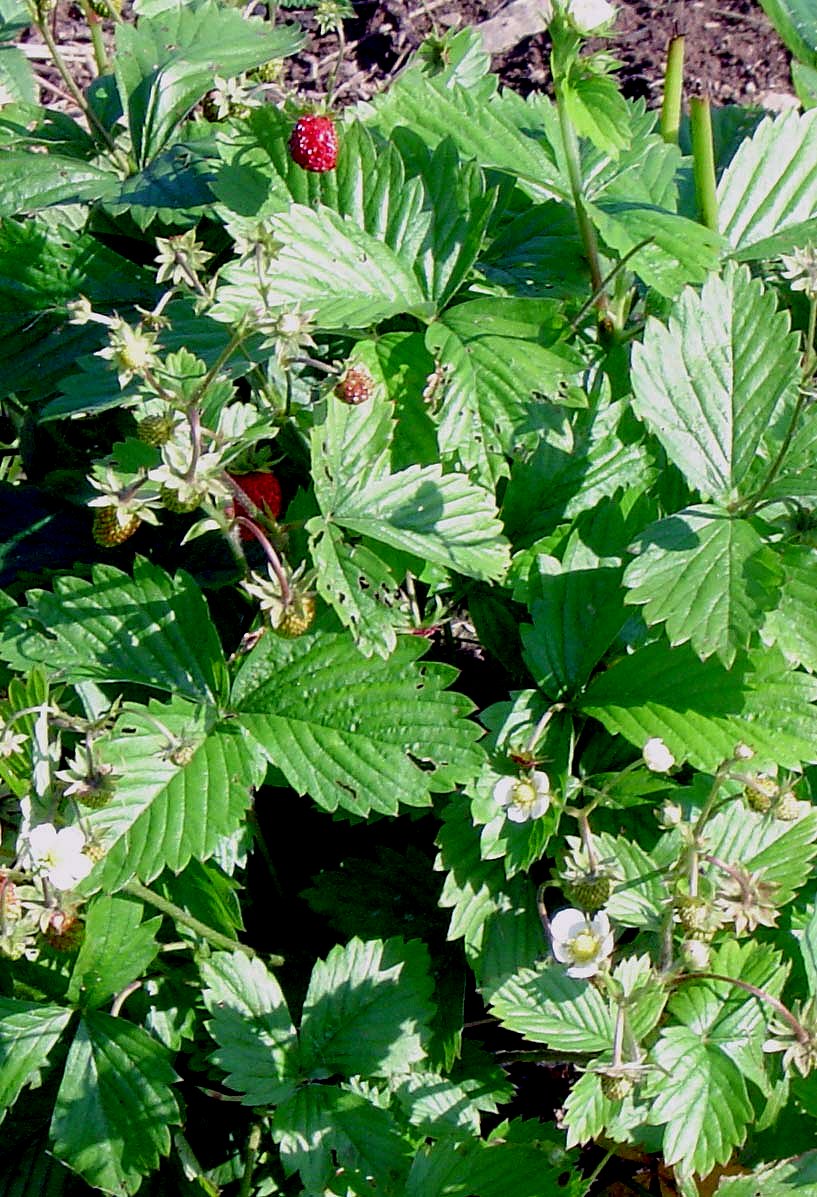
Photo: Toubib at Dutch Wikipedia Later versions were uploaded by Rasbak at nl.wikipedia., CC BY-SA 3.0 · source

Fruit plant · Rosaceae
Wild strawberry
Fragaria vesca
In other languages: Bosaardbei (Nederlands) · Fraisier des bois (Français)
Wild strawberry is a native perennial that grows throughout Europe, including Belgium, along woodland edges, in clearings and on verges. It forms low rosettes of three-part leaves, with small white flowers and tiny red fruits that are far more aromatic than ordinary strawberries. The wild form produces plenty of runners and so spreads into a dense carpet. For gardens, the everbearing alpine cultivars are especially popular, such as ‘Rügen’ and the yellow-fruited ‘Yellow Wonder’, which make few or no runners. They are easy, hardy and happy in sun or partial shade.
Light
Sun or partial shade
preferably some sun
Moisture
Normal
no wet feet
Legal basis
Sand, loam or clay
any pH
Hardiness
Fully hardy
down to -25 °C
Size
0.2 m
tall, 0.3 m wide
Flowering
May–August
| Pruning months | March |
|---|---|
| Height | 0.2 m |
| Native to Belgium | Yes |
| Good for bees, butterflies and birds | Yes, for bees and birds |
| Poisonous to people and pets | Not known to be poisonous |
| Flowering | May–August |
Identify
Wild strawberry: how do you recognise it?
- Habit
- Low rosette, 15–25 cm tall; the wild form spreads into a dense carpet by runners, everbearing cultivars stay as clumps.
- Leaves
- Divided into three toothed, bright green leaflets; stays partly green in mild winters.
- Flower
- Small, white, with five rounded petals and a yellow centre; from May to August, and later still on everbearers.
- Fruit
- Conical, 1–2 cm, red or in some cultivars creamy yellow, with the seeds on the outside. Very aromatic.
- Runners
- Above-ground stems that form new plants a short way off; everbearing cultivars make few or none.
Flowering: May–August · Harvest and fruit: April–September · Sowing: February–March · Plants: March–May and September · Pruning: March
In your garden
Why grow it?
- Small, very fragrant and sweet fruits from June until autumn.
- An attractive edible ground cover beneath fruit bushes and in partial shade.
- Native: bees visit the flowers and birds feast on the fruits.
- Fully hardy and rarely troubled by disease.
- Also suits a pot, a hanging basket or an edging along the vegetable garden.
Wild strawberry: where does it grow best?
- Sun or partial shade; in full sun they fruit a little more, in partial shade they stay fresher.
- Humus-rich sandy, loamy or clay soil, acid to chalky: they are not fussy.
- Normal, moisture-retentive soil; water in dry summers.
- Plant 25–30 cm apart; a little wider as ground cover for forms with runners.
- Lovely at the front of a border, under currant bushes or in a trough on the patio.
- Light
- Sun and partial shade
- Soil type
- Sand, loam or clay
- Acidity
- Not fussy
- Moisture
- Normal
- Size
- 0.2 m tall, 0.3 m wide
- Hardiness
- Hardy (to -25 °C)
Goes well with
- Redcurrant: Wild strawberries make a good edible ground cover beneath currant bushes.
- Gooseberry: Another fruit bush giving light shade beneath.
- Chives: An easy herb for the same vegetable-garden edge, with flowers for bees.
- Borage: Draws plenty of bees into the vegetable garden.
- Lady’s mantle: Another low ground cover from the same family, lovely at the edge of a border.
Maintenance
Wild strawberry: when and how to plant it?
Plant in March–May and September.
- Plant in March, April, May or September, when the soil is moist.
- Loosen the soil and mix in some compost.
- Dig a hole slightly larger than the root ball and set the plant so the crown sits just at soil level: no deeper and no higher.
- Plant 25–30 cm apart and firm the soil well.
- Water in straight away, then regularly in dry spells for the first few weeks.
- Spread a mulch of straw or leaf mould between the plants: it keeps the fruits clean.
Care
- Water
- Regularly in dry spells, especially while fruiting and in pots. Water at the base, not over the fruits.
- Feeding
- A thin layer of compost in spring. Too much fertiliser gives lots of leaves and less flavour.
- Mulching
- Straw or leaf mould keeps the soil moist and the fruits dry and clean.
- Runners
- Cut off unwanted runners in summer; let a few root if you want new plants.
- Renewing
- After three or four years the plants crop less: replace them with young plants or seedlings.
- Harvest
- Every two or three days, pick the fully red, soft fruits.
Tip: Plant everbearing wild strawberries as ground cover under fruit bushes or along a path in partial shade. Pick every couple of days: that way you beat the slugs and blackbirds to them.
Wild strawberry: when to prune it?
Pruning months: March.
When: It does not really need pruning. In March, do cut away the old brown leaves.
How:
- In March, cut dead and discoloured leaves off just above the crown, without damaging it.
- In summer, remove any runners you do not need.
- Remove rotten or nibbled fruits straight away so mould does not spread.
- Plants that look untidy after summer can be lightly tidied up.
Propagation
- Seed
- In February–March indoors. Scatter the fine seed on moist seed compost and press it in without covering: it needs light to germinate, at 15–20 °C, in two to four weeks. Plant out from April.
- Runners
- In July–August, pin a young plantlet on a runner into a small pot of compost. Once rooted, cut the runner and plant it out in September.
- Division
- Everbearers without runners can be divided in March or September: lift the clump and split it into pieces, each with its own crown.
Wild strawberry: how does it get through the winter?
Hardy to −25 °C.
- Fully hardy, to about −25 °C: no protection needed in Belgian winters.
- The leaves stay partly green in mild winters; leave them until you tidy up in March.
- In a pot: in hard frost, move the pot against a wall so the roots do not freeze.
Diseases and pests
- Slugs and snails: Nibbled fruits and slime trails. Pick them off in the evening, keep fruits off the soil with straw and welcome hedgehogs and birds into the garden.
- Birds: Blackbirds peck the ripe fruits. A net over the plants while fruiting helps; or simply grow enough to share.
- Grey mould: Grey fluff on rotting fruits in wet weather. Remove diseased fruits at once, leave space between plants and mulch with straw.
- Leaf spot: Small purplish-red spots on the leaves. Cut off affected leaves and renew the plants every few years.
Through the year
- February: Sow indoors.
- March: Cut away old leaves. Plant, sow, divide.
- April: Plant. Plant out seedlings. Give some compost.
- May: Plant. First flowers. Lay straw under the plants.
- June: Pick the first fruits.
- July: Harvest. Pin down or cut off runners.
- August: Harvest. Water in dry spells.
- September: Plant. Plant out rooted runners. Everbearers still fruiting.
- October: Last fruits.
- November: Dormant. Leave the leaves.
Use
Edible and useful
- Leaves (April–June)
- The young leaves in April–June can be dried for tea, perhaps with raspberry or blackberry leaves. Let them dry completely: half-wilted leaves are best not used.
- Fruit (June–September)
- Pick the small, fragrant fruits from June to September as soon as they are fully red; they ripen one by one, so check every couple of days. They taste far more intense than ordinary strawberries. Eat them fresh, on ice cream or a tart, or collect them in a jar with sugar and spirit for a liqueur. White varieties ripen too but stay white: taste them once they are soft.
- Storing
- Fresh wild strawberries keep for a day at most in the fridge: wash them just before eating, or better not at all. They freeze well spread on a tray and then kept in a box. Dried leaves keep for a year in a closed jar.
Caution: Wild strawberries are safe; people allergic to strawberries react to wild strawberries too. Do not confuse them with mock strawberry (Potentilla indica), which has yellow flowers and dry, tasteless upright fruits: not poisonous, just disappointing. In the wild, do not pick where dogs go or along roads, and wash them if you do.
Eating and using is at your own risk: see the terms of use.
Recipes
- Wild strawberry liqueur (Liqueur · ± 750 ml · 10 min + 6 weeks steeping)
- Wild strawberry leaf tea (Tea · 1 cup · 10 min + drying)
Good for wildlife
- Bees
- Nectar and pollen for honeybees and wild bees.
- Birds
- Berries, seeds or insects as food, or a place to nest.
You and this species
Did you know?
- The true fruits of a strawberry are the tiny ‘seeds’ on the outside; the red, juicy part is the swollen base of the flower.
- The large garden strawberry is not descended from the wild strawberry but arose in Europe in the 18th century from a cross between two American species.
- Long before the large garden strawberry existed, wild strawberries had been grown in European gardens for centuries.