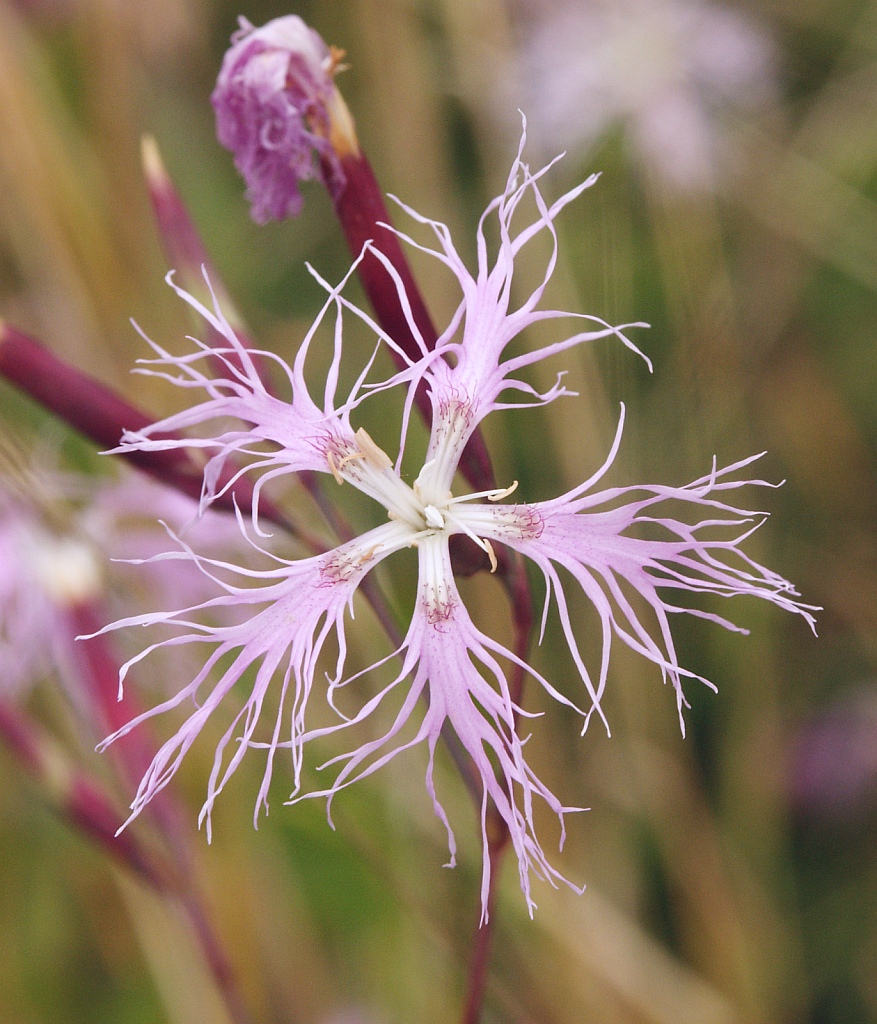
Photo: Bernd Haynold, CC BY-SA 2.5 · source

Perennial · Caryophyllaceae
Large pink
Dianthus superbus
In other languages: Prachtanjer (Nederlands) · Œillet superbe (Français)
Large pink is a wild pink from Europe and much of Asia, where it grows in damp hay meadows, open woodland and mountain meadows. It forms loose clumps of narrow green leaves with slender stems up to about 50 cm. From June into September it bears the flowers that give it its name: lilac to pale pink, sometimes white, with petals deeply cut into fine threads. They have a strong, sweet scent. It is often short-lived, but self-seeds readily in a good spot, so you can still keep it in the garden for years.
Light
Sun or partial shade
preferably some sun
Moisture
Normal to wet
must not dry out
Legal basis
Sand or loam
any pH
Hardiness
Fully hardy
down to -35 °C
Size
0.5 m
tall, 0.3 m wide
Flowering
June–September
| Pruning months | March |
|---|---|
| Height | 0.5 m |
| Native to Belgium | No, planted |
| Good for bees, butterflies and birds | Yes, for bees and butterflies |
| Poisonous to people and pets | Not known to be poisonous |
| Flowering | June–September |
Identify
Large pink: how do you recognise it?
- Habit
- Loose clump of upright, branching stems 30–50 cm tall and about 30 cm wide.
- Leaves
- Narrow and linear, green to slightly grey-green, in opposite pairs on the stems.
- Flower
- Flowers 3–5 cm across with five petals cut well beyond halfway into fine segments.
- Scent
- Strong and sweet, in the garden and in the vase.
- Colour
- Lilac to pale pink, sometimes white.
- Lifespan
- Often short, 2–3 years, but it self-seeds.
Flowering: June–September · Harvest and fruit: June–September · Sowing: March–April · Plants: March–April and September–October · Pruning: March
In your garden
Why grow it?
- Remarkable, deeply cut flowers that look like fine lace.
- A lovely sweet scent, in the border and in a small posy.
- A long flowering season, from June into September.
- Attracts bees and butterflies; butterflies in particular reach the nectar deep in the flower with their long tongues.
- One of the few pinks for moister soil and light part shade.
- Looks good in a naturalistic border or a flower-rich meadow.
Large pink: where does it grow best?
- Sun to light part shade; in full sun it needs enough moisture.
- Sandy or loamy soil with some humus; acid, neutral or chalky is fine.
- Moist to normal: unlike most pinks it dislikes a bone-dry spot. It does not tolerate standing water in winter, though.
- Leave some bare soil around the base so it can self-seed.
- Plant 25–30 cm apart, in groups of 3–5.
- Light
- Sun and partial shade
- Soil type
- Sand or loam
- Acidity
- Not fussy
- Moisture
- Normal or wet
- Size
- 0.5 m tall, 0.3 m wide
- Hardiness
- Hardy (to -35 °C)
Goes well with
- Siberian iris: Narrow leaves and blue flowers for the same moist soil.
- Great burnet: Dark red buttons on tall stems, a fine partner in a naturalistic border.
- Ragged robin: Also with finely frayed pink flowers, for a damp-meadow feel.
- Purple moor grass: An airy grass that likes moist soil.
- Purple loosestrife: Pinkish-purple spikes later in summer, also for a moist spot.
Maintenance
Large pink: when and how to plant it?
Plant in March–April and September–October.
- Plant in March–April or in September–October.
- Dig a hole slightly larger than the pot and mix in a little compost.
- Set the plant at the same depth as in the pot and firm the soil well.
- Leave 25–30 cm between plants and plant in small groups for more impact.
- Water straight away and keep the soil moist for the first few weeks.
- Mulch lightly with leaf mould, keeping the base of the stems clear.
Care
- Watering
- Water regularly in dry weather; in dry soil it soon lets its leaves droop.
- Feeding
- A thin layer of compost in spring is enough.
- Deadheading
- Remove spent flowers to prolong flowering, but from August leave a few to set seed.
- Support
- In rich soil or a windy spot the stems may flop; let them lean on neighbouring plants or add a few twigs.
- Seedlings
- In spring, keep a few seedlings: they will replace the old plants.
Tip: From late August, let a few flowers set seed and keep some bare soil around the clump: large pink will then self-seed and replace itself, even though each plant lives only a few years.
Large pink: when to prune it?
Pruning months: March.
When: It hardly needs pruning. In March, cut away the old, dead stems; in summer you can remove spent flowers.
How:
- Cut spent flowers or whole spent stems back to the next leaf or side bud.
- From late August, leave some of the flowers so they can set seed.
- In March, cut the dead stems back to the fresh leaves at the base.
Propagation
- Seed
- In March–April indoors at room temperature, covering the seed thinly; plant out from May. It also self-seeds.
- Cuttings
- In June–July: root non-flowering shoots of 5–8 cm in sandy cutting compost.
Large pink: how does it get through the winter?
Hardy to −35 °C.
- Very hardy, to about −35 °C: no protection needed.
- Wet, compacted soil in winter can make the clumps rot; make sure water can drain away.
- Leave the spent stems until March; the seed then drops by itself.
- In a pot: leave it outside, but raised on pot feet.
Diseases and pests
- Short-lived: The plant disappears after 2–3 years. This is normal for the species: let it self-seed or sow a few every year.
- Slugs: Young plants and seedlings get eaten. Check in the evening and pick off the slugs.
- Flopping: Long stems fall over after rain. Plant among supporting neighbours and do not overfeed.
- Aphids: On the stem tips in spring. Hose them off or let natural predators do the work.
Through the year
- March: Cut away dead stems. Sow indoors. Plant.
- April: Plant. Sow indoors.
- May: Plant out seed-raised plants. Water in dry weather.
- June: Flowering starts. Take cuttings.
- July: Full flower. Deadhead.
- August: Flowering. Let some flowers set seed.
- September: Late flowers. Plant. Collect seed or let it drop.
- October: Plant. Leave self-sown seedlings in place.
Use
Edible and useful
- Flowers (June–September)
- Large pink flowers later and for longer than common pink: from June into September. Its lilac to pale pink, deeply fringed flowers have a strong, sweet scent, and the fine petals taste sweet and lightly spicy. Pick them on a dry morning, when they have just opened, and shake them to remove insects. Pull the petals out of the calyx and snip off the white or green base: it is bitter. Scatter the fine strands over a salad, fruit or a dessert, or infuse them in vinegar, cream or syrup. Only pick some of the flowers each time, and from late August leave a few to set seed so the plant self-sows: it only lives for a few years.
- Storing
- Fresh petals keep for a day in a closed box with damp kitchen paper in the fridge. You can also dry them in a single layer on a rack somewhere airy and out of the sun, but they then lose some of their scent: use them fresh if you can. The vinegar keeps for a year in a cool, dark place.
Caution: Only eat flowers from plants that have not been sprayed: let a newly bought plant grow for a season first. Only eat the petals, without the base, and not the calyx, stems or leaves. Use them in moderation, as a garnish or flavouring, and not during pregnancy: traditional Chinese herbalism uses the herb of the large pink and advises pregnant women against it. Not every pink: in the catalogue, sweet William and China pink are listed as poisonous, and those are not eaten. Never pick wild large pinks: they have become very rare in Belgium and the Netherlands.
Eating and using is at your own risk: see the terms of use.
Recipes
- Large pink vinegar (Vinegar · ± 500 ml · 15 min + 2 weeks infusing)
- Large pink panna cotta (Dish · 4 people · 30 min + 4 hours setting)
Good for wildlife
- Bees
- Nectar and pollen for honeybees and wild bees.
- Butterflies
- Nectar for butterflies.
You and this species
Did you know?
- In Japan, a variety of this pink, nadeshiko, is one of the seven traditional flowers of autumn.
- The nectar sits at the bottom of a long calyx tube, so mainly butterflies and moths with long tongues can reach it.
- Superbus is Latin for ‘splendid’ or ‘proud’, a nod to its striking, fringed flowers.