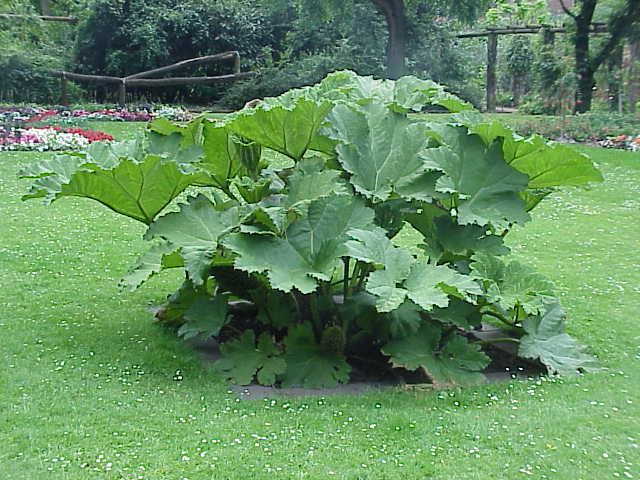
Photo: Kurt Stüber [1], CC BY-SA 3.0 · source

Perennial · Gunneraceae
Giant rhubarb
Gunnera manicata
In other languages: Mammoetblad (Nederlands) · Rhubarbe géante (Français)
Giant rhubarb comes from the damp mountain forests and marshes of south-east Brazil. It is a gigantic perennial with round, deeply lobed leaves up to two metres across, held on thick, prickly stalks. In a single season it grows to about 2 m tall and 3 m wide, then dies back in winter to large buds at ground level. In spring a cone-shaped, greenish-brown flower spike appears at the base, but it is grown above all for its leaves. Gardeners choose it as a spectacular, almost prehistoric focal point beside a pond or stream.
Caution: Make sure you buy Gunnera manicata and not its relative Gunnera tinctoria: that one is on the EU list of invasive alien species and may not be sold or planted in the EU. Wear gloves against the prickles.
Light
Sun or partial shade
preferably some sun
Moisture
Moist to wet
must not dry out
Legal basis
Loam, clay or peat
acid to neutral
Hardiness
down to -10 °C
protect in harsh winters
Size
2 m
tall, 3 m wide
| Pruning months | November |
|---|---|
| Height | 2 m |
| Native to Belgium | No, planted |
| Poisonous to people and pets | Not known to be poisonous |
Identify
Giant rhubarb: how do you recognise it?
- Habit
- A huge clump about 2 m tall and 3 m wide, which shoots again each spring from a thick rhizome.
- Leaves
- Round, deeply lobed and rough, up to two metres across, with coarse veins; dull dark green.
- Leaf stalk
- Thick and fleshy, up to about 2 m long and covered in sturdy prickles.
- Flower
- A cone-shaped, greenish-brown spike at the base of the plant, made up of thousands of tiny flowers; of little ornamental value.
- Roots
- A thick, creeping rhizome with large, hairy winter buds.
Plants: April–May · Pruning: November
In your garden
Why grow it?
- The largest leaf you can grow in a Belgian garden: up to two metres across.
- A real eye-catcher beside a pond, a stream or in a wet corner of a large garden.
- It gives an exotic jungle feel from May until the first frost.
- It thrives in wet ground where many other plants rot.
- Its huge canopy shades the soil, so weeds have little chance.
Giant rhubarb: where does it grow best?
- Sun or partial shade, in a spot where the soil always stays wet: a pond or stream bank is ideal.
- Deep, humus-rich soil: loam, clay or peat, acid to neutral.
- Sheltered from strong wind, which tears the huge leaves.
- Allow at least 3 m of space all round: this is not a plant for a small garden.
- Light
- Sun and partial shade
- Soil type
- Loam, clay or peat
- Acidity
- Acid or neutral
- Moisture
- Wet
- Size
- 2 m tall, 3 m wide
- Hardiness
- Half hardy (to -10 °C): protect it in harsh winters
Goes well with
- Royal fern: Likes the same acid, wet soil and adds a finer leaf beside the giant ones.
- Rodgersia: Large, lobed leaves and plumes in summer, in the same wet spot.
- Japanese iris: Broad, flat flowers in June–July at the water’s edge.
- Meadowsweet: A native plant with fragrant, creamy-white plumes in summer.
Maintenance
Giant rhubarb: when and how to plant it?
Plant in April–May.
- Plant in April–May, when the soil warms up and the hardest night frosts are over.
- Dig a generous hole at least 60 cm wide and deep and enrich it with compost or well-rotted manure.
- Set the plant at the same depth as in the pot: the bud stays just above the soil.
- Keep at least 3 m between it and other large plants.
- Water generously and keep the soil wet all summer.
- Mulch with a thick layer of compost or rotted manure to hold in moisture.
Care
- Watering
- The soil must never dry out. Away from a naturally wet spot, water often and heavily in summer.
- Feeding
- In April, a thick layer of well-rotted manure or compost around the plant: it is a hungry feeder.
- Mulching
- A thick mulch keeps the soil cool and moist.
- Winter protection
- In autumn, fold the dead leaves over the crown and cover with straw against frost.
- Spring
- Remove the protection in April and keep some fleece at hand to cover the young leaves during late night frosts.
Tip: Give it a spot at the edge of a pond, where the soil stays wet by itself. In November, do not forget to protect it with its own leaves and straw.
Giant rhubarb: when to prune it?
Pruning months: November.
When: It is not really pruned. In November, after the first frost, cut off the dead leaves and use them to protect the crown.
How:
- Cut the leaves off at the base after the first night frost.
- Turn them upside down over the buds like a roof and cover with straw or dry leaves.
- In April, clear away the remains of the old leaves as the new buds start to grow.
- Torn or withered leaves can simply be cut off in summer.
Caution: Wear sturdy gloves and long sleeves: the leaf stalks and the undersides of the leaves are covered in prickles.
Propagation
- Basal cuttings
- In April, cut a young bud with a piece of rhizome from the edge of the plant. Let it root in a large pot of moist compost and plant it out the following year.
- Seed
- Sow fresh seed in spring on moist seed compost, indoors in a warm, bright place. Seedlings grow slowly and are tender for their first winters.
Giant rhubarb: how does it get through the winter?
Hardy to −10 °C: protect in harsh winters.
- Only moderately hardy, to about −10 °C, and in Belgium only with protection: the leaves are killed by the first frost.
- Fold the dead leaves over the crown and cover with a thick layer of straw or dry leaves.
- In severe winters, add hessian or fleece so the buds do not freeze.
- Remove the protection carefully in April and cover the young leaves during late frosts.
Diseases and pests
- Frozen buds: After a hard winter the plant fails to shoot or grows weakly. Protect it well every autumn and do not uncover it too early.
- Brown leaf edges: A sign of drought or too much sun in a dry spot. Water more and mulch thickly.
- Torn leaves: Caused by wind. Choose a sheltered spot; damaged leaves can be cut off.
- Slugs: They eat the young, soft leaves in spring. Pick them off or set a beer trap.
Through the year
- March: Leave the protection in place. In mild weather, check that the buds are not rotting.
- April: Remove the protection. Add manure or compost. Plant.
- May: Plant. Protect young leaves from late frost and slugs.
- June: The leaves grow fast. Water heavily.
- July: Water in dry spells. Top up the mulch.
- August: Leaves at full size. Water in dry spells.
- September: Last growth. Water in dry spells.
- October: Gather straw or dry leaves for winter protection.
- November: After the first frost, cut the leaves and fold them over the crown. Cover with straw.
- December: Check the protection after storms or heavy snow.
You and this species
Did you know?
- Small glands at the base of the leaf stalks house cyanobacteria that fix nitrogen from the air; the plant gets part of its nutrients from them.
- Despite the name, it is not related to rhubarb: the genus forms a plant family of its own, the Gunneraceae.
- The genus is named after Johan Ernst Gunnerus, an 18th-century Norwegian bishop and botanist.