Photo: Wikimedia Commons, CC BY-SA 3.0 · source

Shrub · Lamiaceae
French lavender
Lavandula stoechas
In other languages: Kuiflavendel (Nederlands) · Lavande papillon (Français)
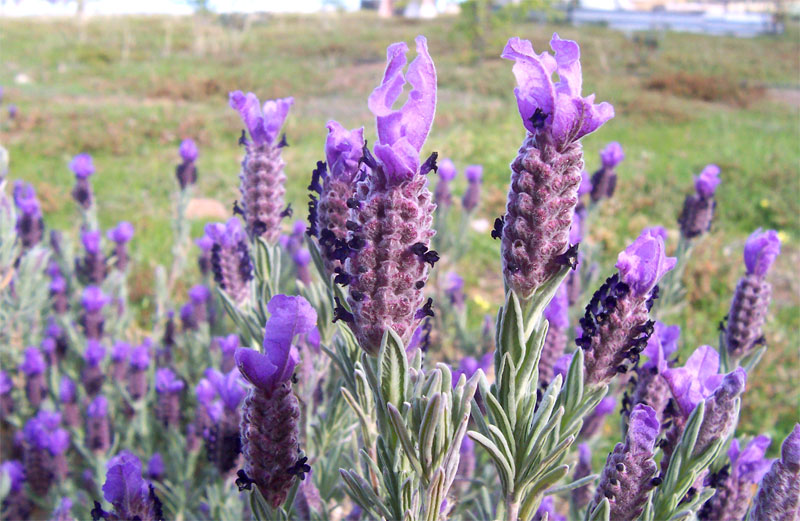
French lavender (Lavandula stoechas) comes from the western and central Mediterranean: Spain, Portugal, southern France, Italy and North Africa, where it grows on dry, poor soil in the maquis. It is a compact, evergreen shrub of about 60 cm with narrow, grey-green, strongly aromatic leaves. From May to August, short, plump spikes of dark purple flowers appear, topped with eye-catching ‘flags’ or ‘ears’ of coloured bracts. It flowers earlier and for longer than English lavender, but is less hardy. There are forms with purple, pink or white flags.
Light
Full sun
warm and bright
Moisture
Dry
tolerates drought
Legal basis
Sand or loam
acid to neutral
Hardiness
down to -10 °C
protect in harsh winters
Size
0.6 m
tall, 0.6 m wide
Flowering
May–August
| Pruning months | April and August |
|---|---|
| Height | 0.6 m |
| Native to Belgium | No, planted |
| Good for bees, butterflies and birds | Yes, for bees and butterflies |
| Poisonous to people and pets | Not known to be poisonous |
| Flowering | May–August |
Identify
French lavender: how do you recognise it?
- Habit
- Compact, rounded shrub 50–60 cm tall and as wide.
- Leaves
- Narrow, 1–4 cm, grey-green and slightly downy, strongly aromatic.
- Flower
- Short, plump, four-sided spikes 2–3 cm long with tiny dark purple flowers, from May to August.
- Flags
- Coloured bracts 1–5 cm long on top of the spike, purple, pink or white.
- Scent
- Spicy and resinous, with a hint of camphor; sharper than that of English lavender.
Flowering: May–August · Harvest and fruit: May–August · Plants: April–May · Pruning: April and August
In your garden
Why grow it?
- A long flowering season, from May to August, with playful flags on top of the flower spikes.
- Bees, bumblebees and butterflies love it.
- Evergreen, grey-green and aromatic: an attractive shrub even out of flower.
- Copes with heat and drought: ideal for a sunny patio, a gravel garden or a pot.
- A warm, spicy scent when you brush past the leaves.
French lavender: where does it grow best?
- Full sun and warmth; the sunnier the spot, the better it flowers.
- Poor, very free-draining sandy or loamy soil, acid to neutral: it likes lime less than English lavender does.
- Dry, especially in winter: wet soil is the main killer.
- Sheltered from cold winds, for example in front of a south-facing wall or in a gravel garden.
- Plant 40–50 cm apart; in a pot, terracotta is best.
- Light
- Sun
- Soil type
- Sand or loam
- Acidity
- Acid or neutral
- Moisture
- Dry
- Size
- 0.6 m tall, 0.6 m wide
- Hardiness
- Half hardy (to -10 °C): protect it in harsh winters
Goes well with
- Rosemary: Another aromatic Mediterranean shrub for the same sunny, dry spot.
- Rock rose: Large, papery flowers in early summer; it also loves drought.
- Sage: Grey leaves and purple flowers, lovely in a herb or gravel garden.
- Thyme: A low, scented carpet at the foot of the lavender.
- Feather grass: Airy, swaying stems that complete the Mediterranean look.
Maintenance
French lavender: when and how to plant it?
Plant in April–May.
- Plant in April–May, once hard night frosts are over.
- Mix heavy soil generously with grit or coarse sand; in a pot use compost with one third grit.
- Set the plant at the same depth as in its pot and firm the soil well.
- Leave 40–50 cm between plants.
- Water thoroughly once, then only when the soil is dry.
- Spread gravel around the base rather than bark: gravel keeps the stem dry, bark holds moisture.
Care
- Watering
- In the ground only for the first few weeks and in long droughts. In a pot in summer as soon as the top few centimetres are dry; never leave water in the saucer.
- Feeding
- Not needed in the garden. In a pot, a little organic fertiliser in April; too much makes it floppy.
- Deadheading
- Regularly cut off spent spikes down to the first pair of leaves: new flowers will follow.
- Mulching
- A layer of gravel around the base keeps the stem dry and reflects warmth.
- Repotting
- Every two years in April, into a slightly larger pot with a gritty mix.
Tip: Grow French lavender in a terracotta pot with a gritty mix and overwinter it in a bright, frost-free, dry place: that way you will keep it for years, even after a hard winter.
French lavender: when to prune it?
Pruning months: April and August.
When: A light trim in April, once the frosts are over, and a shaping trim after the main flush of flowers in late August.
How:
- During flowering, snip off spent spikes with a short piece of stem.
- In late August, shorten the whole shrub by about a third, always above green leaves.
- In April, cut off frosted or dead tips back to healthy green growth.
- This keeps the shrub compact and stops it going bare at the base too soon.
Caution: Never cut into old, bare wood: French lavender will not regrow from it. Do not prune after early September either, or the new shoots will not harden off before winter.
Propagation
- Semi-ripe cuttings
- In August–September: 5–8 cm cuttings from non-flowering shoots in a mix of sand and cutting compost. Overwinter frost-free and plant out in spring.
- Softwood cuttings
- In May–June: young, non-flowering tips 5 cm long, under plastic in moist cutting compost. Roots form within a few weeks.
French lavender: how does it get through the winter?
Hardy to −10 °C: protect in harsh winters.
- Moderately hardy, to about −10 °C, and only in dry soil. In open ground it often fails to survive a cold, wet winter.
- In the garden: choose a dry, sheltered spot with plenty of gravel; keep a few cuttings indoors as a back-up.
- In a pot: overwinter it in a bright, frost-free place, such as a cold greenhouse, a cool conservatory or a garage with a window, at 2–10 °C.
- Water sparingly in winter and put the pot back outside in April–May, once hard frosts are over.
Diseases and pests
- Winter losses: The plant turns grey and dies after a wet winter. Plant in very free-draining soil or overwinter in a pot, frost-free and dry.
- Woody and bare: Without pruning it soon becomes open and bare at the base. Trim lightly every year; old, bare plants are best replaced with young cuttings.
- Rosemary beetle: Small, shiny beetles striped metallic green and purple, and grey larvae, that eat leaves and flowers. Shake them off over a newspaper or pick them off.
- Froghopper: Blobs of cuckoo spit on the stems in spring. Harmless; hose them off with water.
Through the year
- March: Check overwintered plants. Water sparingly.
- April: Cut off frosted tips. Planting. Move pots outside in mild weather.
- May: Flowering begins. Planting. Take softwood cuttings.
- June: Flowering. Cut off spent spikes.
- July: Flowering. Water pots in dry spells.
- August: After the main flush, shorten by a third. Take semi-ripe cuttings.
- September: Take cuttings. No more pruning.
- October: Before the first frost, move pots to a bright, frost-free place.
- November: Overwinter in a bright, cool, dry spot.
- December: Water sparingly. Keep cuttings frost-free.
Use
Edible and useful
- Flowers (May–August)
- Cut the flower heads from May to August on a dry morning, when the flags are well coloured and the first flowers beneath them are opening: the scent is then at its strongest. Cut with a piece of stem, always above green leaves. French lavender smells spicier and sharper than English lavender, with a hint of camphor and resin. Its short, plump heads with their purple, pink or white flags look lovely in a small dried bunch, a pot-pourri or a scented sachet. It is not a kitchen herb: choose English lavender for that. Cutting off the faded heads keeps it flowering for longer; leave plenty for the bees and butterflies too.
- Storing
- Tie the heads in small bunches and hang them upside down somewhere dark, dry and airy for 1 to 2 weeks, or spread them out on a rack. Out of the sun, the flags keep their colour best. Store the dried heads in a closed box or jar, dry and dark: they stay fragrant for a year.
Caution: French lavender is not for eating or drinking: it contains much more camphor than English lavender and tastes bitter and resinous. For the kitchen, use English lavender (Lavandula angustifolia), and that too in moderation. Never swallow lavender essential oil, and do not apply it undiluted to the skin. Keep sachets and pot-pourri out of reach of young children and pets, and replace them once they get dusty. Preferably cut when there are few bees on the flowers.
Eating and using is at your own risk: see the terms of use.
Recipes
- French lavender sachets (Other · 4 sachets · 15 min + 1 to 2 weeks drying)
- French lavender and rose petal pot-pourri (Other · 1 bowl · 20 min + 2 weeks drying and maturing)
Good for wildlife
- Bees
- Nectar and pollen for honeybees and wild bees.
- Butterflies
- Nectar for butterflies.
You and this species
Did you know?
- The ‘flags’ are not flowers but sterile, coloured bracts. They draw pollinators to the small true flowers beneath them.
- The name stoechas refers to the Stoechades, the old name for the Îles d’Hyères off the south coast of France, where the plant grows wild.
- In parts of Australia French lavender has run wild and is regarded as an invasive plant. In our climate that risk is small.