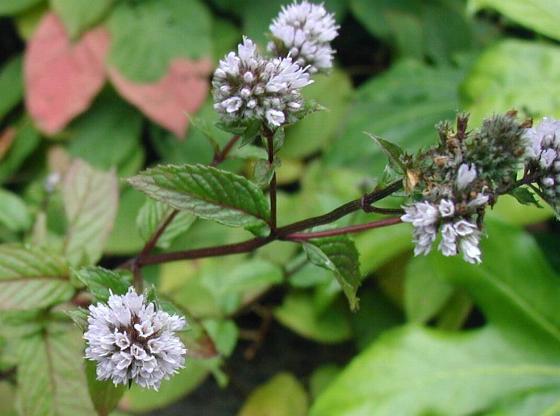
Photo: Sten Porse, CC BY-SA 3.0 · source

Herb · Lamiaceae
Peppermint
Mentha × piperita
In other languages: Pepermunt (Nederlands) · Menthe poivrée (Français)
Peppermint is a fragrant culinary herb, a natural hybrid between water mint and spearmint. Its leaves have a strong, fresh menthol flavour that you recognise at once, lovely in tea, desserts, salads and cocktails. From July to September it bears lilac flower spikes that attract bees and butterflies. The plant is fully hardy, grows fast and spreads by underground and surface runners. There are several forms, such as black peppermint with dark, purplish stems, and ‘Chocolate’, with dark leaves and a sweet scent.
Caution: Peppermint spreads aggressively by runners. Always plant it in a confined space, such as a bottomless bucket or a pot, or it will overrun the rest of the garden.
Light
Sun or partial shade
preferably some sun
Moisture
Normal to wet
must not dry out
Legal basis
Sand, loam or clay
any pH
Hardiness
Fully hardy
down to -25 °C
Size
0.6 m
tall, 0.6 m wide
Flowering
July–September
| Pruning months | March and September |
|---|---|
| Height | 0.6 m |
| Native to Belgium | No, planted |
| Good for bees, butterflies and birds | Yes, for bees and butterflies |
| Poisonous to people and pets | Not known to be poisonous |
| Flowering | July–September |
Identify
Peppermint: how do you recognise it?
- Habit
- Upright, branching stems 40–60 cm tall, spreading quickly by runners.
- Leaves
- Opposite, lance-shaped and toothed, dark green, often flushed purple.
- Stems
- Square, as in all members of the mint family, and often reddish purple.
- Scent
- Strong and fresh, of menthol, as soon as you rub a leaf.
- Flowers
- Narrow, lilac flower spikes at the shoot tips, from July to September.
- Roots
- Shallow rhizomes and runners that spread quickly.
Flowering: July–September · Harvest and fruit: June–September · Plants: March–May and September · Pruning: March and September
In your garden
Why grow it?
- The best-known mint flavour: fresh or dried for tea, desserts, sauces and drinks.
- Grows fast and gives fresh leaves from spring to autumn.
- Its lilac flower spikes attract bees, hoverflies and butterflies in summer.
- Fully hardy and easy: it comes back every spring.
- Also does well in a pot on the patio.
Peppermint: where does it grow best?
- Sun or partial shade. In full sun, though, the soil must stay moist.
- Fertile, moisture-retentive soil: sand, loam or clay, acid to chalky.
- Moist to wet: it likes soil that does not dry out.
- Always in a confined space: a bottomless bucket, a trough or a pot.
- One plant is usually enough for a family: it soon fills 50–60 cm.
- Light
- Sun and partial shade
- Soil type
- Sand, loam or clay
- Acidity
- Not fussy
- Moisture
- Normal or wet
- Size
- 0.6 m tall, 0.6 m wide
- Hardiness
- Hardy (to -25 °C)
Goes well with
- Chives: Another culinary herb that copes with moist soil.
- Parsley: Together the basis of a herb trough by the kitchen.
- Lovage: A tall, hardy culinary herb for the same moist, fertile soil.
- Lemon balm: Another fresh herb for tea, best kept in its own pot too.
Maintenance
Peppermint: when and how to plant it?
Plant in March–May and September.
- Plant in March–May or in September.
- Sink a large bucket or container without a bottom into the ground, with the rim 3–5 cm above soil level, so the runners cannot creep over it.
- Fill it with garden soil mixed with compost and set the plant at the same depth as it was in the pot.
- For a pot on the patio, use ordinary potting compost and a pot with a drainage hole.
- Water in well straight away and keep the soil moist for the first few weeks.
Care
- Water
- Keep the soil moist, especially in pots and during dry summers.
- Feeding
- A layer of compost in spring. Give pots some organic fertiliser now and then in summer.
- Harvesting
- Snip 10 cm shoot tips regularly: it stays compact and keeps producing fresh leaves. The flavour is strongest just before flowering.
- Runners
- Check every spring that no runners have crept over the rim of the bucket, and pull them out.
- Renewing
- Every two or three years, lift it, divide it and replant the youngest part in fresh soil.
Tip: Leave the rim of the bucket a few centimetres above the ground and check around it every spring: otherwise surface runners simply creep over the edge. Pick often, because the more you harvest, the fresher the leaves.
Peppermint: when to prune it?
Pruning months: March and September.
When: After flowering, in September, and in March remove last year’s dead stems.
How:
- After flowering, cut all the stems back to a few centimetres above the ground: it soon regrows with fresh leaves.
- In March, cut away the dead stems, just before the new leaves appear.
- Cut stems with rust down to the ground as soon as you see them.
Caution: Do not put stems with mint rust on the compost heap: that way you avoid spreading the fungus.
Propagation
- Cuttings
- In May–August: snip 10 cm shoot tips, strip the lower leaves and stand them in a glass of water or in moist cutting compost. Roots appear within one to two weeks.
- Division
- In March–April or in September, cut off a piece of rhizome with runners and shoots and plant it separately.
- Seed
- Not possible: peppermint rarely sets viable seed, and seed sold as peppermint does not give true peppermint.
Peppermint: how does it get through the winter?
Hardy to −25 °C.
- Fully hardy, to about −25 °C: no protection needed.
- It dies back above ground and sprouts again from the rhizomes in spring.
- Stand a pot against a wall: roots in a pot are more vulnerable to frost.
- For fresh leaves in winter, pot up a piece of rhizome in autumn and keep it on a cool, bright windowsill.
Diseases and pests
- Mint rust: Orange to brown pustules on the stems and the undersides of the leaves. Cut affected stems down to the ground and do not compost them.
- Powdery mildew: White powder on the leaves, especially in dry summers. Water at the base, cut back affected stems and give the plants some space.
- Leaf beetles: Small, shiny green beetles that eat little holes in the leaves. Pick them off or shake them out of the plant into a bucket.
- Spreading: Left unchecked, it quickly overruns the rest of the garden. Always plant it in a bottomless bucket or a pot.
Through the year
- March: Cut away dead stems. Add compost. Plant or divide.
- April: Plant. Pull out runners outside the bucket.
- May: Harvest. Take cuttings.
- June: Harvest freely. Water in dry spells.
- July: Flowering, full of bees and butterflies. Pick just before flowering.
- August: Flowering. Watch for rust.
- September: Cut back after flowering. Plant or divide.
- October: Pot up a piece of rhizome for the windowsill.
- November: The plant dies back above ground.
Use
Edible and useful
- Leaves (June–September)
- Cut the stems in June and July just before flowering, when the menthol content is highest; after this first cut the plant regrows for a second harvest in August–September. Pick on a dry, sunny morning. Peppermint is sharper and cooler than spearmint: mainly for tea, in chocolate puddings and in liqueur.
- Storing
- Dry the stems in small bunches, hung upside down somewhere airy and dark, until the leaves rustle. Then strip them off and store them whole in a closed jar in the dark, where they keep their aroma for a year. Fresh stems keep for a few days in a glass of water.
Caution: Peppermint tea is safe for most people but can make heartburn worse. Do not give peppermint (and certainly not peppermint oil) to babies and young children: menthol can affect their breathing. Never swallow undiluted peppermint essential oil. Peppermint spreads: grow it in a pot or a bottomless container. Do not confuse it with pennyroyal (Mentha pulegium), which is poisonous.
Eating and using is at your own risk: see the terms of use.
Recipes
- Home-grown peppermint tea (Tea · 1 cup · 5 min + drying)
- Peppermint liqueur (Liqueur · ± 750 ml · 15 min + 2 weeks steeping)
Good for wildlife
- Bees
- Nectar and pollen for honeybees and wild bees.
- Butterflies
- Nectar for butterflies.
You and this species
Did you know?
- Its cool, fresh taste comes from menthol, a substance that triggers the cold sensors in your mouth without actually lowering the temperature.
- Peppermint hardly ever sets viable seed: true peppermint is always propagated vegetatively, from cuttings or rhizomes.
- Mitcham, now part of London, was famous in the 18th and 19th centuries for its peppermint fields. The name lives on in the black peppermint ‘Black Mitcham’.