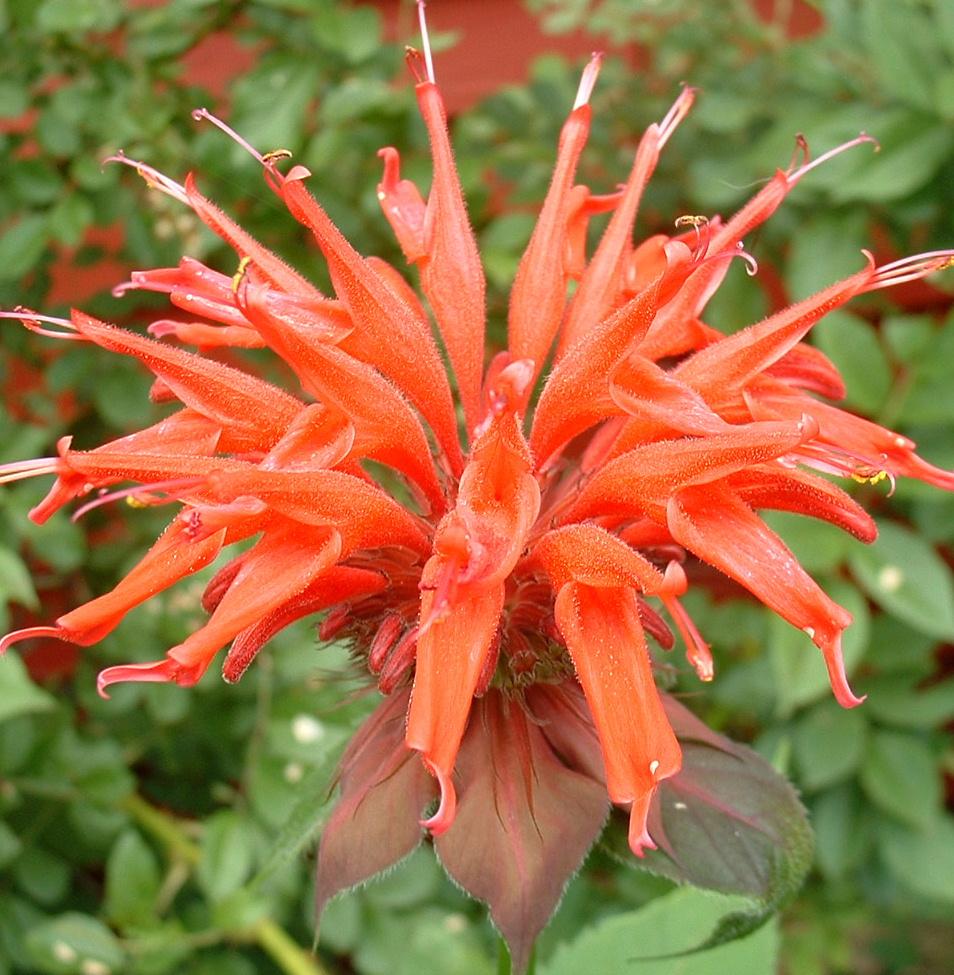
Photo: tracy from north brookfield,Massachusetts, usa, CC BY 2.0 · source

Perennial · Lamiaceae
Scarlet beebalm
Monarda didyma
In other languages: Bergamotplant (Nederlands) · Monarde écarlate (Français)
Scarlet beebalm, or bergamot, is a perennial from the moist woods and stream valleys of eastern North America. It belongs to the mint family, with square stems and leaves that smell wonderfully aromatic when touched. In summer, dense whorls of scarlet, tubular flowers sit on top of the stems. Bees, bumblebees and butterflies seek it out, and the leaves can be used for tea. The red cultivar ‘Cambridge Scarlet’ is well known; the many pink, purple and white bergamots on sale are mostly hybrids.
Light
Sun or partial shade
preferably some sun
Moisture
Normal to wet
must not dry out
Legal basis
Loam or clay
acid to neutral
Hardiness
Fully hardy
down to -30 °C
Size
1 m
tall, 0.5 m wide
Flowering
July–September
| Pruning months | March and September |
|---|---|
| Height | 1 m |
| Native to Belgium | No, planted |
| Good for bees, butterflies and birds | Yes, for bees and butterflies |
| Poisonous to people and pets | Not known to be poisonous |
| Flowering | July–September |
Identify
Scarlet beebalm: how do you recognise it?
- Habit
- Upright clump 70–120 cm tall and 45–60 cm wide, with square stems; spreads slowly by shallow runners.
- Leaves
- Opposite, oval to lance-shaped, 7–15 cm, toothed; dark green and strongly scented.
- Flower
- Dense whorls of tubular, two-lipped flowers at the top of the stem, surrounded by reddish bracts, from July to September.
- Scent
- The leaves smell fresh and spicy, reminiscent of bergamot and mint.
- Roots
- Shallow, creeping rhizomes; the centre of the clump dies out after a few years.
Flowering: July–September · Harvest and fruit: May–September · Sowing: March–April · Plants: March–May and September–October · Pruning: March and September
In your garden
Why grow it?
- Flowers from July to September with striking whorls of scarlet blooms.
- A top plant for bumblebees, bees and butterflies.
- The fragrant leaves and the flowers are edible: leaves for tea, petals in a salad.
- One of the few free-flowering perennials for moist soil in sun or partial shade.
- The round seed heads stay attractive through winter.
Scarlet beebalm: where does it grow best?
- Sun or partial shade; full sun only if the soil stays moist.
- Humus-rich loam or clay, acid to neutral, that stays normal to moist.
- An airy spot where the wind can pass between the plants: this limits powdery mildew.
- Plant 45–60 cm apart and avoid the foot of a warm, dry wall.
- Light
- Sun and partial shade
- Soil type
- Loam or clay
- Acidity
- Acid or neutral
- Moisture
- Normal or wet
- Size
- 1 m tall, 0.5 m wide
- Hardiness
- Hardy (to -30 °C)
Goes well with
- Joe Pye weed: Likes the same moist soil and also draws plenty of butterflies.
- Purple loosestrife: Purple spikes beside red whorls, in the same moist spot.
- Coneflower: Flowers at the same time for a cheerful, natural border.
- Border phlox: Fragrant flower heads in the same summer, in the same rich, moist soil.
- Ornamental grasses: Airy stems that set off the red flowers beautifully.
Maintenance
Scarlet beebalm: when and how to plant it?
Plant in March–May and September–October.
- Plant from March to May or in September–October, when the soil is neither frozen nor too wet.
- Dig a hole twice as wide as the root ball and mix in a few spadefuls of compost.
- Set the plant at the same depth as in the pot and firm the soil well.
- Leave 45–60 cm between plants so that air can circulate.
- Water in thoroughly and mulch around the base with compost or leaf mould.
Care
- Watering
- Keep the soil moist, also after the first year. In dry spells, water at the base, not over the leaves.
- Feeding
- Some compost in spring. Not too much nitrogen: soft leaves are more prone to mildew.
- Mulching
- A layer of compost or leaf mould in spring keeps the soil cool and moist.
- Deadheading
- Remove faded whorls for a longer display, or leave the last ones for a winter silhouette.
- Dividing
- Every three years, lift and divide the clump; throw away the dead centre.
- Harvesting
- Pick leaves for tea just before or during flowering and dry them in the shade.
Tip: In dry summers, water at the base in good time and do not plant too closely: moist soil and plenty of air around the plants are the best defence against mildew.
Scarlet beebalm: when to prune it?
Pruning months: March and September.
When: Cut the dead stems back to just above the ground in March. If the leaves are badly affected by mildew after flowering, you can cut back as early as September.
How:
- In summer, cut faded flower whorls back to a pair of leaves; side flowers will follow.
- In September, remove stems heavily affected by mildew and do not put them on the compost heap.
- Leave healthy stems with seed heads until March: they look good in winter.
- In March, cut all old stems back to just above the ground, before the new shoots emerge.
Propagation
- Division
- In March–April or September–October, lift the clump and take young, healthy pieces from the edge. Discard the woody centre.
- Cuttings
- In April–May, cut young shoots of 5–8 cm at the base and insert them in moist cutting compost. They root within a few weeks.
- Seed
- Sow indoors in March–April at 15–20 °C, barely covering the seed. Plant out after mid-May. Cultivars do not come true from seed.
Scarlet beebalm: how does it get through the winter?
Hardy to −30 °C.
- Fully hardy, to about −30 °C: no protection needed in Belgium.
- The top growth dies down; in spring the plant reshoots from its rhizomes.
- In a pot: stand it against a wall and do not let the compost dry out, even in winter.
Diseases and pests
- Powdery mildew: White powder on the leaves from July, especially in dry soil and still air. Water, give space, cut out affected stems and choose less susceptible cultivars.
- Slugs: They eat the young shoots in April–May. Pick them off in the evening or set a beer trap.
- Bare centre: The middle of the clump dies and stops flowering. Divide the plant and replant only the young outer pieces.
- Spreading: In good soil it creeps further than you want. Chop off the runners with a spade in spring.
Through the year
- March: Cut away old stems. Plant or divide. Sow indoors.
- April: Sow indoors. Take cuttings. Mulch.
- May: Plant out seedlings after mid-May. Watch for slugs.
- June: Water in dry spells. Pick leaves for tea.
- July: Flowering begins. Deadhead faded whorls.
- August: Full flower. Keep the soil moist.
- September: End of flowering. Cut out mildewed stems. Plant or divide.
- October: Plant or divide.
- November: Leave healthy seed heads standing.
- December: Rest.
Use
Edible and useful
- Flowers (July–September)
- The red, pink or purple whorls of flowers from July to September are edible: strip the tubular florets over salad, fruit or cakes, or make tea with them. They taste sweet and spicy.
- Leaves (May–August)
- Pick the leaves from May to August, ideally before flowering. They smell of bergamot (as in Earl Grey tea) with a hint of mint and thyme; in North America they were made into Oswego tea. The related Monarda fistulosa tastes spicier, more like oregano, and can also be used as a kitchen herb.
- Storing
- Dry leaves and flowers in small bunches or loose on a rack, somewhere airy and dark. Keep them in a closed jar in the dark for up to a year.
Caution: As a tea or decoration in normal amounts, bee balm is safe; during pregnancy do not drink large amounts. In dry summers the leaves often get powdery mildew: then only pick healthy leaves.
Eating and using is at your own risk: see the terms of use.
Recipes
- Oswego tea (Tea · 1 teapot (± 750 ml) · 10 min)
- Summer fruit with bee balm flowers and honey (Dish · 4 people · 15 min)
Good for wildlife
- Bees
- Nectar and pollen for honeybees and wild bees.
- Butterflies
- Nectar for butterflies.
You and this species
Did you know?
- The name bergamot comes from the scent of the leaves, which recalls the bergamot orange, the citrus fruit that flavours Earl Grey tea. That tea is flavoured with the citrus fruit, though, not with this plant.
- The genus Monarda is named after Nicolás Monardes, a 16th-century Spanish physician who wrote about plants from the New World.
- In North America hummingbirds visit the red flowers; there it is also called Oswego tea, as the leaves have long been used for tea.