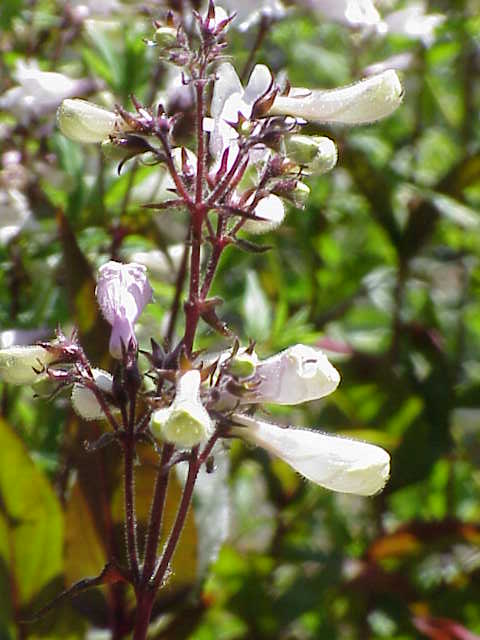
Photo: Wikimedia Commons, CC BY-SA 3.0 · source

Perennial · Plantaginaceae
Foxglove beardtongue
Penstemon digitalis
In other languages: Slangenkop (Nederlands) · Penstémon digitale (Français)
Foxglove beardtongue is a perennial from eastern and central North America, where it grows in prairies, open woods and along woodland edges. It forms a rosette of glossy leaves that stays green in mild winters, from which upright stems of about 90 cm rise in spring. In June and July these carry airy sprays of tubular white flowers, sometimes tinged lilac or pink, that look a little like those of a foxglove. Gardeners value it because it is the hardiest and easiest penstemon, copes well with drought and attracts bumblebees. A well-known variety is ‘Husker Red’, with purple-red leaves and stems and white to pale pink flowers.
Light
Sun or partial shade
preferably some sun
Moisture
Dry to normal
no wet feet
Legal basis
Sand, loam or clay
any pH
Hardiness
Fully hardy
down to -30 °C
Size
0.9 m
tall, 0.45 m wide
Flowering
June–July
| Pruning months | March |
|---|---|
| Height | 0.9 m |
| Native to Belgium | No, planted |
| Good for bees, butterflies and birds | Yes, for bees |
| Poisonous to people and pets | Not known to be poisonous |
| Flowering | June–July |
Identify
Foxglove beardtongue: how do you recognise it?
- Habit
- A rosette of leaves with upright flower stems up to about 90 cm tall and 45 cm wide.
- Leaves
- Lance-shaped, glossy and opposite on the stem; green, purple-red in ‘Husker Red’.
- Flower
- Tubular with an open mouth, white, about 2.5 cm long, in loose sprays in June–July.
- Fruit
- Small brown seed capsules on sturdy stems that stand all winter.
- Roots
- Fibrous roots in a compact clump; it does not spread.
Flowering: June–July · Sowing: February–March · Plants: March–May and September · Pruning: March
In your garden
Why grow it?
- The hardiest penstemon: it survives even severe Belgian winters without protection.
- White flowers in June–July, loved by bumblebees and other bees.
- ‘Husker Red’ has purple-red leaves, especially in spring.
- Copes well with drought and grows in sand, loam and clay.
- The seed stems stay attractive through winter.
- Lovely in a natural border or a prairie-style planting.
Foxglove beardtongue: where does it grow best?
- Sun or partial shade; in full sun it flowers most freely and ‘Husker Red’ colours best.
- Well-drained sand, loam or clay, acid to chalky.
- Dry to moderately moist; it dislikes wet feet in winter.
- Allow 40–45 cm between plants.
- Light
- Sun and partial shade
- Soil type
- Sand, loam or clay
- Acidity
- Not fussy
- Moisture
- Dry or normal
- Size
- 0.9 m tall, 0.45 m wide
- Hardiness
- Hardy (to -30 °C)
Goes well with
- Coneflower: Pink flowers that follow on from the penstemon, in the same sun.
- Switchgrass: An airy ornamental grass from the same prairies.
- Catmint: A blue haze at its feet, also drought tolerant.
- Sage: Violet-blue spikes as a contrast with the white flowers.
Maintenance
Foxglove beardtongue: when and how to plant it?
Plant in March–May and September.
- Plant from March to May or in September, when the soil is neither frozen nor waterlogged.
- Dig a hole twice as wide as the root ball; in heavy clay work in some coarse sand or gravel.
- Set the plant at the same depth as in its pot, with the rosette at soil level.
- Space plants 40–45 cm apart; it looks best in groups of 3–5.
- Water well straight away and again during dry spells in the first weeks.
- Mulch thinly with compost, keeping the rosette clear.
Care
- Watering
- In dry spells during the first year; after that only in long droughts.
- Feeding
- Not needed in ordinary garden soil: rich soil gives floppy stems.
- Spent flowers
- Leave them for the seed capsules and winter structure.
- Support
- Rarely needed; in rich soil or shade the stems may flop.
- Seedlings
- It sometimes self-seeds; seedlings of ‘Husker Red’ do not always have red leaves.
Tip: Leave the seed stems standing in autumn and only cut them down in March: they give winter structure and look lovely with frost on them.
Foxglove beardtongue: when to prune it?
Pruning months: March.
When: In March, cut down the old seed stems. No pruning is needed for the rest of the year.
How:
- Leave the spent stems standing in autumn and winter: they look lovely with frost on them.
- In March, cut them back to just above the leaf rosette.
- Leave the rosette itself: the new stems grow from it.
Caution: Do not cut away the leaf rosette at the base: the plant needs it to get through winter and spring.
Propagation
- Seed
- Sow indoors in February–March in seed compost; the seed often germinates better if you first keep it cold and moist in the fridge for a few weeks. Prick out the seedlings and plant them out in May.
- Division
- In March–April or September, every 3–4 years: split the clump into pieces each with a rosette and roots, and replant them straight away.
Foxglove beardtongue: how does it get through the winter?
Hardy to −30 °C.
- Very hardy, to about −30 °C: no protection is needed in Belgium.
- The leaf rosette stays green in mild winters, often reddish in ‘Husker Red’.
- Wet soil in winter is more dangerous than frost: make sure the soil drains well.
- Leave the seed stems for structure and for overwintering insects.
Diseases and pests
- Root rot: The plant wilts and the rosette turns brown after a wet winter. Plant it in well-drained soil.
- Slugs: They eat the young shoots and the rosette in spring. Pick them off in the evening.
- Flopping stems: In soil that is too rich or too much shade. Do not feed and choose a sunny spot.
- Greener leaves: ‘Husker Red’ loses some of its red colour in summer and in shade. That is normal; sun helps.
Through the year
- February: Sow indoors after giving the seed a cold treatment.
- March: Cut down old seed stems. Sow. Plant or divide.
- April: Plant. Prick out seedlings.
- May: Plant out seedlings. Keep slugs away.
- June: Flowering begins.
- July: Full flower. Water young plants in dry spells.
- August: Seed capsules form.
- September: Plant or divide.
- October: Leave the seed stems standing.
- December: The seed stems decorate the winter garden.
Use
Good for wildlife
- Bees
- Nectar and pollen for honeybees and wild bees.
You and this species
Did you know?
- The name penstemon comes from the Greek pente (five) and stemon (stamen), because the flower has five stamens.
- The English name beardtongue refers to the fifth, sterile stamen, which is hairy like a little beard.
- ‘Husker Red’ was named Perennial Plant of the Year in the United States in 1996.