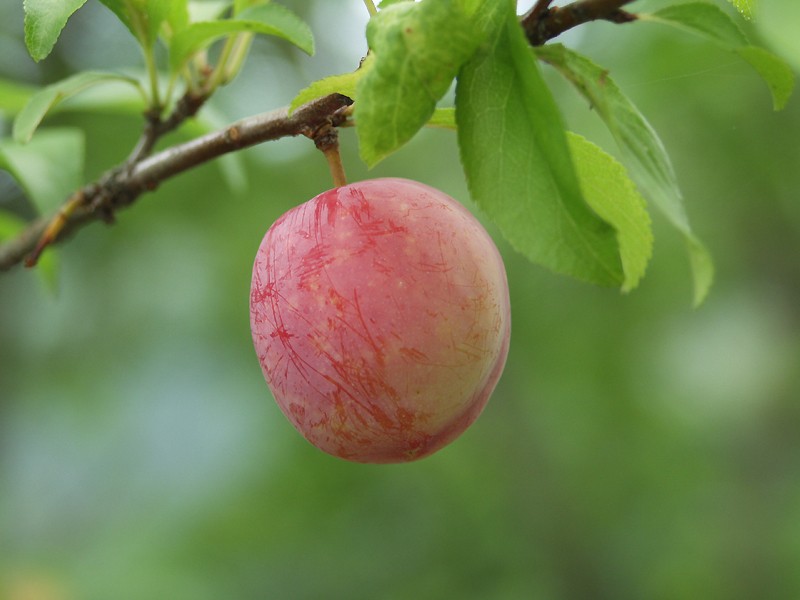
Photo: Wikimedia Commons, CC BY-SA 3.0 · source

Fruit plant · Rosaceae
Japanese plum
Prunus salicina
In other languages: Japanse pruim (Nederlands) · Prunier japonais (Français)
Japanese plum comes originally from China and got its name because it reached the West via Japan. It is a small tree of 4–5 m with an open crown and narrow, willow-like leaves. White flowers appear as early as March–April, often before or with the leaves. The round, juicy fruits of 4–6 cm are red, yellow or purple, and ripen early, from July to September. They are sweeter and firmer than many European plums. Because it flowers so early, a sheltered spot is important, and for a good crop you usually need a second tree as pollinator.
Caution: Do not eat the stone or the leaves: the stones of stone fruit contain substances that can release hydrogen cyanide. Keep stones away from small children and dogs.
Light
Full sun
warm and bright
Moisture
Normal
no wet feet
Legal basis
Sand, loam or clay
any pH
Hardiness
Fully hardy
down to -25 °C
Size
5 m
tall, 4 m wide
Flowering
March–April
| Pruning months | July–August |
|---|---|
| Height | 5 m |
| Native to Belgium | No, planted |
| Good for bees, butterflies and birds | Yes, for bees |
| Poisonous to people and pets | Not known to be poisonous |
| Flowering | March–April |
Identify
Japanese plum: how do you recognise it?
- Habit
- Small tree 4–5 m tall and 4 m wide, with an open, often spreading crown.
- Leaves
- Narrow, inversely oval to lance-shaped, 6–10 cm, with a finely toothed edge; glossy green.
- Flower
- White flowers in small clusters from March to April, often before or with the leaves.
- Fruit
- Round to heart-shaped drupes of 4–6 cm, red, yellow or purple; juicy and sweet, ripe from July to September.
- Roots
- Moderately deep and branching; it needs moist but well-drained soil.
Flowering: March–April · Harvest and fruit: July–August · Plants: March–April and October–December · Pruning: July–August
In your garden
Why grow it?
- Early, juicy plums from July to September, often sweeter than European plums.
- Rich blossom in March–April: the white flowers are a feast for bees early in the year.
- Compact tree of 4–5 m, suitable for small and medium gardens and for fan training against a wall.
- Attractive in three seasons: blossom, leafy summer and fruit.
- Fully hardy and fruitful for many years with good care.
Japanese plum: where does it grow best?
- Full sun and a warm, sheltered spot, preferably against a south or west wall, out of reach of late frost.
- Deep, humus-rich, well-drained loam; sand or clay is possible with added compost. Acid to chalky.
- Normally moist: it should never go dry, but it does not tolerate permanently wet feet.
- Allow 4–5 m per tree. Plant a second Japanese plum that flowers at the same time as a pollinator.
- Light
- Sun
- Soil type
- Sand, loam or clay
- Acidity
- Not fussy
- Moisture
- Normal
- Size
- 5 m tall, 4 m wide
- Hardiness
- Hardy (to -25 °C)
Goes well with
- Daffodil: Early yellow flowers under the blossoming tree.
- Grape hyacinth: Small blue flowers that bloom at the same time as the white blossom.
- Chives: A low, useful underplanting beneath fruit trees.
- Lady’s mantle: A soft, green ground cover under the crown.
Maintenance
Japanese plum: when and how to plant it?
Plant in March–April and October–December.
- Plant in October–December or in March–April, preferably bare-root in the dormant season, not in frost or wet soil.
- Dig a hole twice as wide as the roots and just as deep; loosen the bottom, but do not mix in fresh manure.
- Set the tree so the graft union stays 5–10 cm above the soil and put in a stake on the windward side.
- Fill the hole with the excavated soil, firm well and tie the tree loosely to the stake with a tree tie.
- Water in at once with 10–20 litres, even if it rains.
- Spread a ring of mulch (compost or bark) 1 m wide around the trunk, but not against the trunk.
Care
- Water
- For the first 2–3 years, a good weekly soaking in dry weather. Later too in dry summers, especially while the fruit swells.
- Feeding
- In March, compost or organic feed, then a layer of mulch. Not too much nitrogen, which gives lots of leaf and little fruit.
- Thinning fruit
- In June pinch out surplus fruitlets to about 6–8 cm between plums: this gives larger fruit and prevents broken branches.
- Support
- Support heavily laden branches with a stake or string; Japanese plums tend to overcrop.
- Harvesting
- Pick the plums when fully coloured and slightly soft; they ripen unevenly, so harvest in several rounds.
Tip: It flowers early: choose a spot sheltered from late frost. Prune in summer after harvest, not in winter, to avoid silver leaf; most varieties need a pollinator.
Japanese plum: when to prune it?
Pruning months: July–August.
When: In summer, in July–August after harvest, in dry weather. Not in winter.
How:
- Build an open crown with 3–4 main branches; cut young trees back lightly after planting.
- Remove dead, diseased, crossing and inward-growing branches.
- Take out water shoots (fast, upright shoots) and thin the crown so light and air get in.
- Cut with a sharp, clean knife or secateurs and make clean cuts.
Caution: Do not prune stone fruit in winter: silver leaf then enters through the pruning wounds, a fungus that can kill the tree.
Propagation
- Grafting and budding
- In August bud, or in March–April graft onto a plum rootstock. In practice you buy a grafted tree from a nursery.
- Suckers
- Suckers from the rootstock are not the variety; remove them.
- Seed
- Stones give trees unlike the mother tree; this is not recommended.
Japanese plum: how does it get through the winter?
Hardy to −25 °C.
- Fully hardy, to about −25 °C. The tree itself needs no protection.
- The early flowering is the weak point: cover the blossom with fleece on frosty nights or plant in a sheltered spot.
- Young trees: protect the trunk with a guard against rabbits and hares, which gnaw the bark in winter.
- In a pot: put it against a wall and wrap the pot in hessian.
Diseases and pests
- Late frost: Brown, withered flowers after a frosty night in March–April. Plant in a sheltered spot and cover the tree in flower with fleece.
- Plum fruit moth: Maggoty plums with a pinkish grub near the stone. Hang pheromone traps in May–June and clear up fallen fruit.
- Brown rot: Fruit rots with rings of beige spore pustules and hangs on as shrivelled mummies. Remove all affected fruit and dead twigs.
- Silver leaf: Silvery foliage and dying branches caused by a fungus entering through pruning wounds. Prune only in summer and remove affected branches.
- Aphids: Curled, sticky leaves on young shoots in May–June. Rinse with water; ladybirds and hoverflies often clear them.
Through the year
- March: Flowering. Add compost. Plant or move.
- April: Flowering. Cover with fleece on frosty nights. Plant.
- May: Hang plum moth traps. Water in dry weather.
- June: Thin fruit to 6–8 cm. Support branches.
- July: First harvest. Prune after harvest.
- August: Harvest. Prune after harvest. Remove mummified fruit.
- September: Pick the last plums. Clear up fallen fruit.
- October: Plant. Apply mulch.
- November: Plant. Protect the trunk from rabbits.
- December: Plant if the ground is not frozen. Rest.
Use
Edible and useful
- Fruit (July–August)
- Japanese plums ripen early, in July and August, before most European plums. Pick them when they are deeply coloured and just give near the stalk. They are juicy and sweet with a fresh, slightly tart skin: fresh, in a clafoutis, compote, chutney or on a tray bake.
- Storing
- Ripe plums keep for a few days in the fridge. Stoned and halved, they can be frozen. As compote or jam they keep for months.
Caution: The flesh is safe. Do not crack or eat the stones: the kernel contains amygdalin, which can release cyanide. Japanese plums flower early and often need a second variety for pollination; late frost can destroy the blossom.
Eating and using is at your own risk: see the terms of use.
Recipes
- Japanese plum clafoutis (Dish · 6 people · 50 min)
- Plum compote with cinnamon (Compote · ± 4 portions · 20 min)
Good for wildlife
- Bees
- Nectar and pollen for honeybees and wild bees.
You and this species
Did you know?
- Despite its name, the Japanese plum comes originally from China; it reached the West via Japan.
- The species name salicina means ‘willow-like’, after the narrow leaves that resemble willow leaves.
- A plum is a drupe, like the cherry, peach and apricot: they all belong to the genus Prunus.