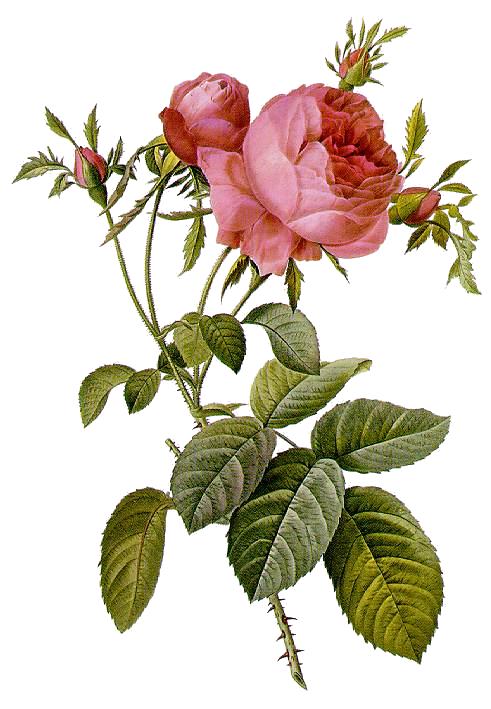
Photo: Pierre-Joseph Redouté, Public domain · source

Shrub · Rosaceae
Cabbage rose
Rosa × centifolia
In other languages: Centifolia (Nederlands) · Rosier cent-feuilles (Français)
The cabbage rose, also known as the Provence rose, is an old garden rose of mixed parentage, largely developed by Dutch breeders between the 17th and 19th centuries. It grows as a loose, arching shrub about 1.5 m tall with soft green, rough leaves and thorny stems. In June, once a year, it carries heavily double, globular flowers in soft pink with an intense, sweet rose scent. It was once grown for rose oil, and it is still a mainstay of the old-rose garden. It is hardy, but needs plenty of sun, rich soil and an airy position.
Light
Full sun
warm and bright
Moisture
Normal
no wet feet
Legal basis
Sand, loam or clay
any pH
Hardiness
Fully hardy
down to -25 °C
Size
1.5 m
tall, 1.2 m wide
Flowering
June
| Pruning months | March and July |
|---|---|
| Height | 1.5 m |
| Native to Belgium | No, planted |
| Good for bees, butterflies and birds | Yes, for bees |
| Poisonous to people and pets | Not known to be poisonous |
| Flowering | June |
Identify
Cabbage rose: how do you recognise it?
- Habit
- Loose, arching shrub about 1.5 m tall and 1.2 m wide, with arching stems covered in prickles.
- Leaves
- Soft green and rough, pinnate with 5–7 leaflets.
- Flowers
- Heavily double, globular to cupped blooms of about 7–10 cm, often nodding, soft pink, in June.
- Scent
- Intense, sweet and classic: the typical ‘old rose’ fragrance.
- Flowering
- Once flowering: a single rich flush in June, no repeat.
Flowering: June · Harvest and fruit: June–July · Plants: March–April and October–November · Pruning: March and July
In your garden
Why grow it?
- Heavily double, globular flowers in soft pink with an intense, classic rose scent.
- A superb cut flower, and the petals are good for potpourri.
- Attracts bees, although heavily double flowers offer less pollen than single roses.
- Hardy to about −25 °C and robust in a sunny, airy spot.
- Gives a romantic old-rose feel, especially with lavender and hardy geraniums.
Cabbage rose: where does it grow best?
- Full sun, at least 6 hours a day. In shade it flowers poorly and gets more diseases.
- Humus-rich, fertile, well-drained soil: loam, sand or clay that is not too wet; pH 6–7.5.
- Normally moist: not too wet and not drying out.
- An open, airy spot, because moving air limits mildew and black spot.
- Allow 1–1.2 m per plant and do not plant where roses have stood for years (rose sickness).
- Light
- Sun
- Soil type
- Sand, loam or clay
- Acidity
- Not fussy
- Moisture
- Normal
- Size
- 1.5 m tall, 1.2 m wide
- Hardiness
- Hardy (to -25 °C)
Goes well with
- Lavender: A sunny, fragrant partner with purple flowers that complement the rose nicely.
- Hardy geranium: A low, flowering plant that covers the bare base of the rose.
- Catmint: Lavender-blue flowers that last long and attract bees.
- Lady’s mantle: A soft, yellow-green edging at the front of the border.
- Sage: Purple flower spikes in summer in a sunny border.
Maintenance
Cabbage rose: when and how to plant it?
Plant in March–April and October–November.
- Plant in March–April or in October–November, on frost-free days and in soil that is not too wet.
- Soak a bare-root rose in water for a few hours before planting.
- Dig a hole 40–50 cm wide and deep and mix in compost, not fresh manure.
- Set the plant so that the graft union (the swelling at the base of the stems) lies about 3–5 cm below the soil surface.
- Fill in, firm well and give a generous watering.
- Cut away damaged roots, shorten over-long stems lightly and spread a layer of compost or bark around the base.
Care
- Water
- In dry spells give a good can of water weekly at the base, preferably in the morning and without wetting the leaves.
- Feeding
- In March give compost or rose feed. If you like, once more after flowering. Not after July, so the wood can ripen.
- Mulching
- A layer of compost or bark about 5 cm thick in spring keeps the soil moist and suppresses weeds.
- Spent flowers
- Cut off faded flowers for a tidy plant. Rain turns the heavy blooms brown quickly.
- Support
- The heavy, arching stems can be tied to a support or ring so that they do not trail on the ground.
Tip: Plant it so that air can move through the shrub and give compost every spring: that is the best protection against mildew and black spot. Prune lightly straight after flowering.
Cabbage rose: when to prune it?
Pruning months: March and July.
When: Prune lightly straight after flowering, in July, and finish off in March.
How:
- After flowering: cut the faded shoots back by about a third and remove dead or weak stems.
- Every few years thin out a few of the oldest, thickest stems at the base.
- In March: shorten last year’s side shoots to 2–3 buds (about 10–15 cm). The flowers are borne on these side shoots.
- Cut away crossing stems to keep air moving through the shrub.
Caution: Do not shorten the long main stems in spring: the flowers are borne on side shoots of old wood and you would lose blooms.
Propagation
- Hardwood cuttings
- In October–November take cuttings of 20–25 cm from ripened shoots, remove the lower buds and push them two-thirds into the ground in a sheltered spot. Success varies and it takes a year.
- Suckers
- On its own roots it may form suckers. Cut them off with roots in autumn or early spring and replant them elsewhere.
Cabbage rose: how does it get through the winter?
Hardy to −25 °C.
- Hardy to about −25 °C: in Belgium usually without protection.
- For grafted plants: in November mound 15–20 cm of garden soil or compost over the base and remove it after severe frost.
- Clear away fallen leaves around the shrub, because the black spot fungus overwinters in them.
- In a pot: stand it against a sheltered wall and wrap the pot in hessian.
Diseases and pests
- Powdery mildew: White powder on the leaves and buds, especially in dry soil and a stuffy spot. Provide sun, air and enough water at the base, and cut away affected shoots. Cabbage roses are prone to it.
- Black spot: Black spots with fringed edges and leaf fall from summer. Do not water over the leaves, clear up affected leaves and leave space between plants.
- Rust: Orange, powdery pustules under the leaves. Remove affected leaves and do not overfeed with nitrogen.
- Aphids: On young shoots and buds in May–June. Rinse them off with water or let ladybirds do the work.
- Rain damage: The heavy flowers stay stuck together in rain and turn brown. Cut them off; an airy spot helps.
Through the year
- March: Plant. Shorten side shoots to 2–3 buds. Give compost.
- April: Plant. Spread mulch. Watch for aphids.
- May: The buds form. Water in dry weather. Watch for mildew.
- June: Flowering, once a year. Cut flowers for a bouquet.
- July: Prune lightly after flowering. Thin out old stems.
- August: Water in dry weather. Clear up diseased leaves.
- September: Clear up fallen leaves.
- October: Plant. Take hardwood cuttings.
- November: Plant. Mound up the base in severe frost.
- December: Rest.
Use
Edible and useful
- Flowers (June–July)
- Pick the flowers in June and July on a dry morning, when they have just opened fully and smell strongest. Pull off the petals and snip off the white base, which is bitter. The damask rose (like the apothecary’s rose and the cabbage rose) is the classic rosewater rose: for rose petal jelly, syrup, rose sugar, rosewater and in baking.
- Storing
- Dry the petals in a thin layer on paper somewhere airy and dark and keep them in a closed jar for up to a year. Use fresh petals the same day.
Caution: Only use roses that have not been sprayed: florists’ roses, and often garden-centre ones too, are treated. Let new plants grow for a season first. People allergic to roses or with hay fever may react to the pollen: use only the petals.
Eating and using is at your own risk: see the terms of use.
Recipes
- Rose petal syrup (Syrup · ± 500 ml · 20 min + overnight steeping)
- Rose petal jelly (Jelly · ± 3 small jars · 30 min + 1 hr steeping)
- Rosewater for the skin (Skin and body care · ± 250 ml · 30 min)
Good for wildlife
- Bees
- Nectar and pollen for honeybees and wild bees.
You and this species
Did you know?
- The name centifolia means ‘hundred-leaved’ (Latin centum, a hundred, and folium, leaf), after its many petals.
- Around Grasse in southern France, the cabbage rose, the ‘rose de mai’, was grown for the perfume industry.
- Moss roses are spontaneous mutations of the cabbage rose: they have a mossy covering of hairs on the calyx and stem.