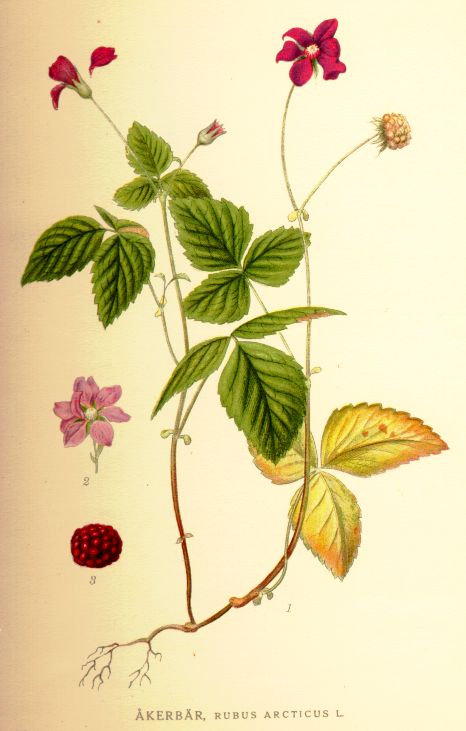
Photo: Carl Axel Magnus Lindman, Public domain · source

Fruit plant · Rosaceae
Arctic raspberry
Rubus arcticus
In other languages: Arctische framboos (Nederlands) · Framboisier arctique (Français)
The Arctic raspberry grows wild in the northern forests and damp grasslands of Scandinavia, the Baltic states and Siberia, all the way to Alaska. It is a low, herbaceous plant of 20–30 cm that spreads by underground runners and forms a dense carpet. From May to July it carries bright pink flowers, followed by small, dark red fruits with a very intense, sweet-sharp aroma. In Finland and Sweden the berry is regarded as a delicacy. The plant is extremely hardy, but it needs a cool, moist, acid to neutral soil.
Caution: Spreads by underground runners and can form a large carpet after a few years. Dig out runners where you do not want them.
Light
Sun or partial shade
preferably some sun
Moisture
Normal to wet
must not dry out
Legal basis
Sand or loam
acid to neutral
Hardiness
Fully hardy
down to -40 °C
Size
0.3 m
tall, 0.5 m wide
Flowering
May–July
| Pruning months | February–March |
|---|---|
| Height | 0.3 m |
| Native to Belgium | No, planted |
| Good for bees, butterflies and birds | Yes, for bees |
| Poisonous to people and pets | Not known to be poisonous |
| Flowering | May–July |
Identify
Arctic raspberry: how do you recognise it?
- Habit
- Low, herbaceous plant 20–30 cm tall and about 50 cm wide, spreading by runners. The stems are thornless and mostly die back in autumn.
- Foliage
- Usually with three leaflets, fresh green with a toothed edge.
- Flower
- Bright pink flowers of about 2 cm with narrow petals, from May to July.
- Fruit
- Small, dark red to purplish, raspberry-like fruits of 1–1.5 cm, ripe in July–August, with an intense aroma.
- Roots
- Thin, creeping rhizomes just below the surface, from which new shoots appear every spring.
Flowering: May–July · Harvest and fruit: July–August · Plants: March–April and September–October · Pruning: February–March
In your garden
Why grow it?
- Very aromatic little fruits, which you rarely find in the shops.
- A low ground cover for sun and half shade, with pink flowers in summer.
- Extremely hardy: down to about −40 °C.
- The flowers attract bees and bumblebees from May to July.
- Takes up little room and also suits a pot or a fruit border.
Arctic raspberry: where does it grow best?
- Sun to half shade: they fruit more richly in sun, but in warm summers some shade is welcome.
- Humus-rich, loose soil: sand or loam, acid to neutral (pH 5.5–6.5).
- Evenly moist to wet, but no standing water.
- Sheltered from drying wind.
- Plant 30–40 cm apart: within 2–3 years the plants grow together into a carpet.
- Light
- Sun and partial shade
- Soil type
- Sand or loam
- Acidity
- Acid or neutral
- Moisture
- Normal or wet
- Size
- 0.3 m tall, 0.5 m wide
- Hardiness
- Hardy (to -40 °C)
Goes well with
- Cranberry: Likes the same acid, moist soil.
- Wild strawberry: Another low ground cover with edible fruits, also in half shade.
- Ferns: Fresh green foliage in the same moist half shade.
- Lady’s mantle: Soft leaves and yellow flowers in moist soil.
Maintenance
Arctic raspberry: when and how to plant it?
Plant in March–April and September–October.
- Plant in March–April or in September–October, on a day when the soil is not frozen.
- Loosen the soil and mix in plenty of compost or leaf mould. Chalky soil is not suitable.
- Plant at least two different cultivars together so they pollinate each other, 30–40 cm apart.
- Set the plants at the same depth as in the pot: the rhizomes lie just below the surface.
- Water well and spread a layer of bark or leaf-mould mulch about 5 cm thick.
- In a pot: use an open, humus-rich potting compost with good drainage and allow at least 5 litres per plant.
Care
- Water
- Keep the soil lightly moist at all times, especially during flowering and fruiting. Use rainwater if you can.
- Feeding
- In March, a thin layer of compost or organic fertiliser. Do not overfeed.
- Mulching
- A layer of bark or leaf mould keeps the soil cool and moist and suppresses weeds.
- Maintenance
- Cut the dead stems to the ground in February–March. Dig out runners where the carpet gets too wide.
- Pollination
- Two different cultivars ensure good fruit set; bees and bumblebees do the rest.
- Harvest and kitchen
- Pick the fruits when they are completely dark red; they are soft and spoil quickly. Eat them fresh or make jam, sorbet or liqueur.
Tip: Plant at least two different cultivars together and keep the soil lightly moist at all times: then the flowers set fruit well. Use rainwater if you can.
Arctic raspberry: when to prune it?
Pruning months: February–March.
When: Late February to March, before the new shoots appear.
How:
- Cut last year’s dry, brown stems down to just above the ground.
- Also remove weak or diseased shoots.
- Dig out runners that stray too far from the carpet.
- Use clean secateurs and compost the clippings.
Caution: Do not cut off fresh shoots in summer: the flowers and fruits form on the new shoots.
Propagation
- Division and runners
- In March–April or September–October: dig up pieces of rhizome with shoots and replant them separately straight away.
- Root cuttings
- In late winter: lay 5–8 cm pieces of rhizome in damp, sandy potting compost and keep them frost-free. They sprout in spring.
- Seed
- Possible, but slow and not true to type: the seeds need a cold period. Not suitable for cultivars.
Arctic raspberry: how does it get through the winter?
Hardy to −40 °C.
- Fully hardy down to about −40 °C: the rhizomes survive every winter in Flanders.
- The above-ground stems die back. Leave them in place until February–March as natural protection.
- In a pot the roots can freeze more easily: stand the pot against a wall and insulate the sides with hessian or bubble wrap.
Diseases and pests
- Drought: Brown leaf edges and shrivelled fruits. Keep the soil evenly moist and mulch thickly.
- Slugs: They eat young shoots and fruits. Collect them at dusk and keep the bed edge free of hiding places.
- Grey mould: Grey fuzz on fruits in damp weather. Pick ripe fruits promptly, keep the carpet airy and remove affected fruits.
- Few fruits: Usually caused by lack of cross-pollination or late frost on the flowers. Plant two cultivars and cover on frosty nights in May.
Through the year
- February: Cut dead stems to the ground.
- March: Plant. Give compost. Apply mulch.
- April: Plant. New shoots appear.
- May: Flowering starts. Keep moist. Cover on frosty nights.
- June: Flowering. Keep moist. Watch for slugs.
- July: Last flowers and first fruits. Harvest.
- August: Harvest. Keep moist.
- September: Plant or divide. Dig out runners.
- October: Plant. Mulch for the winter.
Use
Edible and useful
- Fruit (July–August)
- Here, expect few fruits: the Arctic raspberry likes cool summers and a moist, acid soil, and only sets fruit well with two different varieties; a carpet often gives just a handful at a time. In July and August, pick the small, dark red fruits as soon as they are fully coloured and soft. They are sweet-sour and far more fragrant than an ordinary raspberry: in Finland and Sweden they are a delicacy. Eat them straight away, or collect them in the freezer until you have enough for a liqueur or a jar of jam with ordinary raspberries.
- Storing
- Fresh fruits keep for a day at most in the fridge: they are soft and soon go mouldy. Freeze them spread out on a plate and then put them in a box: that way you can collect them throughout the harvest, for up to 6 months.
Caution: Do not eat mouldy fruit: in damp weather grey mould soon sets in. So pick often and throw away any affected fruit. The liqueur contains alcohol: not for children, not during pregnancy and not if you still have to drive. Do not expect a big harvest here: in a warm summer or without a second variety there are often only a few fruits.
Eating and using is at your own risk: see the terms of use.
Recipes
- Arctic raspberry liqueur (Liqueur · ± 450 ml · 20 min + 5 weeks)
- Arctic raspberry and raspberry jam (Jam · ± 2 jars of 200 ml · 25 min)
Good for wildlife
- Bees
- Nectar and pollen for honeybees and wild bees.
You and this species
Did you know?
- In Finland the berry is called mesimarja and in Sweden åkerbär; it is regarded as a delicacy there and is made into jam, dessert and liqueur.
- Unlike most Rubus species, the plant is herbaceous: it has no thorns and the stems die back every autumn.
- The plant survives winters down to about −40 °C thanks to its rhizomes, which shelter underground.