Photo: Wikimedia Commons, Public domain · source

Fruit plant · Rosaceae
Loganberry
Rubus × loganobaccus
In other languages: Loganbes (Nederlands) · Mûre de Logan (Français)
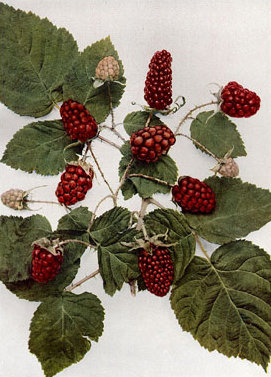
The loganberry is a cross between a blackberry and a raspberry that arose by chance in 1881 in the garden of Judge James Harvey Logan in California. It is a rambling shrub with long, flexible, usually prickly canes that you tie in to wires, just like a blackberry. In May–June it bears white flowers that bees like to visit. In July–August these are followed by elongated, dark red berries with a fresh, tart flavour, ideal for jam, pies and stewed fruit. Besides the prickly form there is a thornless selection, ‘LY 654’, which is more pleasant to pick and prune.
Light
Sun or partial shade
preferably some sun
Moisture
Normal
no wet feet
Legal basis
Sand, loam or clay
acid to neutral
Hardiness
Fully hardy
down to -20 °C
Size
2 m
tall, 3 m wide
Flowering
May–June
| Pruning months | March and August–September |
|---|---|
| Height | 2 m |
| Native to Belgium | No, planted |
| Good for bees, butterflies and birds | Yes, for bees |
| Poisonous to people and pets | Not known to be poisonous |
| Flowering | May–June |
Identify
Loganberry: how do you recognise it?
- Habit
- Rambling shrub with long, flexible canes up to 2–3 m. The canes are biennial: they grow in the first year and fruit in the second.
- Leaves
- Made up of 3–5 toothed leaflets, green, paler underneath.
- Flowers
- White flowers of 2–3 cm in small clusters in May–June.
- Fruit
- Elongated, dark red to wine-red berries of 3–4 cm. When picked, the core stays inside the fruit, as with a blackberry.
- Prickles
- Most forms have fine prickles; ‘LY 654’ is thornless.
Flowering: May–June · Harvest and fruit: July–August · Plants: March–April and October–November · Pruning: March and August–September
In your garden
Why grow it?
- Large, flavourful berries that you rarely find in the shops.
- It ripens in July–August, before most blackberries.
- The white flowers in May–June are valuable for bees.
- Trained on wires or a fence, it takes up little ground space and forms a green wall.
- Productive and robust: a well-kept plant crops for many years.
Loganberry: where does it grow best?
- Sun or partial shade; in sun the berries are sweeter.
- Humus-rich, well-drained soil: sand, loam or clay, acid to neutral.
- Evenly moist: the soil must not dry out while the fruit is forming.
- A sheltered spot, because the canes are less hardy than those of a blackberry.
- Allow 3 m of width per plant along wires or a fence.
- Light
- Sun and partial shade
- Soil type
- Sand, loam or clay
- Acidity
- Acid or neutral
- Moisture
- Normal
- Size
- 2 m tall, 3 m wide
- Hardiness
- Hardy (to -20 °C)
Goes well with
- Raspberry: Together in the fruit garden: summer raspberries ripen just before or alongside the loganberry.
- Redcurrant: Another summer crop for the same sunny to partly shaded fruit corner.
- Pot marigold: Attracts hoverflies and other beneficial insects to the fruit garden.
- Rhubarb: A fruit-corner staple with a spring harvest, well before the berries ripen.
Maintenance
Loganberry: when and how to plant it?
Plant in March–April and October–November.
- Plant in March–April or in October–November, when the soil is neither frozen nor waterlogged.
- Put up a support first: wires at about 90, 120, 150 and 180 cm between sturdy posts.
- Dig a hole 40 cm wide and mix in a few spadefuls of compost.
- Set the plant at the same depth as it was in the pot and firm it in; allow 3 m to the next plant.
- With a bare-root plant, cut the canes back to about 25 cm after planting, so it produces strong new shoots.
- Water thoroughly and mulch with compost or straw.
Care
- Watering
- In dry spells, especially from flowering to harvest, water generously at the base once a week.
- Feeding
- In March, compost or an organic soft-fruit feed around the base.
- Mulching
- A layer of compost, straw or wood chips keeps the soil moist and suppresses weeds.
- Tying in
- Tie in the new canes regularly during summer so they do not snap or get in the way.
- Harvesting
- Pick every few days in July–August, when the berries are dark red and soft. They are tarter than raspberries: delicious in jam, pies, stewed fruit or frozen for later.
- Birds
- Protect the ripening berries from birds with a net.
Tip: Keep this year’s young canes separate from the fruiting ones, for example by tying them in up the centre or along one side. After harvest you can then cut all the fruited canes to the ground without hesitation.
Loganberry: when to prune it?
Pruning months: March and August–September.
When: After harvest, in August–September. A small tidy-up follows in March.
How:
- After harvest, cut all canes that have fruited down to the ground.
- Choose 6–8 strong new canes, tie them in to the wires in a fan and remove the rest.
- During summer, train the new canes up the centre or along one side, so they stay separate from the fruiting canes.
- In March, cut back frosted or dead tips to healthy wood.
Caution: Wear strong gloves with prickly forms. Never cut out this year’s new canes: they will carry next year’s fruit.
Propagation
- Tip layering
- In July–August bend the tip of a new cane down to the ground and bury it 10–15 cm deep. By autumn it will have rooted: then cut it free and plant it in its new spot.
Loganberry: how does it get through the winter?
Hardy to −20 °C.
- Hardy to about −20 °C: no problem in a normal Belgian winter.
- In severe winters the cane tips may be frosted; cut them back in March.
- In a cold, exposed spot you can bundle the young canes together in winter and tie them low along the bottom wire. In March, tie them in again in a fan.
- Clear away rotten fruit and dead leaves before winter.
Diseases and pests
- Raspberry beetle: Small white grubs in the ripe berries. Pick regularly, remove affected fruit and lightly hoe around the plant in winter.
- Spotted wing drosophila: Soft, collapsing berries with small maggots, especially in late summer. Harvest often and completely, and remove overripe and fallen fruit.
- Grey mould: Grey, fluffy mould on the berries in wet weather. Keep the plant airy, pick off rotten fruit and water at the base.
- Birds: Blackbirds peck the ripe berries. Put a net over the wires in good time.
- Cane diseases: Purple or grey spots on the canes, which later die back. Cut out affected canes and keep the plant open.
Through the year
- March: Cut back frosted tips. Add compost. Plant.
- April: Plant. Mulch.
- May: Flowering. Tie in new canes.
- June: Flowering. Water in dry spells. Put up a net against birds.
- July: Harvest. Tip layer for new plants.
- August: Harvest. After harvest, cut out the fruited canes.
- September: Tie in the new canes in a fan.
- October: Plant. Sever and replant layered tips.
- November: Plant. In a cold spot, bundle the young canes.
Use
Edible and useful
- Fruit (July–August)
- Pick the long, dark red berries in July and August, when they are deep red and come away easily (the core stays inside, as with a blackberry). Loganberries are sharper and fuller in flavour than raspberries: wonderful in jam, crumble, a sauce for game and duck, or fresh with a little sugar.
- Storing
- Fresh, one to two days in the fridge, unwashed and in a shallow tray. Frozen spread on a tray and then bagged, they keep for a year.
Caution: Loganberries are safe. Wear gloves: the canes are thorny (thornless varieties exist too). Cut out the canes that have fruited after harvest to keep the plant healthy.
Eating and using is at your own risk: see the terms of use.
Recipes
- Loganberry jam (Jam · ± 4 jars · 30 min)
- Loganberry and apple crumble (Dish · 6 people · 50 min)
Good for wildlife
- Bees
- Nectar and pollen for honeybees and wild bees.
You and this species
Did you know?
- The loganberry arose in 1881 in Santa Cruz, California, in the garden of Judge James Harvey Logan, probably from a chance cross between a blackberry and a raspberry.
- When picked, the white core stays inside the fruit, as with a blackberry; with a raspberry it stays on the plant.
- The loganberry is considered one of the parents of the boysenberry.