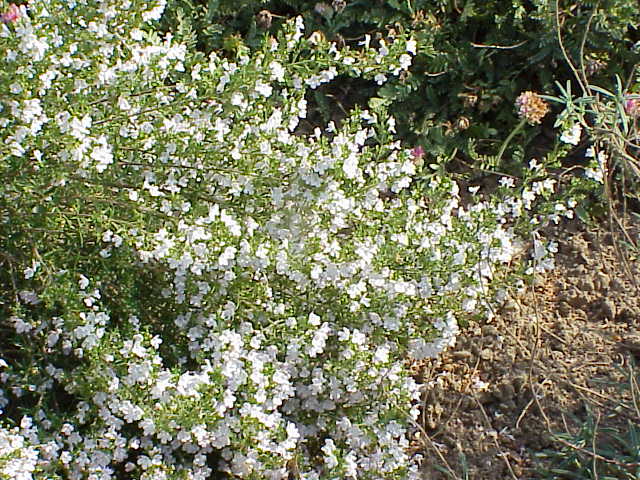
Photo: Kurt Stüber [1], CC BY-SA 3.0 · source

Herb · Lamiaceae
Summer savory
Satureja hortensis
In other languages: Bonenkruid (Nederlands) · Sarriette annuelle (Français)
Summer savory is an annual culinary herb from southern Europe and the Mediterranean, related to thyme and mint. It forms a loose, upright little bush 20–30 cm tall, with thin, branched stems and narrow, soft green leaves. From July to September tiny white, pale lilac or pink lipped flowers appear in the leaf axils, and bees love them. The leaves taste spicy and peppery, somewhere between thyme and mint, and are traditionally paired with beans. It is easy to sow, grows quickly and suits both the vegetable garden and a pot on the patio. Its perennial, hardy cousin is winter savory.
Light
Full sun
warm and bright
Moisture
Dry to normal
no wet feet
Legal basis
Sand, loam or clay
any pH
Hardiness
down to 0 °C
protect in harsh winters
Size
0.3 m
tall, 0.2 m wide
Flowering
July–September
| Pruning months | July–August |
|---|---|
| Height | 0.3 m |
| Native to Belgium | No, planted |
| Good for bees, butterflies and birds | Yes, for bees |
| Poisonous to people and pets | Not known to be poisonous |
| Flowering | July–September |
Identify
Summer savory: how do you recognise it?
- Habit
- Annual, loose and upright, 20–30 cm tall and 20 cm wide, with thin, branched, slightly hairy stems that become a little woody at the base.
- Leaves
- Narrow and lance-shaped, 1–3 cm long, opposite, soft green to grey-green.
- Flowers
- Small lipped flowers in the leaf axils, white, pale lilac or pink, from July to September.
- Scent and flavour
- Strongly aromatic and peppery; milder and slightly sweeter than winter savory.
- Roots
- Fine and shallow: in a pot it dries out quickly.
Flowering: July–September · Harvest and fruit: June–September · Sowing: March–May · Plants: May · Pruning: July–August
In your garden
Why grow it?
- Adds flavour to beans, peas, lentils, stews and marinades.
- Grows quickly from seed: you can start harvesting about two months after sowing.
- The small flowers attract plenty of bees in late summer.
- Small and compact: fits in a pot, a balcony box or between vegetables.
- Easy to dry, so you have your own savory in winter too.
- The leaves release a pleasant herby scent when you brush past.
Summer savory: where does it grow best?
- Full sun: that is where the flavour is strongest.
- Light, well-drained soil: sand, loam or clay, acid to chalky. Rather lean than too rich.
- Dry to moderately moist; it cannot stand waterlogging.
- Sow or plant 15–20 cm apart, in rows 25–30 cm apart.
- In a pot or trough at least 20 cm deep, with herb compost and a little gravel at the bottom.
- Light
- Sun
- Soil type
- Sand, loam or clay
- Acidity
- Not fussy
- Moisture
- Dry or normal
- Size
- 0.3 m tall, 0.2 m wide
- Hardiness
- Frost tender: overwinter indoors (above 0 °C)
Goes well with
- French bean: Traditionally sown next to beans, and their regular partner in the kitchen.
- Thyme: The same sunny, dry spot in the herb garden.
- Marjoram: A related herb with the same needs, for a Mediterranean herb corner.
- Basil: Another warmth-loving annual herb for a pot on the patio.
- Pot marigold: Cheerful orange flowers among the vegetables, also loved by bees.
Maintenance
Summer savory: when and how to plant it?
Plant in May.
- Sow outdoors where it is to grow in May, once the soil has warmed up and frosts are over.
- Scatter the seed thinly in a shallow drill and barely cover it: savory needs light to germinate.
- Alternatively, sow indoors in March–April in small pots at 15–20 °C and plant out in May, after the last frost.
- Thin the seedlings or plant 15–20 cm apart.
- Keep the soil lightly moist until germination, ideally with a mister so the seed is not washed away.
- Keep the row weed-free until the plants are big enough; mulching is not needed.
Care
- Watering
- Moderate: only during long dry spells and in pots. Better too dry than too wet.
- Feeding
- Not needed in open ground; in a pot, a little organic fertiliser once in June.
- Harvesting
- From June, snip the tips once the plant is 15 cm tall. The leaves have the best flavour just before flowering.
- Drying
- Just before flowering, cut stems, tie them in bunches and hang them upside down in an airy, shady place. Strip off the dry leaves and store them in a closed jar.
- In the kitchen
- Cook a sprig with beans, peas or lentils, or use it in stews, soups and marinades. It is also part of many herbes de Provence mixes.
Tip: In July, cut the stems just before flowering and dry them in bunches: you will have savory all year round, and the plant will regrow once more.
Summer savory: when to prune it?
Pruning months: July–August.
When: This annual herb needs no real pruning. Regular harvesting in July–August keeps the plant compact and bushy.
How:
- Pinch out the tips regularly, just above a pair of leaves: this makes the plant branch.
- Just before flowering, cut half the stems for drying; the plant will then regrow.
- Let a few plants flower for the bees and for your own seed.
- Pull the plants up after the first frost and put them on the compost heap.
Propagation
- Seed
- Sow again every year, indoors in March–April or outdoors in May. Use fresh seed if possible: old seed germinates less well.
- Saving seed
- Let a few plants flower and cut the stems once the seeds are brown. Let them finish drying in a paper bag and sow them the following spring. It sometimes self-seeds too.
Summer savory: how does it get through the winter?
Hardy to 0 °C: protect in harsh winters.
- Summer savory is an annual and cannot take frost: at 0 °C the plant dies.
- Dry enough leaves in summer for the winter; dried, they keep their flavour well.
- If you want fresh leaves in winter too, grow perennial winter savory, which is hardy.
Diseases and pests
- Damping off: Seedlings collapse at the base and fall over. Sow thinly in clean seed compost and do not overwater.
- Slow growth: In cold, wet soil it barely grows. Do not sow until May, in a warm, sunny spot.
- Aphids: On the tips of young plants. Hose them off, or pinch out the tips and use them.
- Soft, bland leaves: Too much shade, water or fertiliser. Move it somewhere sunnier and give it less.
- Slugs: Can eat young seedlings. Pick them off in the evening or sow indoors first.
Through the year
- March: Sow indoors in small pots, in good light.
- April: Sow indoors. Prick out seedlings.
- May: Sow outdoors where it is to grow. Plant out indoor-raised plants after the last frost.
- June: Thin out. First harvest of tips.
- July: Harvest. Just before flowering, cut stems for drying.
- August: Flowering. Harvest and dry. Let a few plants flower for the bees.
- September: Last harvest. Collect seed.
- October: Clear the plants after the first frost.
Use
Edible and useful
- Leaves (June–September)
- Cut the stems from June to September, ideally just before flowering when the flavour is strongest; you can cut the plant two or three times. Summer savory tastes peppery, a little like thyme. The classic is runner beans or broad beans with savory, with a sprig cooked along with them. Also good in pea soup, lentils, stews and herb vinegar.
- Storing
- Savory dries well: hang the stems in small bunches upside down somewhere airy and dark and strip off the leaves once dry. They keep for a year in a closed jar. Fresh sprigs keep for a few days in the fridge, wrapped in a damp cloth.
Caution: As a kitchen herb, savory is safe. The essential oil is strong: never swallow it or put it on your skin. During pregnancy do not drink large amounts of savory tea. Summer savory is an annual: sow it again every year, outdoors from mid-May.
Eating and using is at your own risk: see the terms of use.
Recipes
- Runner beans with savory and bacon (Dish · 4 people · 30 min)
- Savory herb vinegar (Vinegar · ± 500 ml · 10 min + 3 weeks steeping)
Good for wildlife
- Bees
- Nectar and pollen for honeybees and wild bees.
You and this species
Did you know?
- In German it is called Bohnenkraut, literally bean herb: in many countries it has gone with beans for centuries.
- In Bulgaria, savory is a key ingredient of the spice mix sharena sol, which sits on the table the way salt and pepper do here.
- Its relative, winter savory, is an evergreen perennial that forms a low, woody shrub and lasts for many years.