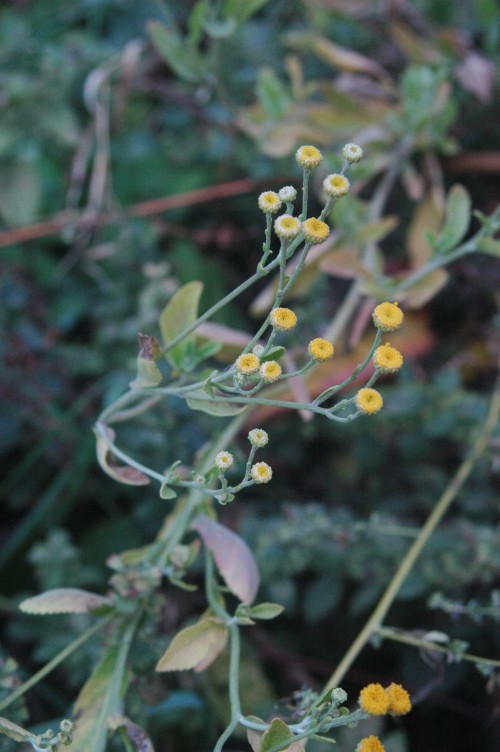
Photo: Stanislav Doronenko, CC BY 2.5 · source

Herb · Asteraceae
Costmary
Tanacetum balsamita
In other languages: Balsemwormkruid (Nederlands) · Menthe-coq (Français)
Costmary (Tanacetum balsamita) is an old monastery herb from western Asia that has grown in European gardens for centuries. It forms a clump of grey-green, oblong, toothed leaves that smell of mint and balsam. In August–September small yellow, button-like flower heads appear, although here it sometimes flowers sparingly. In the past the leaves were used as a bookmark in the Bible. It is a sturdy, modest perennial for a sunny herb garden and stays in the same spot for years.
Caution: It keeps spreading by rhizomes. Cut away runners in time or limit the roots with a barrier.
Light
Full sun
warm and bright
Moisture
Normal
no wet feet
Legal basis
Sand, loam or clay
any pH
Hardiness
Fully hardy
down to -25 °C
Size
0.8 m
tall, 0.5 m wide
Flowering
August–September
| Pruning months | March |
|---|---|
| Height | 0.8 m |
| Native to Belgium | No, planted |
| Poisonous to people and pets | Not known to be poisonous |
| Flowering | August–September |
Identify
Costmary: how do you recognise it?
- Habit
- Herbaceous perennial 0.8–1 m tall and 50 cm wide, with upright, leafy stems.
- Leaves
- Grey-green, oblong, 10–20 cm, with a toothed edge; the lower leaves have a stalk, the upper ones sit directly on the stem.
- Flower
- Small yellow, button-like flower heads in loose clusters, in August–September.
- Scent
- Strong and fresh, somewhere between mint and balsam.
- Roots
- Creeping rhizomes that let the plant spread slowly.
Flowering: August–September · Harvest and fruit: May–September · Plants: April–May and September · Pruning: March
In your garden
Why grow it?
- Aromatic leaves with a fresh scent of mint and balsam, which you can pick all season.
- A tough, almost indestructible perennial that needs little care.
- A historic herb with a good story, ideal for a monastery-style garden or herb border.
- The small yellow button flowers in late summer attract insects.
- Use the leaves sparingly in the kitchen, for tea or in a scented sachet.
Costmary: where does it grow best?
- Sun is ideal; it also grows in light partial shade, but a little floppier.
- Ordinary garden soil: sand, loam or clay, neutral to chalky.
- Normally moist to slightly dry; in heavy, wet soil it suffers in winter.
- Allow 40–50 cm between plants: they spread slowly.
- Light
- Sun
- Soil type
- Sand, loam or clay
- Acidity
- Not fussy
- Moisture
- Normal
- Size
- 0.8 m tall, 0.5 m wide
- Hardiness
- Hardy (to -25 °C)
Goes well with
- Sage: Grey-green leaves next to the grey-green costmary, in the same sunny spot.
- Lavender: A Mediterranean scent alongside, and the same dry sun.
- Purple coneflower: Large pink flowers as a contrast to the small yellow buttons.
- Oregano: A herb corner that thrives in the same soil and attracts bees.
Maintenance
Costmary: when and how to plant it?
Plant in April–May and September.
- Plant in April–May or in September, when the soil is neither frozen nor too wet.
- Dig a hole at least twice as wide as the root ball.
- Set the plant at the same depth as in its pot and firm the soil.
- Keep 40–50 cm between plants.
- Water thoroughly straight away.
Care
- Water
- Weekly in dry weather in the first year. After that it usually looks after itself; water only in long dry spells.
- Feeding
- Little needed: a spadeful of compost in spring is enough.
- Spread
- Keep an eye on it: it spreads by rhizomes. Cut away runners that wander too far.
- Harvesting
- Pick young leaves from May, as long as the plant keeps growing. Fresh leaves have the strongest flavour.
- Dividing
- Divide the clump every 3–4 years to keep it vigorous.
Tip: Plant it with a root barrier or in a bottomless bucket if you want to keep the rhizomes under control. Use the leaves sparingly: the flavour is strong.
Costmary: when to prune it?
Pruning months: March.
When: Late February to March, before new shoots start to grow.
How:
- Cut last year’s dead stems down to just above the ground.
- Remove faded flower stems during the season if you want a neat clump.
- Take out old, woody or dead parts at the base and cut away runners that stray too far.
Propagation
- Division
- In March–April or September, lift the clump and split it into pieces with roots and shoots. Replant straight away and water.
- Runners
- In spring, cut a rooted piece from the edge of the clump and plant it elsewhere. Here it rarely sets seed, so division is the best method.
Costmary: how does it get through the winter?
Hardy to −25 °C.
- Hardy down to about −25 °C: no protection is needed in Belgium.
- The top growth dies back in winter; the plant shoots again in spring.
- In a pot: put the pot in a sheltered spot and do not keep the soil too wet.
Diseases and pests
- Powdery mildew: White powder on the leaves, especially in dry weather with little air. Give more space and cut away affected leaves.
- Aphids: On young shoots in May–June. Rinse off with water or let ladybirds do their work.
- Flopping: In rich soil or partial shade it grows tall and floppy. Plant it in more sun or cut the stems back in June.
- Spreading: The rhizomes creep away. Cut them back in time or plant it in a pot or with a root barrier.
Through the year
- March: Cut dead stems back. Dividing and replanting is also possible.
- April: Plant or divide. Add compost.
- May: Plant. Pick young leaves.
- June: Harvest. Watch for aphids.
- July: Harvest. Water in long dry spells.
- August: Flowering begins. Cut some flowers if you like.
- September: Flowering. Plant or divide in autumn.
- October: Last chance to plant. Leave dead stems standing.
Use
Edible and useful
- Leaves (May–September)
- Pick the young leaves from May to September, as long as the plant is growing; they are strongest when fresh. They smell of mint and balsam, with a hint of lemon, and taste strong and somewhat bitter: one or two leaves are enough. It was once used to flavour ale, hence its other English name, alecost. Use a chopped leaf in a salad, a soup or a stuffing for poultry, for tea, or to scent a cake.
- Storing
- Dry the leaves loose on a rack somewhere airy and dark and keep them in a closed jar for up to a year. Dried leaves keep their balsam scent for a long time and are lovely in a scented sachet or, as in the old days, as a bookmark.
Caution: Use costmary sparingly, as a herb: it is related to tansy and contains strongly scented substances that are not healthy in large amounts. Not during pregnancy or breastfeeding. People allergic to the daisy family may react to it. Do not confuse it with tansy (Tanacetum vulgare), which is poisonous: tansy has deeply cut, fern-like leaves, costmary long, undivided leaves with a toothed edge.
Eating and using is at your own risk: see the terms of use.
Recipes
- Costmary tea (Tea · 1 cup · 10 min)
- Costmary cake (Dish · 1 loaf cake (± 10 slices) · 1 hr 15)
You and this species
Did you know?
- According to tradition, the leaf was used as a bookmark in the Bible: its scent was said to keep readers awake during long services. That is why it is also called bible leaf.
- The name costmary combines costus (an eastern spice) with Mary; in the Middle Ages the herb was dedicated to the Virgin Mary.
- It was used to flavour beer, hence the name alecost.