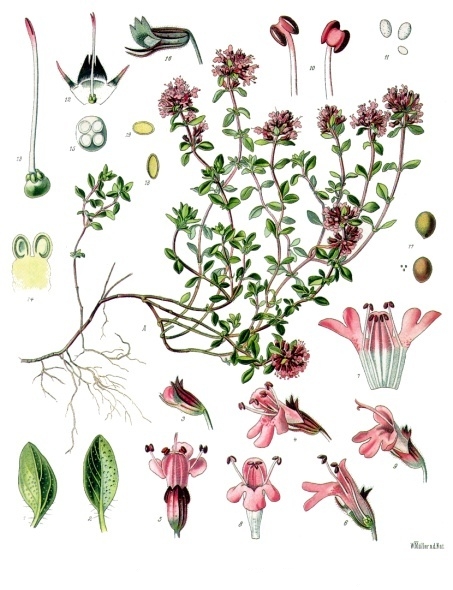
Photo: Walther Otto Müller, Public domain · source

Herb · Lamiaceae
Breckland thyme
Thymus serpyllum
In other languages: Kleine tijm (Nederlands) · Serpolet (Français)
Breckland thyme (Thymus serpyllum), also called wild thyme, is a native, creeping sub-shrub that grows naturally on dry sandy soil, on heathland and in dunes. It forms a low, evergreen carpet barely 10 cm tall, with tiny leaves and pinkish-purple flowers in June–August. The whole plant is aromatic, especially when trodden on. It is ideal for a sunny, poor spot, in a rock garden or between paving slabs and stepping stones. Use the leaves as you would common thyme.
Light
Full sun
warm and bright
Moisture
Dry
tolerates drought
Legal basis
Sand or loam
acid to neutral
Hardiness
Fully hardy
down to -25 °C
Size
0.1 m
tall, 0.4 m wide
Flowering
June–August
| Pruning months | April and August |
|---|---|
| Height | 0.1 m |
| Native to Belgium | Yes |
| Good for bees, butterflies and birds | Yes, for bees and butterflies |
| Poisonous to people and pets | Not known to be poisonous |
| Flowering | June–August |
Identify
Breckland thyme: how do you recognise it?
- Habit
- Creeping, flat mat 5–10 cm tall and 30–40 cm wide, with woody, trailing stems.
- Leaves
- Very small, oval to elliptic, 3–8 mm, evergreen; with an aromatic scent.
- Flower
- Small pinkish-purple flowers in round heads, from June to August.
- Stem
- Round and hairy all round, trailing and rooting; that sets it apart from broad-leaved thyme.
- Roots
- The trailing stems root into the ground, so the mat grows slowly outwards.
Flowering: June–August · Harvest and fruit: May–September · Sowing: March–April · Plants: April–May and September · Pruning: April and August
In your garden
Why grow it?
- A native ground cover for sunny, poor spots where little else will grow.
- From June to August, a carpet of pinkish-purple flowers that attracts bees and butterflies.
- Evergreen and fragrant: a pleasant plant along paths and seating areas.
- Drought tolerant and undemanding.
- The leaves are edible and can be used like common thyme, fresh or dried.
Breckland thyme: where does it grow best?
- Full sun in a warm, open spot.
- Dry, lean, well-drained soil: sand or loam, acid to neutral.
- Dry: heavy, wet soil is its worst enemy, especially in winter.
- Plant 25–30 cm apart: the mat closes up within two to three years.
- Light
- Sun
- Soil type
- Sand or loam
- Acidity
- Acid or neutral
- Moisture
- Dry
- Size
- 0.1 m tall, 0.4 m wide
- Hardiness
- Hardy (to -25 °C)
Goes well with
- Fescue: A fine grey-green grass that, like thyme, loves dry sandy soil.
- Stonecrop: The same sun and drought, with fleshy leaves beside the fine thyme carpet.
- Heather: A natural neighbour on acid, sandy soil.
- Maiden pink: Small pink flowers in the same poor, sunny soil.
Maintenance
Breckland thyme: when and how to plant it?
Plant in April–May and September.
- Sow indoors in March–April: scatter the seeds on seed compost, press them in and barely cover them, at 15–20 °C.
- Prick out the seedlings and gradually harden them off to the open air in May.
- Plant in April–May or in September, 25–30 cm apart.
- Mix heavy soil with sand or fine grit for extra drainage.
- Set the plant at the same depth as in its pot and water.
Care
- Water
- In the first year give a good soak now and then in dry weather. After that it looks after itself.
- Feeding
- Not needed: poor soil gives a compact, highly aromatic mat.
- Weeding
- In the first years, pull grass and weeds out of the mat by hand.
- Mulching
- A thin layer of sand or fine gravel keeps the foliage dry and prevents rot in wet winters.
- Harvesting
- Snip tips and small leaves from June; they are most fragrant just before flowering. Use them fresh or dry them.
Tip: Plant it in the joints between paving slabs or stepping stones: it tolerates treading and every step releases its scent. A thin layer of sand or gravel around the plants helps it through wet winters.
Breckland thyme: when to prune it?
Pruning months: April and August.
When: Light pruning in April and a trim after flowering, in August.
How:
- In April, remove dead, brown tips and clear fallen leaves from the mat.
- After flowering, in August, lightly trim off the faded flower heads to keep the mat dense.
- Never cut into old, bare wood.
Caution: Do not prune too late in autumn: new shoots may then be killed by frost.
Propagation
- Seed
- In March–April, scatter the seeds indoors on seed compost and barely cover them, at 15–20 °C. Germination takes about 2–3 weeks.
- Division
- In spring or September, cut a rooted piece from the edge of the mat and plant it elsewhere.
Breckland thyme: how does it get through the winter?
Hardy to −25 °C.
- Fully hardy to about −25 °C: even in a hard winter you need not protect it.
- Wet soil is more dangerous than frost: ensure drainage, with sand or grit if necessary.
- In a pot or trough: keep it sheltered from rain so the roots do not rot.
Diseases and pests
- Root rot: Brown, dying patches after wet winters. Ensure drainage and cut away affected parts.
- Bare patches: In the centre of older mats or in shade. Trim lightly after flowering and plant new pieces in the gaps.
- Grass and weeds: They smother the mat. Weed by hand in the first years.
- Long, thin shoots: Too little sun or too much feed. Move it to a sunnier spot and do not feed.
Through the year
- March: Sow indoors at 15–20 °C.
- April: Light spring trim. Sow and plant.
- May: Plant. Weed.
- June: Flowering begins. Harvest tips for the kitchen.
- July: Flowering: bees and butterflies visit.
- August: Trim lightly after flowering.
- September: Plant or divide.
Use
Edible and useful
- Flowers (June–July)
- Pick the little flowers in June and July, when the plant is in full bloom, on a dry morning. Snip off the flowering tops and strip the flowers loose with your fingers, or use the small tops as they are. You can use them in syrup, tea or as an edible decoration on salad and goat’s cheese. Be sure to leave plenty of flowers for the bees and bumblebees.
- Leaves (May–September)
- Snip the sprigs with scissors or a knife on a dry morning, once the dew has gone. The flavour is strongest just before and during flowering, but you can harvest from May to September. Never cut more than a third of the plant at once and do not cut into old, bare wood, because the plant struggles to regrow from it. Strip the leaves from the stalks with your fingers, from top to bottom. In soups and stews you can also cook whole sprigs and take them out at the end.
- Storing
- Fresh thyme keeps for a week in the fridge, wrapped in a damp cloth or in an open bag. You can freeze sprigs loose in a bag, or chopped leaves in ice cubes with olive oil; that keeps for up to 6 months. Dried thyme keeps for up to a year in a tightly closed jar, dry and dark. Syrup keeps for six months in sterilised bottles.
Caution: Thyme is safe as a culinary herb in ordinary amounts. Never swallow the concentrated essential oil or thymol, and do not use strong extracts as food. People who are allergic to the mint family (such as mint, sage, oregano and lavender) may react to thyme too. If you have doubts, for example during pregnancy, while breastfeeding or when taking medication, ask your doctor or pharmacist before drinking thyme tea every day. Wild thyme (breckland thyme or creeping thyme) grows on protected dunes and heath and is rare: do not pick it in nature areas, but harvest from garden plants. Plants bought at a garden centre may have been treated: let them grow for a few weeks and wash the sprigs well. Do not pick beside busy roads or where dogs go, use only plants that clearly smell of thyme, and never eat anything you have not identified with certainty.
Eating and using is at your own risk: see the terms of use.
Recipes
- Thyme and lemon syrup (Syrup · ± 600 ml · 20 min + 1 hour steeping)
- Fresh thyme tea (Tea · 2 cups · 10 min)
- Dried thyme (Dried · ± 25 g dried leaves · 15 min + 1–2 weeks drying)
- Roast potatoes with thyme and garlic (Dish · serves 4 · 55 min)
Good for wildlife
- Bees
- Nectar and pollen for honeybees and wild bees.
- Butterflies
- Nectar for butterflies.
You and this species
Did you know?
- The species name serpyllum refers to its creeping habit.
- In French it is called serpolet, and it is used in the kitchen as a wild thyme.
- In the wild it grows on dry sandy soil, on heathland and in dunes.