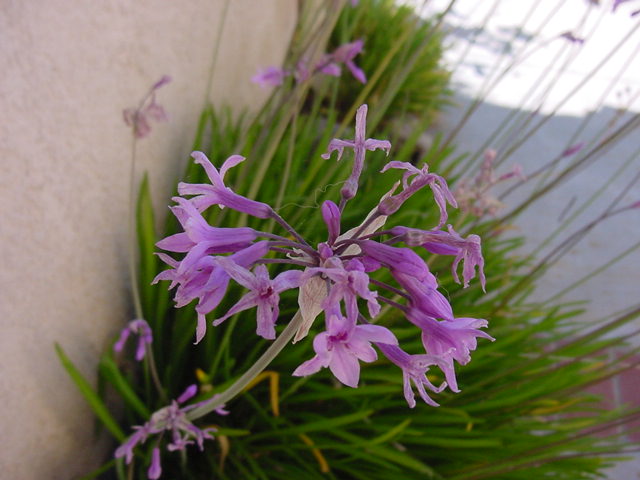
Photo: No machine-readable author provided. CatherineMunro assumed (based on copyright claims)., CC BY-SA 3.0 · source

Bulb or tuber · Amaryllidaceae
Society garlic
Tulbaghia violacea
In other languages: Tulbaghia (Nederlands) · Tulbaghia (Français)
Tulbaghia violacea comes from South Africa, where it grows in grasslands and on rocky slopes. It is a clump-forming plant with narrow, grey-green leaves and upright stems of about 50 cm carrying umbels of small, star-shaped lilac flowers. It flowers from June to September. The leaves and flowers smell and taste of garlic, especially when bruised, and are used as a herb. A well-known form is ‘Silver Lace’, with white-edged leaves. It loves sun and dryness and is a fine choice for a pot or a sunny, sheltered spot in the border.
Caution: Leaves and flowers smell and taste of garlic; use them sparingly as a herb. Like other plants in the garlic family they are not suitable for dogs and cats: do not let them nibble on them.
Light
Full sun
warm and bright
Moisture
Dry to normal
no wet feet
Legal basis
Sand or loam
neutral to chalky
Hardiness
down to -8 °C
protect in harsh winters
Size
0.5 m
tall, 0.3 m wide
Flowering
June–September
| Pruning months | April |
|---|---|
| Height | 0.5 m |
| Native to Belgium | No, planted |
| Good for bees, butterflies and birds | Yes, for bees |
| Poisonous to people and pets | Not known to be poisonous |
| Flowering | June–September |
Identify
Society garlic: how do you recognise it?
- Habit
- Clump-forming plant about 50 cm tall and 30 cm wide, with fleshy roots.
- Leaves
- Narrow, strap-like, grey-green, 20–40 cm long. They smell of garlic when bruised.
- Flower
- Umbels of 8–20 star-shaped lilac flowers on slender stems, from June to September.
- Scent and taste
- Leaves and flowers smell and taste of garlic; the flowers are milder than the leaves.
- Roots
- Fleshy, rhizome-like roots that form a larger clump year after year.
Flowering: June–September · Harvest and fruit: May–September · Plants: April–May · Pruning: April
In your garden
Why grow it?
- Flowers for a full four months, from June to September, with lilac umbels.
- The leaves and flowers are edible: they taste of garlic and are delicious in a salad.
- Drought tolerant: a good choice for a sunny, dry spot or a pot on the patio.
- A summer source of nectar for bees and bumblebees.
- Compact and easy, also for a small garden or a balcony.
Society garlic: where does it grow best?
- Full sun in a warm, sheltered spot, for example against a south-facing wall or on the patio.
- Well-drained loam or sandy soil, neutral to chalky. In a pot: compost with some sand.
- Dry to normally moist; in winter the soil must not stay wet.
- Leave 25–30 cm between plants; a 25–30 cm pot takes one plant.
- Light
- Sun
- Soil type
- Sand or loam
- Acidity
- Neutral or chalky
- Moisture
- Dry or normal
- Size
- 0.5 m tall, 0.3 m wide
- Hardiness
- Half hardy (to -8 °C): protect it in harsh winters
Goes well with
- Lavender: The same sun and dryness; purple shades that go well together.
- Coneflower: Large flowers in the same weeks and in the same sunny soil.
- Verbena bonariensis: Tall, airy purple flowers give the border depth.
- Ornamental grasses: Fine grasses such as feather grass give a light, soft backdrop.
Maintenance
Society garlic: when and how to plant it?
Plant in April–May.
- Plant in April or May, when no more frost is expected.
- Choose a sunny spot with free-draining soil; on heavy soil mix sand into the planting hole.
- Plant at the same depth as in the pot, with the crown just below the soil surface.
- Space the plants 25–30 cm apart and water generously after planting.
- In a pot: use a pot with drainage holes and sandy compost; it flowers best in a pot that is not too large.
Care
- Water
- Little needed once established. In a pot, water when the top layer is dry, and in a dry summer also in the border.
- Feeding
- Not much needed. In a pot, in summer, a light feed of fertiliser for flowering plants every four weeks.
- Spent flowers
- Cut off spent stems: it gives new flowers and a tidy plant.
- Harvesting
- Snip off the outer leaves and the flowers as you would chives, from May to September.
- Mulching
- A layer of bark or leaf mulch around the base keeps the soil moist and protects the roots in winter.
Tip: Overwinter it in a pot in a frost-free place, or under a thick layer of mulch against a south-facing wall. Snip leaves and flowers like chives for a mild garlic flavour in salads and herb butter.
Society garlic: when to prune it?
Pruning months: April.
When: In April: cut off the frost-damaged and dead leaves before the new growth starts.
How:
- Cut brown or dead leaves off at the base in April.
- Cut off spent flower stems in summer for more flowers.
- Keep the green leaves: they are also what you harvest as a herb.
Caution: Do not prune too early in spring: the leaves protect the heart of the plant from late frost.
Propagation
- Division
- Divide the clump in April–May, every 3–4 years. Cut off a piece with roots and leaves and replant it straight away.
- Seed
- Sow in March or April indoors at 18–20 °C. Plant the young plants out after mid-May; they often flower in the first or second year.
Society garlic: how does it get through the winter?
Hardy to −8 °C: protect in harsh winters.
- Tolerates about −8 °C: in Belgium that is right on the limit, so extra protection is wise.
- In the border: choose a sheltered spot against a south-facing wall and lay a thick 10 cm layer of leaf or bark mulch in November.
- In a pot: stand it in a bright, frost-free place (5–10 °C) in winter and water only very little.
Diseases and pests
- Frost damage: The leaves turn brown after severe frost. Cut them off in April; the plant usually regrows from the roots.
- Root rot: The plant fades away in wet, cold soil. Plant in free-draining soil and avoid water in winter.
- Slugs: They nibble young shoots in spring. Pick them off in the evening.
- Few flowers: Too little sun or too much nitrogen. Choose a sunny spot and feed sparingly.
Through the year
- March: Check overwintered plants.
- April: Cut off dead leaves. Plant or divide.
- May: Put outdoors after mid-May. First leaves to harvest.
- June: Flowering begins. Harvest leaves and flowers.
- July: Full flower. Cut off spent stems.
- August: Flowering. Water in dry spells.
- September: Last flowers. Stop feeding.
- October: Apply mulch or bring the pot indoors.
- November: Lay a thick layer of mulch against frost.
- December: Rest. Keep the pot dry and frost-free.
Use
Edible and useful
- Flowers (June–September)
- Pick the little lilac, star-shaped flowers from June to September. They taste of garlic, but milder and slightly sweet. Pull the florets off the flower head and scatter them over a salad, soup, potatoes, an omelette or bread with soft cheese: they add colour and a gentle garlic flavour.
- Leaves (May–September)
- Cut the leaves from May to September as you would chives: a few outer leaves at a time, a hand’s breadth above the ground, and never the whole clump at once. The narrow, grey-green leaves only smell of garlic when you crush or cut them, and taste stronger than the flowers. Chop them finely and use them raw, or add them to a hot dish only at the end, like chives or wild garlic.
- Storing
- Leaves and flowers are best fresh. In a glass with a little water or in a bag in the fridge they keep for two to three days. Chopped leaves can be frozen in ice cubes with a little water or oil, or made into herb butter. Drying is not worth it: they lose their flavour.
Caution: Use society garlic in moderation, as a herb rather than a vegetable, as you would garlic. Like other garlic-flavoured plants, it is not suitable for dogs and cats: do not let them eat it and do not give them leftovers. On a plant from a garden centre, only eat the new leaves that have grown at home, as ornamental plants are sometimes treated with products not approved for food.
Eating and using is at your own risk: see the terms of use.
Recipes
- Society garlic herb butter (Dish · ± 150 g · 15 min + 1 hr chilling)
- Potato salad with society garlic (Dish · 4 people · 30 min)
Good for wildlife
- Bees
- Nectar and pollen for honeybees and wild bees.
You and this species
Did you know?
- The genus is named after Rijk Tulbagh, governor of the Cape Colony in the 18th century, who served the Dutch East India Company.
- The leaves only smell of garlic when you bruise or cut them.
- It is not true garlic, but it is a distant relative: both belong to the same subfamily within the daffodil family.