Side by side
Redcurrant or blackcurrant? How to tell them apart
Ribes rubrum · Ribes nigrum
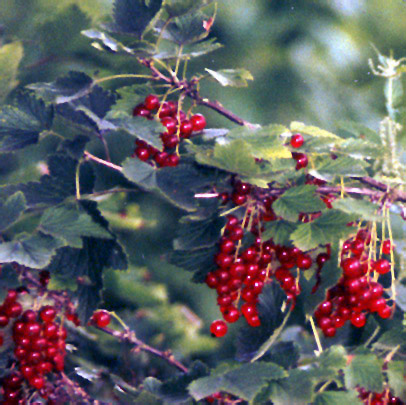
You can tell a redcurrant by its odourless leaves and its strings of glossy red or white berries; a blackcurrant has leaves dotted with yellow glands that smell strongly when crushed, and black berries.
Rub a leaf and smell your fingers: a strong, spicy blackcurrant smell means blackcurrant, no smell means redcurrant. Without fruit, that is the quickest test.


| Redcurrant | Blackcurrant | |
|---|---|---|
| Leaves | Alternate, 3–5-lobed, 4–8 cm, toothed; odourless. | Alternate, 3–5-lobed, toothed, 5–10 cm; yellow glands underneath that smell strongly when crushed. |
| Flowering | Hanging strings of small greenish-yellow flowers in April (April). | Hanging strings of small greenish-red flowers in April (April–May). |
| Fruit | Strings of glossy red or white berries in June–July. | Black berries (blackcurrants) in July. |
| Bark | Greyish-brown and smooth. | Light brown and smooth. |
| Shape and height | Shrub, 1–1.5 m | Shrub, 1–2 m |
| Site | Sun or partial shade, any garden soil, normal | Sun or partial shade, any garden soil, moist to wet |
| Native to Belgium | Yes | Yes |
| Good for bees, butterflies and birds | Yes, for bees and birds | Yes, for bees and birds |
| Poisonous to people and pets | Not known to be poisonous | Not known to be poisonous |
| Pruning months | July and November–February | August and November–February |
The best feature in each season
- Spring
- Both flower in April with hanging strings of small flowers: greenish yellow on the redcurrant, greenish red on the blackcurrant. Bees like to visit them.
- Summer
- The redcurrant is laden with glossy red or white strings in June–July; the blackcurrant bears its black berries in July.
- Autumn
- The leaves of both have three to five toothed lobes, those of the blackcurrant slightly larger. Smell them: the scent remains the best feature.
- Winter
- Both are thornless shrubs. The redcurrant has smooth, greyish-brown branches, the blackcurrant light brown ones; the buds and twigs of the blackcurrant smell of blackcurrant too.
Where do they grow?
Both are native and grow in damp woods and along streams, but you know them mainly from the kitchen garden and the fruit garden. The blackcurrant likes moist soil.
Which one for your garden?
- Both are easy fruit bushes for a small garden, good for bees and birds. Protect the ripe berries with a net, or share them with the blackbirds.
- Do not plant them close to a Weymouth pine or another five-needled pine: they are alternate hosts of white pine blister rust, a fungus that seriously damages those pines.
Did you know? In French the blackcurrant is cassis: it gives its name to crème de cassis, the famous liqueur from Burgundy.
Read on
- Plant profile: Redcurrant
- Plant profile: Blackcurrant
- Redcurrant: when and how to prune
- Blackcurrant: when and how to prune
- Identification key: the question that separates them
Also looks like
- Redcurrant or gooseberry
- Redcurrant or mountain currant
- Jostaberry or blackcurrant
- Flowering currant or blackcurrant