Side by side
Redcurrant or gooseberry? How to tell them apart
Ribes rubrum · Ribes uva-crispa
You can tell a redcurrant by its thornless branches and its berries in hanging strings; a gooseberry has 1–3 spines under each bud and bears large, single berries.
Feel the branches: the gooseberry prickles, with spines under each bud, the redcurrant does not. Then look at the berries: small, glossy red or white berries in long strings on the redcurrant; large green, yellow or red berries, smooth or hairy, single or a few together on the gooseberry. The leaf has 3–5 lobes on both, but is smaller and rounder on the gooseberry.
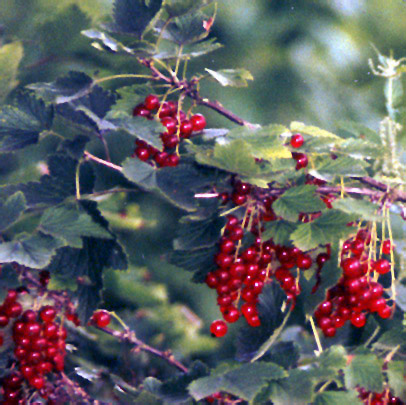


| Redcurrant | Gooseberry | |
|---|---|---|
| Leaves | Alternate, 3–5-lobed, 4–8 cm, toothed; odourless. | Alternate or in clusters, rounded, 3–5-lobed, 2–5 cm. |
| Flowering | Hanging strings of small greenish-yellow flowers in April (April). | Small, hanging, greenish-red flowers in April (April). |
| Fruit | Strings of glossy red or white berries in June–July. | Large green, yellow or red berries, smooth or hairy (July). |
| Bark | Greyish-brown and smooth. | Stems with 1–3 spines below each bud. |
| Shape and height | Shrub, 1–1.5 m | Shrub, 0.5–1.5 m |
| Site | Sun or partial shade, any garden soil, normal | Sun or partial shade, any garden soil, normal |
| Native to Belgium | Yes | Yes |
| Good for bees, butterflies and birds | Yes, for bees and birds | Yes, for bees, butterflies and birds |
| Poisonous to people and pets | Not known to be poisonous | Not known to be poisonous |
| Pruning months | July and November–February | July–August and November–February |
The best feature in each season
- Spring
- Both flower in April. The redcurrant has hanging strings of greenish-yellow flowers, the gooseberry small reddish-green flowers, single or a few together.
- Summer
- The redcurrant ripens in June–July with strings of glossy red or white berries; the gooseberry in July with large berries to eat straight from the bush or use in tarts and jam.
- Autumn
- After the harvest the leaf helps: 4–8 cm and toothed on the redcurrant, smaller (2–5 cm), round and often in tufts on the gooseberry.
- Winter
- Without leaves the spines are the surest feature: the gooseberry has them under each bud, the redcurrant has smooth, grey-brown branches. Winter is also when you prune both.
Where do they grow?
Both are native: the gooseberry grows naturally in our woods and hedgerows too, and the redcurrant is a kitchen-garden classic. They grow in sun and partial shade, in almost any good soil.
Which one for your garden?
- Both fit a small garden, as a bush, a standard or a cordon along a wire or wall. The redcurrant is easier to pick; keep the gooseberry open, which limits mildew and makes picking between the spines more pleasant.
- Redcurrants are an alternate host of white pine blister rust: do not plant them right next to a Weymouth pine. In April, bees and bumblebees visit the flowers of both.
Did you know? Red, white and pink currants all belong to the same species: only the colour of the berry differs.
Read on
- Plant profile: Redcurrant
- Plant profile: Gooseberry
- Redcurrant: when and how to prune
- Gooseberry: when and how to prune
- Identification key: the question that separates them