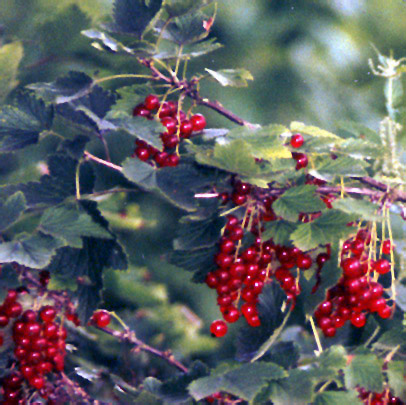
Photo: Agnieszka Kwiecień (Nova); Phptpshoped by H20, CC BY-SA 3.0 · source

Shrub · Currant family (Grossulariaceae)
Redcurrant
Ribes rubrum · also: Red currant, White currant
The redcurrant is a spineless currant bush of 1–1.5 m and a kitchen-garden classic. In April it hangs with strings of small greenish-yellow flowers, in June–July with glossy red or white berries, like jewellery on the branches. It is native, fully hardy and self-fertile: a single bush will crop. It grows in sun and partial shade, in almost any good soil, and fits even a small garden as a bush, a standard or a cordon along a wire or wall.
Caution: Redcurrants are an alternate host of white pine blister rust: don’t plant them close to a Weymouth pine.
Light
Sun or partial shade
preferably some sun
Moisture
Normal
no wet feet
Legal basis
Any garden soil
any pH
Hardiness
Throughout Belgium
no protection needed
Size
1–1.5 m
tall
Flowering
April
| Pruning months | July and November–February |
|---|---|
| Height | 1–1.5 m |
| Native to Belgium | Yes |
| Good for bees, butterflies and birds | Yes, for bees and birds |
| Poisonous to people and pets | Not known to be poisonous |
| Flowering | April |
Identify
Redcurrant: how do you recognise it?
- Habit
- Spineless bush of 1–1.5 m with 6–8 upright main branches, often on a short leg.
- Leaf
- Alternate, 3–5-lobed, 4–8 cm, toothed; odourless.
- Bark
- Greyish-brown and smooth.
- Flower
- Hanging strings of small greenish-yellow flowers in April.
- Fruit
- Strings of glossy red or white berries in June–July.
- Difference from blackcurrant
- Blackcurrant has strongly scented leaves and black berries.
- Difference from gooseberry
- Gooseberry has spines and large, single berries.
Flowering: April · Harvest and fruit: June–July · Pruning: July and November–February
Identify by feature: Hanging flower clusters · Red berries
Looks like it, but isn’t
- Blackcurrant Ribes nigrum: strongly scented leaves and black berries. Difference from blackcurrant
- Gooseberry Ribes uva-crispa: spines and large, single berries. Difference from gooseberry
In your garden
Why grow it?
- Strings of red or white currants in June–July, fresh, in jelly or on tarts.
- Self-fertile: a single bush already gives a good crop.
- Grows in sun and partial shade and takes up little room, especially as a cordon along a wire.
- Native, fully hardy and reliable, year after year.
Redcurrant: where does it grow best?
- Sun to partial shade; in sun the berries are sweeter.
- Any good garden soil that holds moisture but does not stay wet.
- Allow 1.2–1.5 m between bushes; as a cordon along a wire or wall, 40 cm is enough.
- Sheltered from cold winds: the April blossom is sensitive to night frost.
- Light
- Sun or partial shade
- Legal basis
- Any garden soil
- Moisture
- Normal
- Size
- 1.5 m tall, 1.2 m wide
- Hardiness
- Throughout Belgium, no protection needed
Goes well with
- Gooseberry: Together in a soft-fruit corner: same soil, same pruning time.
- Blackcurrant: Completes the soft-fruit corner with blackcurrants in July, though you prune it differently.
- Raspberry: A fruit row with currants and raspberries from June into autumn.
- Pot marigold: Flowers for a long time between the bushes and attracts hoverflies, which eat aphids.
Good and bad companions
Goes well with
- Suits the woodland edge or the light shade of: ginkgo, box elder, ash, honey locust, field maple, silver maple
Best kept away from
- Blister rust alternates between currants and this pine: weymouth pine
Maintenance
Redcurrant: when and how to plant it?
- Plant from November to March, bare-root or from a pot.
- Mix some compost into the soil and plant at the same depth as before: a redcurrant grows on a short leg, unlike a blackcurrant.
- After planting, cut each branch back by half, to an outward-facing bud.
- If you like, choose two varieties for a longer harvest, such as ‘Jonkheer van Tets’ (early) and ‘Rovada’ (late, long strings).
Care
- Watering
- In dry spells while the berries swell; dry soil gives small berries.
- Mulching
- Cover the soil in spring with compost or straw. The roots are shallow: don’t hoe deeply.
- Feeding
- In March, some compost or organic fruit fertiliser under the bush.
- Birds
- Put a net over the bush as soon as the berries colour; blackbirds love them.
- Harvest
- Pick whole strings once the berries at the bottom of the string have coloured too.
Tip: Pick redcurrants by the string and only strip them from the stalks with a fork in the kitchen: that way they stay whole.
Redcurrant: when to prune it?
Pruning months: July and November–February.
When: In winter, with a light summer prune after harvest.
How:
- Keep 6–8 main branches on a short leg, with an open centre to let light into the bush.
- In winter, shorten the side shoots to 1–2 buds: this forms short fruiting spurs.
- Remove branches older than 4 years and let a strong young shoot take their place.
- After harvest, cut the new side shoots back to 4–5 leaves, for more light and air.
Caution: Don’t prune a redcurrant like a blackcurrant: it fruits mainly on short spurs on older wood and at the base of last year’s shoots.
Propagation
- Hardwood cuttings
- In November, take cuttings of 25–30 cm from one-year-old shoots. Remove all buds except the top 3–4, so that a short leg forms, and push them halfway into the soil; after a year they have rooted.
- Layering
- Bend a low branch to the ground and cover it with soil; after a year you can cut it free and replant it.
Redcurrant: how does it get through the winter?
Hardy throughout Belgium: no protection needed.
- Fully hardy.
- Winter is the time for formative pruning and for planting new bushes, in mild weather.
- If night frost threatens while the bush is flowering in April, cover it with fleece.
Diseases and pests
- Currant blister aphid: Red or yellow blisters on the leaves in spring. Not very harmful; cut off badly affected shoot tips during the summer prune.
- Leaf spot: Small brown spots and early leaf fall in summer. Clear up fallen leaves and keep the bush open.
- Gooseberry sawfly: In May–June, green, black-spotted larvae strip the leaves, from the centre outwards. Check under the leaves regularly and pick them off.
- Birds: Blackbirds and thrushes take the berries. Net the bush in good time.
Through the year
- January: Winter pruning in mild weather.
- February: Finish winter pruning; planting is still possible.
- March: Compost and mulch under the bush.
- April: Flowering: watch out for night frost.
- May: Check under the leaves for gooseberry sawfly larvae.
- June: Net the bush; pick the first berries.
- July: Harvest, then a light summer prune.
- November: Planting and cuttings; winter pruning can start.
- December: Winter pruning.
Use
What can you use it for?
- Food and drink
- Red and white currants, fresh, in jelly or on tarts.
Caution: Alternate host of white pine blister rust (Weymouth pine).
Edible and useful
- Berries (June–July)
- Pick red and white currants strig by strig when all the berries are coloured and glossy; they can then hang on the bush for another week or two. Strip them from the stalks with a fork. Fresh with a little sugar, on tarts, in jelly, juice or cordial, or in a tangy sauce for game.
- Storing
- A few days in the fridge. They freeze very well, with or without stalks. Jelly and cordial in clean, hot jars and bottles.
Caution: Redcurrants are safe, but do not confuse them with the poisonous red berries of honeysuckle, spindle or yew, for example, or with the raw berries of guelder rose. You can recognise redcurrant by its long, hanging strigs and palmately lobed leaves.
Eating and using is at your own risk: see the terms of use.
Recipes
- Redcurrant jelly (Jelly · ± 4 jars · 45 min + 3 hours draining)
- Redcurrant cordial (Syrup · ± 1 litre · 40 min + 3 hours draining)
- Redcurrant meringue pie (Dish · 1 pie of 24 cm (8 slices) · 45 min + 1 hr chilling and baking)
- Redcurrant liqueur (Liqueur · ± 700 ml · 20 min + 4 weeks steeping)
Good for wildlife
- Bees
- Nectar and pollen for honeybees and wild bees.
- Bumblebees
- Nectar and pollen for bumblebees, also from deep flowers and early in spring.
- Birds
- Berries, seeds or insects as food, or a place to nest.
You and this species
Did you know?
- Redcurrants hang on the bush like jewellery; a kitchen-garden classic.
- White currants are a colour form of the same species; they often taste a little milder.
- Redcurrants are rich in pectin: that is why redcurrant jelly sets so easily.
- In Bar-le-Duc in France, a famous redcurrant jam is made for which the seeds are still removed from every berry by hand, using a goose quill.
- White currants are not a separate species: they are varieties of redcurrant that lack the red pigment.