Side by side
Bird cherry or wild cherry? How to tell them apart
Prunus padus · Prunus avium
How to tell them apart – bird cherry: flowers in long hanging spikes and dull bark; wild cherry: glossy red-brown bark with horizontal bands, leaf with two red glands on the stalk.

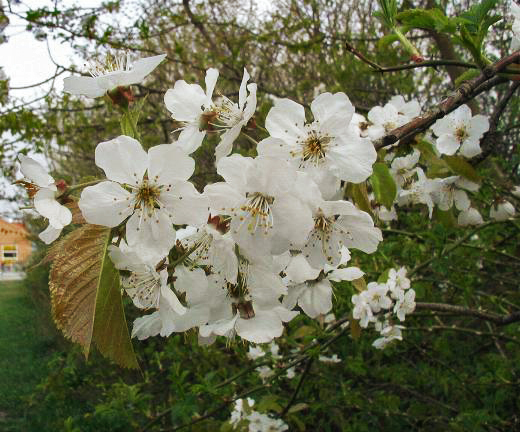


How do you recognise them?
- Bird cherry
- Dull, finely toothed leaf and long hanging spikes of fragrant white flowers in April–May.
- Compared with wild cherry: flowers in long hanging spikes and dull bark.
- Wild cherry
- Glossy red-brown bark with horizontal bands; leaf with two red glands on the stalk.
| Bird cherry | Wild cherry | |
|---|---|---|
| Leaves | Alternate, elliptical, 6–12 cm, thin and dull, finely and sharply toothed; small glands at the top of the leaf stalk. | Alternate, obovate with a pointed tip, 6–15 cm, coarsely toothed, slightly drooping. Two small red glands at the top of the leaf stalk. |
| Flowering | Long hanging spikes of white, strongly scented flowers in April–May (April–May). | White flowers in clusters, in April, just before or with the leaves (April). |
| Fruit | Black, bitter little cherries. | Small, dark red, sweet cherries in June–July; loved by birds. |
| Bark | Grey-brown, smells unpleasant when damaged. | Glossy red-brown, peeling in horizontal bands, with horizontal lines of lenticels. |
| Shape and height | Broadleaf tree, 5–15 m | Fruit tree, 15–25 m |
| Site | Sun or partial shade, any garden soil, moist to wet | Full sun, any garden soil, normal |
| Native to Belgium | Yes | Yes |
| Good for bees, butterflies and birds | Yes, for bees, butterflies and birds | Yes, for bees, butterflies and birds |
| Poisonous to people and pets | Not known to be poisonous | Not known to be poisonous |
| Pruning months | June–August | June–August |
What does it mean for your garden?
- Both are native and good for wildlife: choose what suits your soil, your light and the space you have.
- Wild cherry grows 15–25 m tall: too big for an ordinary garden, but fine in a large garden, a park or a meadow.
Read on
- Plant profile: Bird cherry
- Plant profile: Wild cherry
- Bird cherry: when and how to prune
- Wild cherry: when and how to prune
- Identification key: the question that separates them
Also looks like
- Snowy mespilus or bird cherry
- Bird cherry or black cherry
- Wild cherry or Japanese cherry
- Wild cherry or sour cherry
- Bird cherry or St Lucie cherry
- Plum or wild cherry
- St Lucie cherry or wild cherry
Identify by feature
This comparison is compiled from the Bladwijzer species pages.