Side by side
Red oak or pin oak? How to tell them apart
Quercus rubra · Quercus palustris
You can tell a red oak by its large leaves of 12–22 cm that are only cut halfway to the midrib and its branches that grow obliquely upwards; a pin oak has smaller, glossy leaves cut almost to the midrib, and lower branches that hang down.
Look at how deeply the leaf is cut: about halfway on the red oak, almost to the midrib on the pin oak, so that its lobes are narrow and pointed. Both have lobes ending in fine bristle tips and acorns that only ripen in their second year. From a distance, the crown gives the pin oak away: neatly pyramidal, with drooping lower branches.
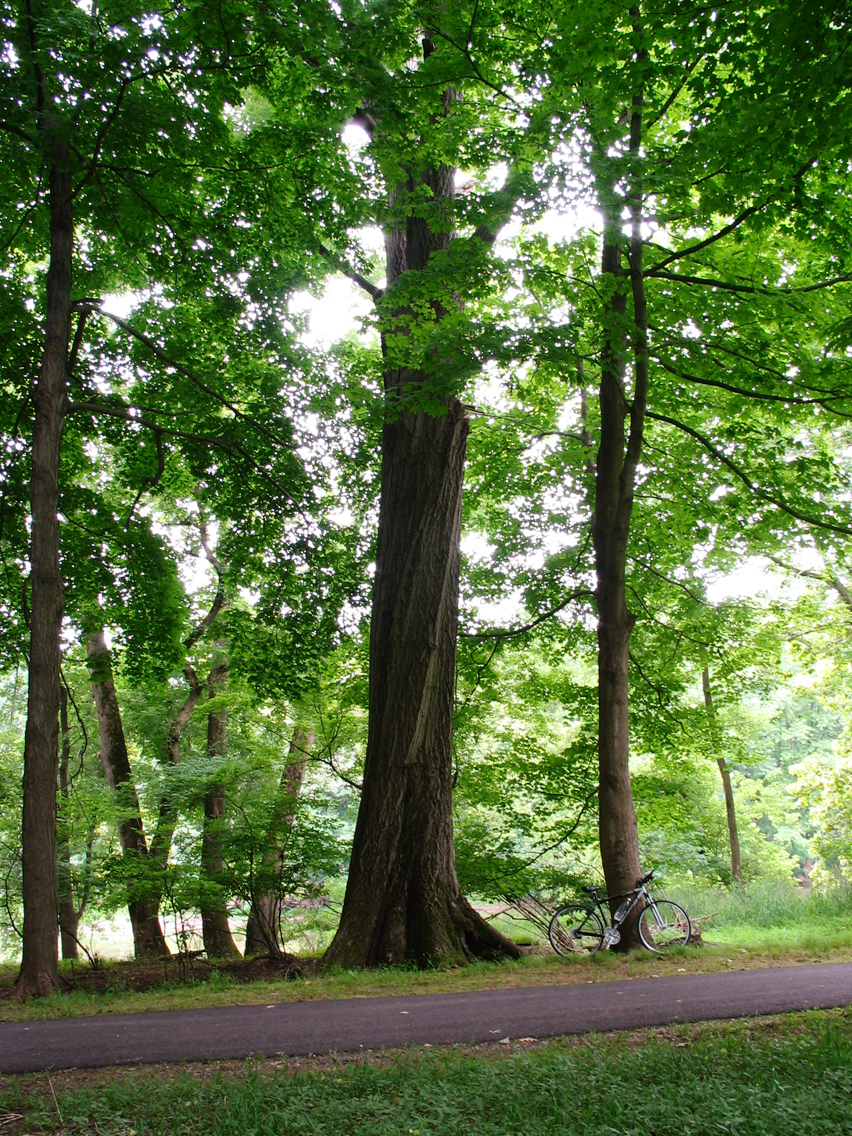


| Red oak | Pin oak | |
|---|---|---|
| Leaves | Alternate, 12–22 cm, with 7–11 pointed lobes ending in fine bristle tips. Autumn colour red to red-brown. | Alternate, 8–15 cm, glossy, cut almost to the midrib into 5–7 pointed lobes with bristle tips; tufts of brown hairs in the vein axils underneath. Scarlet autumn colour; the dead leaves often hang on for a long time. |
| Flowering | May | April–May |
| Fruit | Short, stout acorns in a shallow, flat cup; they only ripen in their second year. | Small, almost round acorns (1–1.5 cm) in a shallow cup; they only ripen in their second year. |
| Bark | Smooth and grey for a long time, later with shallow, broad ridges. | Smooth and greyish-brown for a long time, later finely fissured. |
| Shape and height | Broadleaf tree, 20–30 m | Broadleaf tree, 20–25 m |
| Site | Full sun, acid soil, normal | Full sun, acid soil, moist to wet |
| Native to Belgium | No, naturalised | No, planted |
| Good for bees, butterflies and birds | Yes, for birds | Yes, for birds |
| Poisonous to people and pets | Not known to be poisonous | Not known to be poisonous |
| Pruning months | July–August and November–February | July–August and November–February |
The best feature in each season
- Spring
- Both come into leaf in May. The young leaves of the pin oak are smaller and more deeply cut, with tufts of brown hairs in the vein axils underneath.
- Summer
- The leaf decides it: 12–22 cm with 7–11 lobes cut halfway on the red oak; 8–15 cm, glossy and deeply cut into 5–7 pointed lobes on the pin oak.
- Autumn
- Both colour beautifully: the red oak red to russet, the pin oak scarlet. The acorns are short and stout in a flat cup on the red oak, small and almost round (1–1.5 cm) on the pin oak.
- Winter
- The dead leaves of the pin oak often stay on the tree for a long time. Look at the branches too: angled upwards on the red oak; rising at the top, horizontal in the middle and drooping at the bottom on the pin oak.
Where do they grow?
Both come from eastern North America. The red oak has been widely planted here in woods, parks and avenues, and seeds itself freely in woodland. The pin oak grows there naturally on wet, often flooded ground in river valleys, and is found here mainly as an avenue and park tree.
Which one for your garden?
- Do not plant the red oak near woodland or nature areas: it spreads there and crowds out native species, and its leaf litter rots slowly and acidifies the soil. For wildlife, a native English oak or sessile oak is a better choice.
- The pin oak is a tree of 20–25 m for a large garden or an avenue; it tolerates wet ground, but must have acidic soil. As with all oaks, the acorns are poisonous to horses and cattle in large amounts.
Did you know? Because their acorns take two years to ripen, in summer you often see tiny acorns from this year next to almost ripe ones from last year on the same shoot of these oaks.
Read on
- Plant profile: Red oak
- Plant profile: Pin oak
- Red oak: when and how to prune
- Pin oak: when and how to prune
- Identification key: the question that separates them