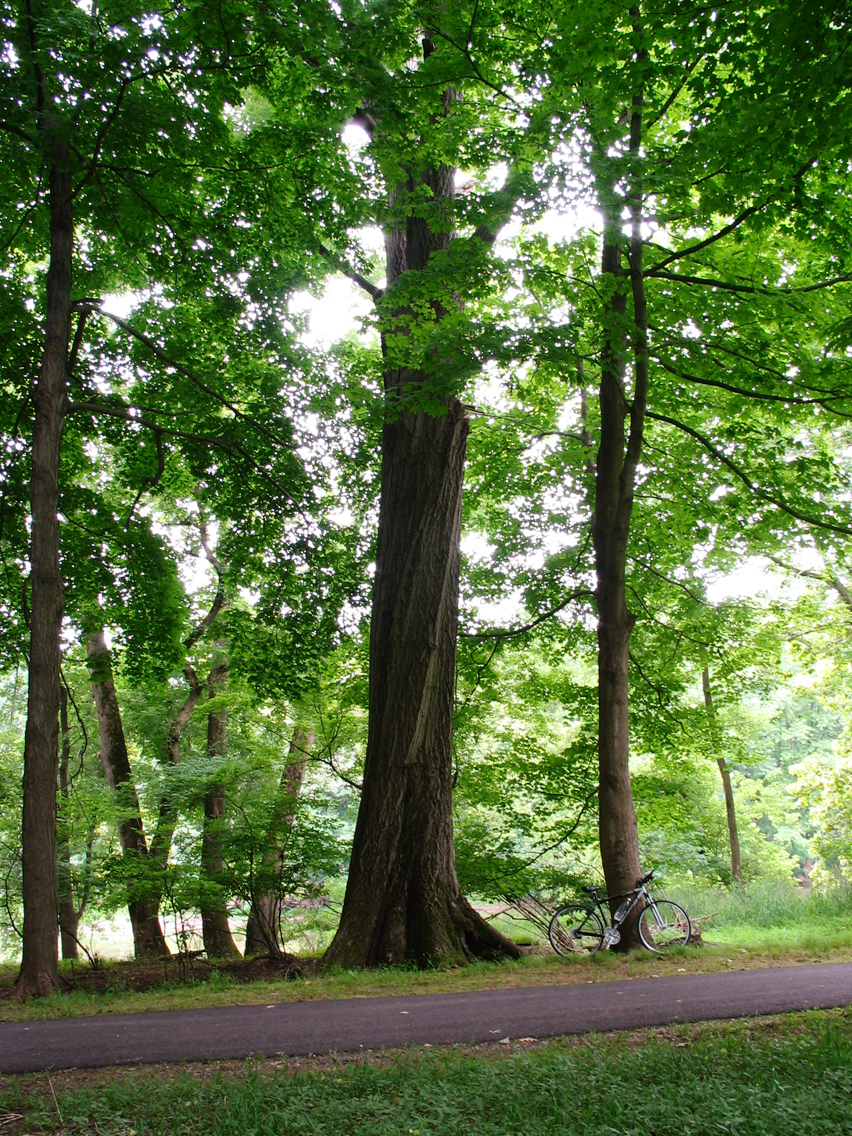
Photo: Wikimedia Commons, CC BY-SA 3.0 · source

Broadleaf tree · Beech family (Fagaceae)
Red oak
Quercus rubra · also: Northern red oak
The red oak comes from eastern North America and has been widely planted here in woodland, parks and avenues. It grows fast to 20–30 m, with large leaves whose pointed lobes end in bristle tips, and a red to red-brown autumn colour. Handsome, but not without drawbacks: it seeds itself prolifically in woodland and crowds out native species there, and little grows under its dense crown and slow-rotting leaf litter. For wildlife, a native English oak or sessile oak is a far better choice.
Caution: Escapes into woodland and crowds out native species there; its leaf litter breaks down slowly and acidifies the soil. Don’t plant it near woodland or nature areas. As with all oaks, acorns are poisonous to horses and cattle in large amounts.
Light
Full sun
warm and bright
Moisture
Normal
no wet feet
Legal basis
Acid soil
acid
Hardiness
Throughout Belgium
no protection needed
Size
20–30 m
tall
Flowering
May
| Pruning months | July–August and November–February |
|---|---|
| Height | 20–30 m |
| Native to Belgium | No, naturalised |
| Good for bees, butterflies and birds | Yes, for birds |
| Poisonous to people and pets | In part: see Caution above |
| Flowering | May |
Identify
Red oak: how do you recognise it?
- Habit
- Large tree of 20–30 m with a broad, rounded, dense crown; fast-growing.
- Leaf
- Alternate, 12–22 cm, with 7–11 pointed lobes ending in fine bristle tips. Autumn colour red to red-brown.
- Bark
- Smooth and grey for a long time, later with shallow, broad ridges.
- Fruit
- Short, stout acorns in a shallow, flat cup; they only ripen in their second year.
- Difference from pin oak
- Pin oak has a smaller, much more deeply cut leaf.
- Difference from English and sessile oak
- Our native oaks have rounded lobes without bristle tips, and acorns that ripen in a single summer.
Flowering: May · Pruning: July–August and November–February
Identify by feature: Lobed leaves (like an oak) · Red autumn colour · Nuts, acorns and chestnuts
Looks like it, but isn’t
- Pin oak (Quercus palustris): smaller, much more deeply cut leaf.
In your garden
Why grow it?
- A fiery red autumn colour, brighter than that of our native oaks.
- Grows fast: a strong park and avenue tree.
- Acorns in autumn for jays, squirrels and mice.
- But: near woodland and nature areas we advise against it. Choose an English oak or sessile oak instead, which feed far more insects and birds.
Red oak: where does it grow best?
- Full sun.
- Acid, well-drained soil; on chalky soil its leaves turn yellow.
- A crown 18 m wide with deep shade: only for a park, an avenue or a very large garden, at least 15 m from buildings.
- Not near woodland, a hedgerow or a nature area: it escapes there.
- Light
- Full sun
- Legal basis
- Acid soil
- Moisture
- Normal
- Size
- 25 m tall, 18 m wide
- Hardiness
- Throughout Belgium, no protection needed
Goes well with
- English oak: The native alternative: plant one instead, especially near woodland and nature areas.
- Holly: Evergreen and shade-tolerant: one of the few shrubs that survive under a dense oak crown.
- Silver birch: A light tree for acid soil; its white trunk stands out beautifully against the red autumn leaves.
- Common ivy: An evergreen ground cover for the dry, acid shade under the tree.
Good and bad companions
Goes well with
- Like the acid soil under this tree: heather, rhododendron, japanese skimmia, raspberry, highbush blueberry, witch hazel, broom, gorse
- Tolerate the shade under this tree: oregon grape, rhododendron, oleaster, japanese skimmia, garden privet, camellia, laurustinus, box-leaved honeysuckle
Best kept away from
- Sun-loving plants get too little light under the dense crown: english lavender, heather, butterfly bush, blackthorn, highbush blueberry, sea buckthorn, japanese rose, broom
Maintenance
Red oak: when and how to plant it?
- Don’t plant it near woodland or a nature area; choose an English oak or sessile oak there.
- Plant from November to March, bare-root or root-balled; young trees establish best.
- Dig a hole deep enough for the taproot without bending it.
- Put a stake on the windward side, tie the trunk loosely and water generously after planting.
Care
- Watering
- In dry spells during the first and second year; after that it copes.
- Feeding
- Not needed.
- Seedlings
- Pull up young red oaks in borders, hedgerows and copses while they are small; later the taproot has taken hold.
- Fallen leaves
- The leaves break down slowly and acidify the soil: rake them off lawns and borders and compost them separately.
Tip: Want an oak with autumn colour and great value for wildlife? Plant an English oak or sessile oak: their autumn colour is less fiery, but they feed hundreds of species of insects.
Red oak: when to prune it?
Pruning months: July–August and November–February.
When: Dead, diseased and broken branches can be removed at any time of year. Formative pruning in summer or winter.
How:
- Prune mainly while young, to form a strong crown on a single leader.
- Gradually remove competing leaders and branches that hang too low.
- Cut large branches in three steps, just outside the branch collar.
Caution: Don’t prune while the leaves are breaking in spring.
Propagation
- Sowing
- The acorns only ripen in their second year; sow them outdoors straight away in autumn. But bear in mind that the tree already seeds itself more than enough.
- Better a native oak
- If you want to raise an oak yourself, sow acorns of English oak or sessile oak.
Red oak: how does it get through the winter?
Hardy throughout Belgium: no protection needed.
- Fully hardy.
- Young trees sometimes keep their dead leaves well into winter.
Diseases and pests
- Escaping into the wild: Jays and squirrels spread the acorns; in woodland, dense groups of seedlings come up and crowd out native plants. Pull up seedlings while young.
- Little grows beneath: Deep shade and slow-rotting, acid leaf litter: little grows under the tree. Choose tough shade plants such as ivy.
- Chlorosis: Yellow leaves with green veins on chalky soil. Choose another tree there.
Through the year
- January: Remove dead branches; formative pruning in mild weather.
- February: Last month for winter pruning and for planting bare-root trees.
- March: Planting season ends; water young trees in dry spells.
- April: Leaves breaking: don’t prune. Pull up seedlings.
- July: Summer pruning of young trees.
- August: Summer pruning still possible; water young trees in dry spells.
- October: Red autumn colour; acorns fall.
- November: Clear up the leaves; planting season starts and formative pruning is possible.
- December: Remove dead branches.
Use
What can you use it for?
- Wood
- Wood for furniture and flooring, but not durable enough for outdoor use.
- Garden and landscape
- Fast-growing park and avenue tree with red autumn colour.
Caution: In woodland it crowds out native species; its leaf litter breaks down slowly.
Good for wildlife
- Birds
- Berries, seeds or insects as food, or a place to nest.
You and this species
Did you know?
- From North America and widely planted in woodland, where it seeds itself prolifically.
- Its acorns only ripen in their second year; in English oak and sessile oak they ripen in a single summer.
- The wood is handsome for furniture and flooring, but not durable enough for outdoor use: it rots faster than native oak.
- Its wood is unsuitable for wine barrels: the vessels are open, so liquid seeps right through. In English and sessile oak they are plugged by tyloses.
- In the Netherlands it was often planted in firebreaks: strips of broadleaved trees meant to slow forest fires in pine woods.