Side by side
Douglas fir or European silver fir? How to tell them apart
Pseudotsuga menziesii · Abies alba
You can tell a Douglas fir by its pointed, glossy brown buds, needles that smell of citrus when crushed and hanging cones with three-pronged bracts; a European silver fir has round, blunt buds, needles in a comb with two white stripes and upright cones.
Look at the buds at the tip of a shoot: pointed and cigar-shaped, like a beech bud, on the Douglas fir; round and blunt on the silver fir. Crush a few needles: the Douglas fir smells of orange or lemon. Both have flat, soft needles with pale stripes beneath, but on the silver fir they are neatly arranged in two rows, like a comb, with a blunt or notched tip.

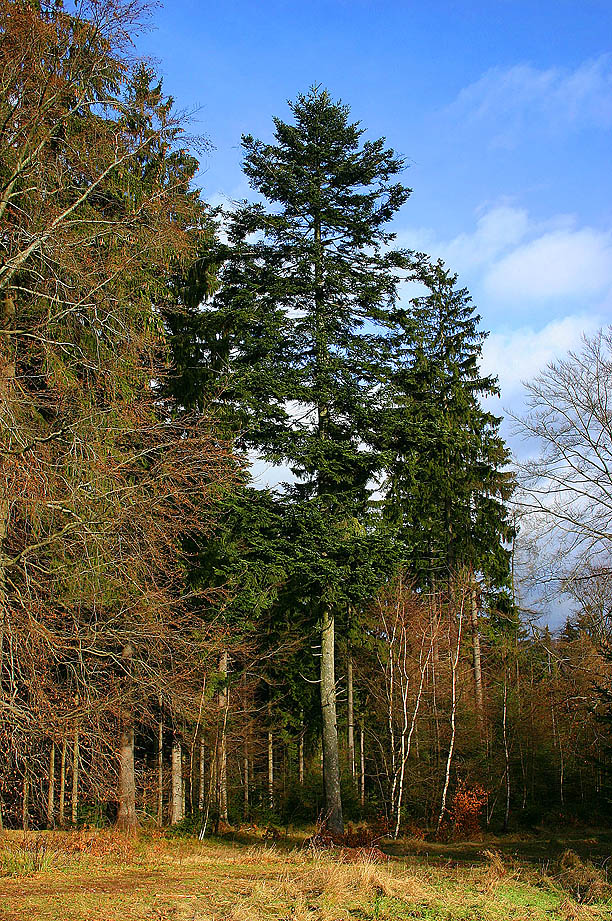


| Douglas fir | European silver fir | |
|---|---|---|
| Needles | Needles 2–3.5 cm, flat, soft and rounded at the tip, with two pale stripes underneath. When crushed they smell of orange or lemon. | Needles 1.5–3 cm, flat and soft with a blunt or notched tip; two white stripes underneath. They are arranged in two rows to the sides (comb-like). The base is widened like a little sucker and leaves a round scar on a smooth twig. |
| Flowering | – | – |
| Cones and seeds | Hanging cones 5–10 cm with protruding, three-pointed bracts between the scales. | Upright cones 10–15 cm that break up on the tree; only the central spike remains. |
| Bark | Smooth with resin blisters at first; on old trees very thick, corky and deeply fissured. | Smooth and silver-grey, in small plates on old trees. |
| Shape and height | Conifer, 30–60 m | Conifer, 30–50 m |
| Site | Sun or partial shade, acid soil, normal | Partial shade or shade, any garden soil, normal |
| Native to Belgium | No, naturalised | No, planted |
| Good for bees, butterflies and birds | Yes, for birds | Little |
| Poisonous to people and pets | Not known to be poisonous | Not known to be poisonous |
| Pruning months | August–September | August–September |
The best feature in each season
- Spring
- On the Douglas fir the pointed buds release light green shoots. On the silver fir they emerge from round, blunt buds; these young shoots are sensitive to late frost.
- Summer
- The cones are borne differently: on the silver fir they stand upright like candles high in the crown, on the Douglas fir they hang scattered through the crown.
- Autumn
- Search the ground: under a Douglas fir you will find whole cones of 5–10 cm with protruding three-pronged bracts. Under a silver fir you will only find loose scales, as the cones break up on the tree; only the central spike stays upright.
- Winter
- Look at the trunk: long smooth and silver-grey on the silver fir, very thick, corky and deeply furrowed on an old Douglas fir. Young Douglas firs have smooth bark with resin blisters.
Where do they grow?
The Douglas fir comes from western North America and is an important forestry tree here, with strong, resinous timber. The European silver fir is the fir of Europe’s middle mountains, such as the Vosges and the Black Forest; it is rarely planted here, as it struggles with drought and late frost.
Which one for your garden?
- Both are far too big for an ordinary garden: the Douglas fir reaches 30–60 m, the silver fir 30–50 m. In a wood, a park or a very large garden they are impressive.
- The Douglas fir wants sun or partial shade and deep, acidic soil, sheltered from strong winds; the silver fir tolerates a lot of shade and wants a cool, moist spot. For a smaller garden a slow-growing fir such as the Korean fir, with its purple cones, is a better choice.
Did you know? The Douglas fir is named after the Scottish plant collector David Douglas, who sent seed to England in 1827. The three-pronged bracts between the cone scales look like the hind legs and tail of a mouse diving into the cone.
Read on
- Plant profile: Douglas fir
- Plant profile: European silver fir
- Douglas fir: when and how to prune
- European silver fir: when and how to prune
- Identification key: the question that separates them