Side by side
Yew or European silver fir? How to tell them apart
Taxus baccata · Abies alba
You can tell a yew by its flat, dark green needles without white bands and its red berries instead of cones; a European silver fir has two white bands under each needle and upright cones.
Turn a twig over. If the underside of the needles is pale green without bands, it is a yew; if you see two bright white bands, it is a fir. In gardens the yew is mostly a hedge or topiary, the fir a tall tree.

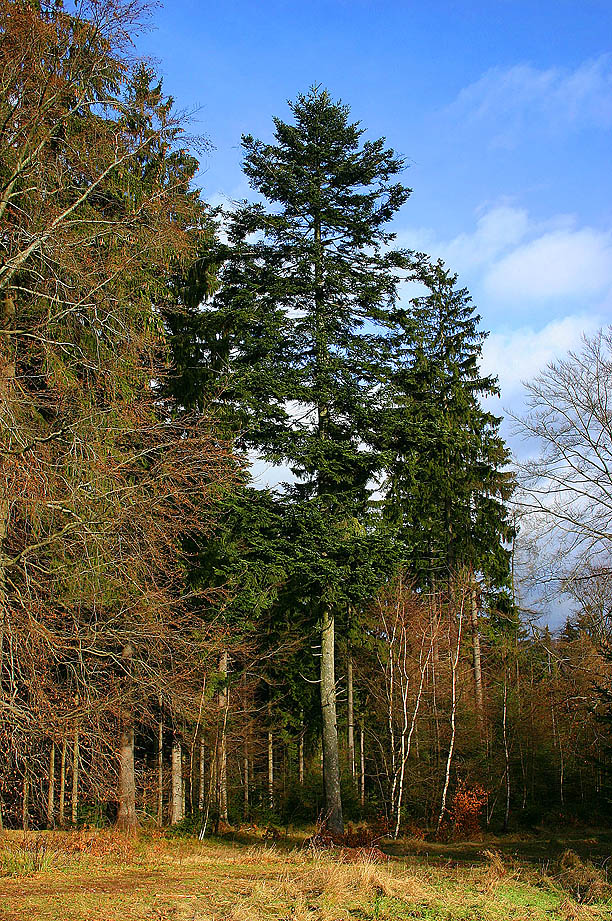


| Yew | European silver fir | |
|---|---|---|
| Needles | Needles 1–3 cm, flat, soft and pointed; glossy dark green above, paler yellow-green below without white stripes. Usually in two rows. | Needles 1.5–3 cm, flat and soft with a blunt or notched tip; two white stripes underneath. They are arranged in two rows to the sides (comb-like). The base is widened like a little sucker and leaves a round scar on a smooth twig. |
| Flowering | – | – |
| Cones and seeds | No cones: each seed sits in a red, fleshy cup (aril). Only female trees bear them. | Upright cones 10–15 cm that break up on the tree; only the central spike remains. |
| Bark | Thin, red-brown and flaking in plates; trunk often fluted and multi-stemmed. | Smooth and silver-grey, in small plates on old trees. |
| Shape and height | Conifer, 10–20 m, often a shrub or hedge | Conifer, 30–50 m |
| Site | Sun to shade, any garden soil, normal | Partial shade or shade, any garden soil, normal |
| Native to Belgium | Yes | No, planted |
| Good for bees, butterflies and birds | Yes, for birds | Little |
| Poisonous to people and pets | Yes, take care with children and pets | Not known to be poisonous |
| Pruning months | May–June and August–September | August–September |
The best feature in each season
- Spring
- In early spring the male yews release clouds of yellow pollen. The fir comes into growth in May with fresh green shoots.
- Summer
- From August, female yews carry small red, fleshy cups, each holding a single seed. The fir then bears upright cones of 10–15 cm at the top of the crown.
- Autumn
- The red berries of the yew last into autumn and are eaten by blackbirds and thrushes. Under a fir lie loose cone scales, because the cones break up on the tree.
- Winter
- Both are evergreen. The yew has reddish-brown bark that flakes off in little plates and often several trunks; the fir has a smooth, silver-grey trunk.
Where do they grow?
The yew is native but rare in the wild, mainly on chalky slopes; in gardens, churchyards and parks it is everywhere. The European silver fir comes from the uplands of Europe and grows here only where it has been planted, in parks and forests.
Which one for your garden?
- Yew makes one of the best hedges: it grows slowly, tolerates deep shade and, alone among the conifers, regrows from old wood. Blackbirds and thrushes eat the red berries and like to nest in a dense yew hedge.
- Take care: the needles, bark and seeds of yew are highly poisonous to people and animals. Keep clippings away from horses, cows and sheep. The fir reaches 30–50 m and is too big for an ordinary garden.
Did you know? Yews can live for more than 1,000 years. Only the red flesh is not poisonous: birds eat the berries and the poisonous seed passes through them intact.
Read on
- Plant profile: Yew
- Plant profile: European silver fir
- Yew: when and how to prune
- European silver fir: when and how to prune
- Identification key: the question that separates them
Also looks like
- Douglas fir or European silver fir
- Norway spruce or European silver fir
- European silver fir or Nordmann fir