Side by side
Lesser periwinkle or common ivy? How to tell them apart
Vinca minor · Hedera helix
How to tell them apart – lesser periwinkle: evergreen ground cover with trailing stems, glossy opposite leaves and bluish-violet flowers in spring; common ivy: alternate, lobed leaves and aerial roots.



How do you recognise them?
- Lesser periwinkle
- Evergreen ground cover with trailing stems, glossy opposite leaves and bluish-violet flowers in spring.
- Common ivy
- Evergreen climber with glossy, lobed leaves and clinging aerial roots.
- Compared with lesser periwinkle: alternate, lobed leaves and aerial roots.
| Lesser periwinkle | Common ivy | |
|---|---|---|
| Leaves | Opposite, elliptic, 2–4 cm, leathery, glossy dark green, untoothed and hairless, with a short stalk. | Alternate, leathery and glossy dark green; 3–5-lobed on climbing stems, diamond-shaped and unlobed on the flowering shoots at the top. |
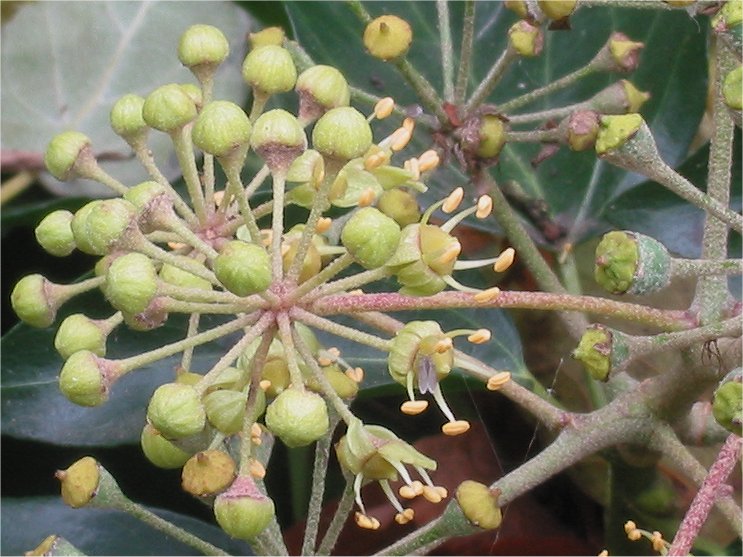
| Flowering | Bluish-violet (sometimes white or purple) flowers (2–3 cm) with 5 obliquely cut-off lobes, single in the leaf axils, March–May (March–May). | Rounded umbels of small yellowish-green flowers in September–November: a late nectar feast for insects (September–November). |
| Fruit | Rarely sets fruit: two narrow little pods. | Bluish-black berries in late winter; poisonous to people, loved by birds. |
| Bark | Long, trailing stems that root at the nodes, and short, upright flowering stems. | Stems with countless short aerial roots that it uses to cling on. |
| Shape and height | Dwarf shrub, 10–20 cm | Climber, climbs to 20–30 m |
| Site | Partial shade or shade, any garden soil, normal | Sun to shade, any garden soil, dry to wet |
| Native to Belgium | Yes | Yes |
| Good for bees, butterflies and birds | – | Yes, for bees, butterflies and birds |
| Poisonous to people and pets | Yes, take care with children and pets | Yes, take care with children and pets |
| Pruning months | March and June | March–April and August–September |
What does it mean for your garden?
- Lesser periwinkle is poisonous to people and pets: take care with children and animals.
- Common ivy is poisonous to people and pets: take care with children and animals.
- Both are native and good for wildlife: choose what suits your soil, your light and the space you have.
Read on
- Plant profile: Lesser periwinkle
- Plant profile: Common ivy
- Lesser periwinkle: when and how to prune
- Common ivy: when and how to prune
- Identification key
Also looks like
This comparison is compiled from the Bladwijzer species pages.