Side by side
Peach or sweet chestnut? How to tell them apart
Prunus persica · Castanea sativa
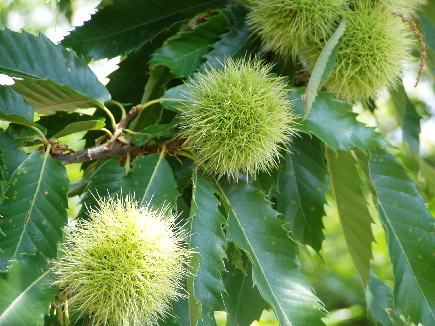
How to tell them apart – peach: small fruit tree with long, narrow, glossy leaves and pink blossom in March, before the leaves; sweet chestnut: much larger leaves with coarse, bristle-tipped teeth, and spiny husks.



How do you recognise them?
- Peach
- Small fruit tree with long, narrow, glossy leaves and pink blossom in March, before the leaves.
- Sweet chestnut
- Long, narrow leaf with regular bristle-tipped teeth; spiny husks with edible chestnuts.
- Compared with peach: much larger leaves with coarse, bristle-tipped teeth, and spiny husks.
| Peach | Sweet chestnut | |
|---|---|---|
| Leaves | Alternate, 8–15 cm, lance-shaped, finely toothed, glossy green and often slightly folded along the midrib. | Alternate, lance-shaped, 10–25 cm, with parallel side veins each ending in a bristle-tipped tooth. |
| Flowering | Pink blossom in March–April, before the leaves, singly or in pairs (March–April). | Long, yellowish-white, strong-smelling catkins in July (June–July). |
| Fruit | Velvety peaches with a hard, grooved stone, in August–September. The nectarine is a smooth-skinned form. | Very spiny husk with 1–3 edible chestnuts. |
| Bark | Reddish-brown to grey, smooth with horizontal streaks. | Grey-brown; on old trees with deep, spirally twisted furrows. |
| Shape and height | Fruit tree, 3–6 m | Fruit tree, 20–30 m |
| Site | Full sun, any garden soil, normal | Full sun, acid soil, normal |
| Native to Belgium | No, planted | No, naturalised |
| Good for bees, butterflies and birds | Yes, for bees | Yes, for bees and birds |
| Poisonous to people and pets | Not known to be poisonous | Not known to be poisonous |
| Pruning months | April–August | November–March |
What does it mean for your garden?
- Sweet chestnut grows 20–30 m tall: too big for an ordinary garden, but fine in a large garden, a park or a meadow.
Read on
- Plant profile: Peach
- Plant profile: Sweet chestnut
- Peach: when and how to prune
- Sweet chestnut: when and how to prune
- Identification key: the question that separates them
Also looks like
Identify by feature
This comparison is compiled from the Bladwijzer species pages.