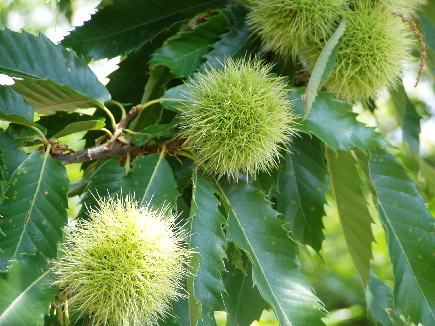
Photo: Amarant at Dutch Wikipedia, CC BY-SA 3.0 · source

Fruit tree · Beech family (Fagaceae)
Sweet chestnut
Castanea sativa · also: Spanish chestnut
The sweet chestnut comes from southern Europe and Asia Minor and was brought to our part of the world by the Romans. It has since become naturalised in woods on acid, sandy loam. You can recognise it by its long, narrow leaf with bristle-tipped teeth and, in autumn, by the spiny husks with edible chestnuts. It grows 20–30 m tall with a broad crown of about 18 m, and old trees develop deeply furrowed bark that twists in a spiral. It is too big for an ordinary garden, but on a large property, in a meadow or park, or as coppice, it is an asset for people and bees alike.
Caution: Don’t confuse the edible sweet chestnut with the horse chestnut from the park: conkers are not edible and are poisonous. You can tell the sweet chestnut by its long, toothed leaf and its husk covered in fine, sharp spines.
Light
Full sun
warm and bright
Moisture
Normal
no wet feet
Legal basis
Acid soil
acid
Hardiness
Throughout Belgium
no protection needed
Size
20–30 m
tall
Flowering
June–July
| Pruning months | November–March |
|---|---|
| Height | 20–30 m |
| Native to Belgium | No, naturalised |
| Good for bees, butterflies and birds | Yes, for bees and birds |
| Poisonous to people and pets | In part: see Caution above |
| Flowering | June–July |
Identify
Sweet chestnut: how do you recognise it?
- Habit
- Tree of 20–30 m with a broad, rounded crown about 18 m across; old trees have a thick, often short trunk.
- Leaves
- Alternate, lance-shaped, 10–25 cm, with parallel side veins each ending in a bristle-tipped tooth.
- Bark
- Grey-brown; on old trees with deep, spirally twisted furrows.
- Flowers
- Long, yellowish-white, strong-smelling catkins in July.
- Fruit
- Very spiny husk with 1–3 edible chestnuts, ripe in October.
- Difference from horse chestnut
- Horse chestnut has a palmately compound leaf and inedible conkers in a husk with short spines.
Flowering: June–July · Harvest and fruit: September–October · Pruning: November–March
Identify by feature: Long, narrow leaves · Nuts, acorns and chestnuts
Looks like it, but isn’t
- Horse chestnut Aesculus hippocastanum: palmately compound leaf and inedible conkers. Difference from horse chestnut
In your garden
Why grow it?
- Edible chestnuts for roasting, as purée or as chestnut flour.
- Flowers in July, when there are few other flowers: a tree busy with bees.
- As coppice it provides durable wood for posts, fencing and cladding.
- With their twisted bark, old trees are true monuments.
- Golden-yellow to brown autumn colour.
Sweet chestnut: where does it grow best?
- Full sun; for a good crop, a warm, sheltered spot.
- Acid, open, free-draining soil such as sandy loam. It tolerates neither lime nor wet ground.
- Allow for 20–30 m in height and a crown of about 18 m: only for a large garden, a farmyard, a meadow or a park.
- As coppice, cut every 10–15 years, it takes up far less space.
- Light
- Full sun
- Legal basis
- Acid soil
- Moisture
- Normal
- Size
- 25 m tall, 18 m wide
- Hardiness
- Throughout Belgium, no protection needed
Goes well with
- English oak: On acid, loamy sand, oak and sweet chestnut have always grown together in woods and hedgerows.
- Holly: An evergreen understorey that tolerates shade and acid soil.
- Hazel: Another nut tree for the edge, which you can coppice just like the chestnut.
- Rowan: A small native tree with orange-red berries that also likes acid soil.
Maintenance
Sweet chestnut: when and how to plant it?
- Plant from November to March when the ground isn’t frozen.
- For chestnuts, choose grafted fruiting varieties: they crop much sooner than a seedling and give bigger nuts.
- Plant at least two trees or two different varieties near each other: a sweet chestnut pollinates itself poorly.
- No lime or chalky compost in the planting hole.
- Put in a stake and water after planting and during dry spells in the first few summers.
Care
- Watering
- In dry spells during the first few years; rarely needed after that.
- Feeding
- Not needed; leave the fallen leaves as a natural mulch.
- Harvesting
- Gather the chestnuts in October as soon as the husks fall and split open; wear sturdy gloves or prise the husks open with your shoe.
- Storing
- Fresh chestnuts quickly dry out or go mouldy: keep them cool in the fridge and use them within a few weeks, or freeze them.
- Coppice
- After cutting, keep the strongest shoots on each stool; they soon grow into poles.
Tip: Roasting chestnuts: cut a cross in the skin with a sharp knife so they don’t burst, then roast them in a pan with holes or for 20–25 minutes in a hot oven. Peel them while they are still warm.
Sweet chestnut: when to prune it?
Pruning months: November–March.
When: Dead, diseased and broken branches can be removed at any time of year. Prune or coppice during winter dormancy (November–March).
How:
- As a tree it needs little pruning: give a young tree a single trunk, remove crossing branches and lift the crown gradually.
- Grown as coppice, it can be cut down every 10–15 years, close to the ground; it regrows vigorously.
- Cut out dead and diseased branches back into healthy wood.
Caution: Do most of your pruning while the tree is young: large saw cuts on an old chestnut heal slowly.
Propagation
- Sowing
- Sow fresh chestnuts in autumn, 3–5 cm deep, in a pot or where they are to grow, and protect them from mice. A seedling gives smaller and variable nuts.
- Grafting
- Fruiting varieties are grafted; that is a job for the nursery.
Sweet chestnut: how does it get through the winter?
Hardy throughout Belgium: no protection needed.
- Fully hardy.
- Winter is the season for planting and for cutting coppice.
Diseases and pests
- Oriental chestnut gall wasp: A tiny wasp from Asia that is spreading across Europe. It causes green to red galls on buds and young leaves, which hold back growth and the crop. Cut the galls off young trees in spring.
- Ink disease: A Phytophthora of wet, heavy soil: the tree declines and black fluid oozes from the base of the trunk. Only plant on free-draining soil.
- Maggoty chestnuts: The caterpillars of a small moth eat the nuts from the inside. Gather chestnuts promptly and throw away affected ones.
- Empty husks: Flat, empty chestnuts point to poor pollination: plant a second tree or variety nearby.
Through the year
- January: Prune during dormancy; cut coppice.
- February: Pruning and planting, when there is no frost.
- March: Last month for pruning and planting.
- May: Leaves emerge; watch for galls on young shoots.
- July: Flowering: long, scented catkins full of bees.
- August: Water young trees in dry spells.
- October: Harvest: gather chestnuts as soon as the husks fall; sowing.
- November: Planting season; pruning can start again.
- December: Pruning; cutting coppice.
Use
What can you use it for?
- Food and drink
- Chestnuts for roasting, as purée or as chestnut flour.
- Wood
- Durable wood for posts, fencing and cladding.
- For wildlife
- Flowers in July, when there are few other flowers for bees.
Edible and useful
- Nuts (September–October)
- Gather the chestnuts from late September to late October, as soon as the spiny husks split and fall. Choose glossy, firm, plump ones. Delicious roasted, in soup, as a purée, in a stuffing or as chestnut spread.
- Storing
- Fresh chestnuts dry out and go mouldy quickly: keep them for no more than two weeks in a paper bag in the salad drawer of the fridge. To keep them longer, boil or roast them, peel them and freeze them, for up to a year.
Caution: Do not confuse sweet chestnuts with poisonous horse chestnuts (conkers). Sweet chestnuts sit two or three together in a husk covered in fine, long spines, are flat on one side and have a pointed tip with a tuft of hairs; conkers usually sit alone in a husk with a few short, thick spines and are round and smooth. Always score the shell before roasting or boiling, or they will burst. Wear gloves when gathering. Throw away chestnuts with holes and any that float. Never eat anything you have not identified with certainty.
Eating and using is at your own risk: see the terms of use.
Recipes
- Roast chestnuts (Dish · 4 people · 45 min)
- Chestnut spread (crème de marrons) (Jam · ± 3 jars of 250 ml · 1 hr 30)
- Chestnut soup with leek and celery (Dish · 4 portions · 1 hr 15)
- Dried sweet chestnuts and chestnut flour (Dried · ± 350 g dried chestnuts · 1 hr + 8–12 hrs drying)
Good for wildlife
- Bees
- Nectar and pollen for honeybees and wild bees.
- Birds
- Berries, seeds or insects as food, or a place to nest.
You and this species
Did you know?
- Spread by the Romans. The roasted chestnuts at Christmas markets come from this tree.
- The wood is rich in tannins: that is why it rots slowly and is popular for posts and fencing.
- On old trees, the deep furrows in the bark spiral around the trunk.
- In poor mountain regions such as the Cévennes and Corsica, chestnut flour was a staple food for centuries; there the tree was called the ‘bread tree’.
- On Mount Etna in Sicily stands the ‘Hundred-Horse Chestnut’. Legend has it that a queen and a hundred knights once sheltered beneath it together from a storm.