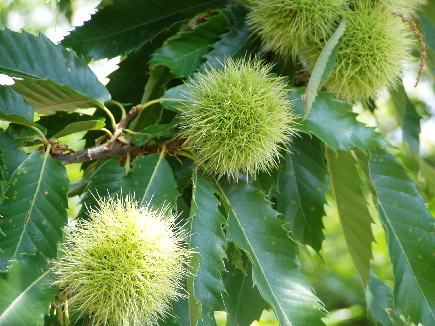
Photo: Amarant at Dutch Wikipedia, CC BY-SA 3.0 · source

Pruning guide · Fruit tree
Sweet chestnut: when and how to prune
Castanea sativa
Prune a sweet chestnut during winter dormancy (November–March), and only lightly: give a young tree a single leading stem and an open crown, or coppice it every 10–15 years.
The sweet chestnut reaches 20–30 m with a broad crown of about 18 m: too big for an ordinary garden, but an asset on a large property, in a field, a park or as coppice. As a tree it needs little pruning. Most of the work comes in the first years, when you shape the tree: large saw wounds on an old chestnut heal slowly. As coppice, it regrows vigorously after cutting.
| Pruning months | November–March |
|---|---|
| Nesting season (15 March–15 August) | Take care in March |
| Flowering | June–July |
| Good for bees, butterflies and birds | Yes, for bees and birds |
| Native to Belgium | No, naturalised |
Sweet chestnut: when to prune it?
Prune during winter dormancy, November–March, ideally before mid-March.
Dead, diseased and broken branches can be sawn off all year round.
Coppice in winter, while the tree is bare and the ground not too wet.
What else to prune in those months? January · February · March · November · December
Sweet chestnut: how to prune it?
- Give a young tree a single leading stem: remove a second, competing leader, and branches that cross.
- Raise the crown gradually: each year remove at most one or two of the lowest branches.
- Saw dead and diseased wood back to healthy wood, in three steps and just outside the branch collar.
- As coppice, cut it every 10–15 years, low to the ground. It regrows vigorously, with straight poles for posts and fencing.
- Leave work at height and branches thicker than 10 cm to a tree surgeon.
How much to cut, and how often?
- A mature tree: as little as possible, apart from dead and diseased wood.
- A young tree: a little formative pruning each year. Coppice: everything, every 10–15 years.
What does it mean for wildlife?
- Prune in winter, before the nesting season (15 March–15 August). Blackbirds, chaffinches and pigeons nest in the broad crown; if you are still at it in March, look first.
- In July the long, fragrant catkins are covered in honeybees and bumblebees: one of the most important nectar trees of the summer.
- In autumn the chestnuts feed jays, squirrels, wood mice and wild boar. Leave some of them on the ground.
- Old chestnuts with hollows and twisted bark are home to woodpeckers, owls, bats and dozens of kinds of beetle. Leave such a hollow if it poses no danger.
Common mistakes
- Pruning an old tree hard, leaving large wounds that heal slowly.
- Sawing a branch off flush with the trunk.
- Planting it in a small garden, and then having to cut it back every year.
- Confusing the edible sweet chestnut with the poisonous horse chestnut.
Caution: Do most of your pruning while the tree is young: large saw cuts on an old chestnut heal slowly.
Nearby: related pruning guides
Similar to: Difference from horse chestnut · Difference from peach
Plant profile: Sweet chestnut · Pruning calendar and basic rules