Side by side
Sweet chestnut or horse chestnut? How to tell them apart
Castanea sativa · Aesculus hippocastanum
You can tell a sweet chestnut by its long, narrow leaves with bristle-tipped teeth and its husk packed with fine spines around edible chestnuts; a horse chestnut has hand-shaped leaves of 5–7 leaflets and poisonous conkers in a husk with short spines.
They are not related, even though both are called chestnut. Look at the leaf: the sweet chestnut has simple, lance-shaped leaves of 10–25 cm that alternate along the twig; the horse chestnut has a hand of 5–7 large leaflets, with the leaves in opposite pairs.
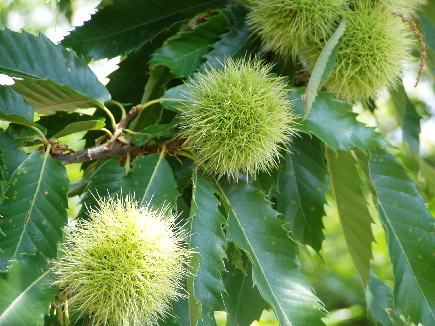


| Sweet chestnut | Horse chestnut | |
|---|---|---|
| Leaves | Alternate, lance-shaped, 10–25 cm, with parallel side veins each ending in a bristle-tipped tooth. | Opposite, palmately compound with 5–7 obovate, toothed leaflets 10–25 cm long. |
| Flowering | Long, yellowish-white, strong-smelling catkins in July (June–July). | Upright white ‘candles’ with yellow to red spots, in May (May). |
| Fruit | Very spiny husk with 1–3 edible chestnuts. | Green spiky husk containing one or two glossy brown conkers (not edible). |
| Bark | Grey-brown; on old trees with deep, spirally twisted furrows. | Grey-brown, flaking in plates on old trees. Large, glossy and very sticky winter buds. |
| Shape and height | Fruit tree, 20–30 m | Broadleaf tree, 20–30 m |
| Site | Full sun, acid soil, normal | Sun or partial shade, any garden soil, normal |
| Native to Belgium | No, naturalised | No, naturalised |
| Good for bees, butterflies and birds | Yes, for bees and birds | Yes, for bees |
| Poisonous to people and pets | Not known to be poisonous | Yes, take care with children and pets |
| Pruning months | November–March | July–August and November–February |
The best feature in each season
- Spring
- In May the horse chestnut is covered in upright white flower candles; the sweet chestnut is only just coming into leaf and flowers later.
- Summer
- In June–July the sweet chestnut flowers with long, creamy-yellow catkins that smell strongly. By then the horse chestnut often has brown blotches on its leaves from the leaf miner moth.
- Autumn
- The husk decides it: on the sweet chestnut it is densely covered in fine, sharp spines like a hedgehog, with 1–3 flattened, edible chestnuts with a little point; on the horse chestnut it has scattered short spines and holds one or two round, glossy conkers.
- Winter
- The horse chestnut has large, glossy and very sticky buds in opposite pairs; the sweet chestnut small, reddish-brown buds that alternate. On an old sweet chestnut the furrows in the bark spiral round the trunk.
Where do they grow?
Neither is truly native. The sweet chestnut came with the Romans and has naturalised in woods on acid sandy loam, mainly in southern Belgium. The horse chestnut comes from the Balkans and has graced squares, parks, avenues and farms since the 17th century.
Which one for your garden?
- Both grow to 20–30 m: too big for an ordinary garden, but lovely on a large farmyard, in a meadow or a park. A sweet chestnut can also be grown as coppice.
- Take care with children and dogs: horse chestnut conkers are poisonous. Only eat chestnuts from a husk covered in fine spines. Bees benefit from both: from the horse chestnut in May, from the sweet chestnut in summer.
Did you know? Snap off a horse chestnut twig in winter and you will see a leaf scar shaped like a horseshoe, complete with the holes for the nails.
Read on
- Plant profile: Sweet chestnut
- Plant profile: Horse chestnut
- Sweet chestnut: when and how to prune
- Horse chestnut: when and how to prune
- Identification key: the question that separates them