Side by side
Blackthorn or cherry plum? How to tell them apart
Prunus spinosa · Prunus cerasifera
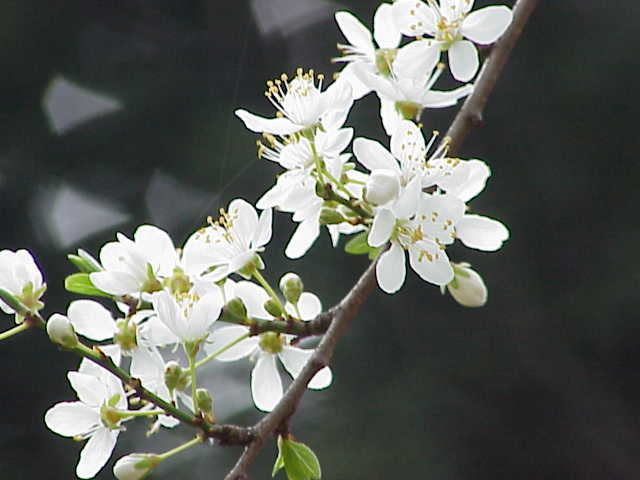
You can tell a blackthorn by its small white flowers on black, thorny branches and its blue, sour sloes; a cherry plum flowers a little earlier still, with larger flowers on green twigs, and carries round yellow or red plums.
Both turn the roadsides white in March. Look at the twigs: black and full of thorny side shoots on the blackthorn, green and glossy, with at most a few short thorns, on the cherry plum. The flowers of the cherry plum are larger, single or in pairs.



| Blackthorn | Cherry plum | |
|---|---|---|
| Leaves | Alternate, small (2–4 cm), oval and finely toothed. | Alternate, 3–7 cm, oval to elliptic, finely scalloped, glossy and hairless except along the veins underneath; dark purple in the purple-leaved plum. |
| Flowering | Small white flowers, massed on the bare branches in March–April (March–April). | White (pale pink in the purple-leaved plum) flowers, single or in pairs, in March, just before or with the leaves (March). |
| Fruit | Blue sloes with a waxy bloom; astringent, better after frost (sloe gin). | Round, cherry-like plums 2–3 cm across on a long stalk, yellow or red, sweet to tart; ripe in July–August. |
| Bark | Dark, almost black, with sharp, thorny side shoots. | Dark grey-brown; young twigs green and glossy, sometimes with short spines. |
| Shape and height | Shrub, 1–4 m | Broadleaf tree, 5–10 m |
| Site | Full sun, any garden soil, dry to wet | Full sun, any garden soil, normal |
| Native to Belgium | Yes | No, naturalised |
| Good for bees, butterflies and birds | Yes, for bees, butterflies and birds | – |
| Poisonous to people and pets | Not known to be poisonous | Not known to be poisonous |
| Pruning months | June–August and November–February | June–August |
The best feature in each season
- Spring
- The cherry plum is the first Prunus to flower, from early March; the blackthorn follows in late March–April, like a white haze on black branches. The purple-leaved form flowers pale pink.
- Summer
- In July–August the cherry plum carries round yellow or red plums of 2–3 cm on a long stalk; the blackthorn small blue sloes that only ripen in autumn.
- Autumn
- Do not taste too readily: sloes stay sour until the frosts. The blackthorn leaf is small (2–4 cm) and dull, the cherry plum leaf larger (3–7 cm) and glossy.
- Winter
- The blackthorn stays a low, thorny shrub of 1–4 m with almost black branches; the cherry plum grows into a small tree of 5–10 m with dark greyish-brown bark and green young twigs.
Where do they grow?
The blackthorn is native and grows in hedges, copses and scrub. The cherry plum comes from south-eastern Europe and western Asia; it has naturalised here and spreads into hedges and copses.
Which one for your garden?
- For a natural hedge, choose the native blackthorn: early blossom for bees, sloes for birds, and the food plant of the black hairstreak. Keep its suckers in check.
- The cherry plum makes a good small tree or hedge for an ordinary garden, with edible little plums, but it is not native and spreads: do not plant it next to a nature reserve and pull up seedlings while they are young. Prune it only in summer, against silver leaf.
Did you know? The purple-leaved cherry plum was brought to France around 1880 by Pissard, gardener to the Shah of Persia: hence the variety name ‘Pissardii’.
Read on
- Plant profile: Blackthorn
- Plant profile: Cherry plum
- Blackthorn: when and how to prune
- Cherry plum: when and how to prune
- Identification key