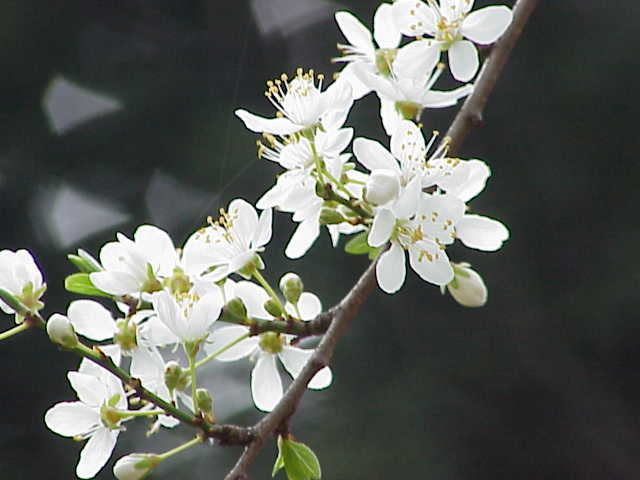
Photo: Kurt Stüber [1], CC BY-SA 3.0 · source

Broadleaf tree · Rose family (Rosaceae)
Cherry plum
Prunus cerasifera · also: Myrobalan plum, Purple-leaved plum
The cherry plum is the first Prunus to flower: as early as March it is covered in white blossom (pale pink in the purple-leaved plum), just before or with the leaves. In summer it bears round, yellow or red little plums on a long stalk, which you can eat fresh or as jam. It originally comes from south-eastern Europe and western Asia, but it has become naturalised here and runs wild in hedges and hedgerows. The form with purple leaves, the purple-leaved plum, is a popular garden tree. It grows 5–10 m tall with a crown of about 6 m, takes pruning well and fits an ordinary garden as a small tree or hedge.
Caution: Not a native species: it runs wild through stones spread by birds and mammals. Don’t plant it next to a nature reserve, and pull up seedlings while they are small. Prune only in summer, to prevent silver leaf.
Light
Full sun
warm and bright
Moisture
Normal
no wet feet
Legal basis
Any garden soil
any pH
Hardiness
Throughout Belgium
no protection needed
Size
5–10 m
tall
Flowering
March
| Pruning months | June–August |
|---|---|
| Height | 5–10 m |
| Native to Belgium | No, naturalised |
| Poisonous to people and pets | Not known to be poisonous |
| Flowering | March |
Identify
Cherry plum: how do you recognise it?
- Habit
- Small tree or large shrub of 5–10 m with a rounded crown about 6 m across; also grown as a hedge.
- Leaves
- Alternate, 3–7 cm, oval to elliptic, finely scalloped, glossy and hairless except along the veins underneath; dark purple in the purple-leaved plum.
- Bark
- Dark grey-brown; young twigs green and glossy, sometimes with short spines.
- Flowers
- White (pale pink in the purple-leaved plum) flowers, single or in pairs, in March, just before or with the leaves.
- Fruit
- Round, cherry-like plums 2–3 cm across on a long stalk, yellow or red, sweet to tart; ripe in July–August.
- Difference from blackthorn
- Blackthorn flowers a little later, with smaller flowers on black, thorny twigs, and bears blue, astringent sloes.
- Difference from plum
- Plum has a larger, dull and wrinkled leaf, and larger, oblong plums.
Flowering: March · Harvest and fruit: July–August · Pruning: June–August
Identify by feature: White blossom · Pink blossom
Looks like it, but isn’t
- Blackthorn Prunus spinosa: flowers a little later, with smaller flowers on black, thorny twigs, and bears blue, astringent sloes. Difference from blackthorn
- Plum Prunus domestica: larger, dull and wrinkled leaf, and larger, oblong plums. Difference from plum
In your garden
Why grow it?
- One of the first flowers for bees and bumblebees in March.
- Edible little plums in July–August, fresh or as jam.
- Takes pruning well: suitable for an early-flowering hedge.
- The purple-leaved plum adds colour all season with its purple foliage.
Cherry plum: where does it grow best?
- Full sun: that is where it flowers best.
- Ordinary garden soil, not too wet; sand, loam or clay.
- Allow for 5–10 m in height and a crown of about 6 m; as a hedge you keep it at 1.5–3 m.
- A sheltered spot protects the early blossom from night frost.
- Light
- Full sun
- Legal basis
- Any garden soil
- Moisture
- Normal
- Size
- 8 m tall, 6 m wide
- Hardiness
- Throughout Belgium, no protection needed
Goes well with
- Blackthorn: The native counterpart: it flowers just after the cherry plum, so a mixed hedge flowers white for weeks on end.
- Cornelian cherry: Flowers even earlier, in February–March, with small yellow flowers: together a hedge full of early blossom for bees.
- Hazel: A native shrub with early pollen in February, for the same mixed hedge.
Maintenance
Cherry plum: when and how to plant it?
- Plant from November to March when the ground isn’t frozen; a container-grown tree can go in at any time of year, except in frost or drought.
- For a hedge, plant about 3 plants per metre.
- Secure a single tree to a stake with a tree tie.
- Mix a little compost into the planting soil and water after planting.
Care
- Watering
- In dry spells during the first year.
- Feeding
- Not needed; a layer of compost in spring is enough.
- Hedge
- Trim the hedge once a year in summer, after flowering (June–August).
- Seedlings
- Birds and mammals spread the stones: pull up seedlings in the garden and the surrounding area while they are small.
Tip: Want early blossom from a native plant? Then choose blackthorn: it flowers shortly after the cherry plum and is a food plant for many native butterflies and moths.
Cherry plum: when to prune it?
Pruning months: June–August.
When: In summer, after flowering (June–August), in dry weather.
How:
- Trim a hedge in June–August, once flowering is over.
- Prune a tree lightly: just remove dead, diseased and crossing branches.
Caution: Don’t prune in autumn or winter: wounds then invite silver leaf, a fungus that can kill branches and even the whole tree.
Propagation
- Sowing
- Sow the stones outdoors in autumn: they need winter cold to germinate. A seedling doesn’t always resemble its parent.
Cherry plum: how does it get through the winter?
Hardy throughout Belgium: no protection needed.
- Fully hardy; only the early blossom can be frosted by night frosts in March.
- Don’t prune in winter: it invites silver leaf.
Diseases and pests
- Silver leaf: The leaves take on a silvery-grey sheen and branches die back. The fungus enters through wounds in autumn and winter: prune only in summer and cut out affected branches well into healthy wood.
- Blossom wilt and brown rot: Blossom and shoot tips wilt and turn brown, or the little plums rot on the tree. Cut out affected twigs and clear away shrivelled fruit.
- Aphids: Curled leaves at the shoot tips in spring. Let ladybirds and hoverflies do their work.
- Shot hole: Small round holes in the leaves, as if hail had gone through them. Clear away fallen leaves; rarely serious for the tree.
Through the year
- February: Planting season when there is no frost.
- March: Flowering, the first of the Prunus: bees and bumblebees.
- April: Leaves emerge; watch for aphids in the shoot tips.
- June: Trim hedges and prune trees in dry weather.
- July: Pruning still possible; the first little plums ripen.
- August: Last month for pruning; pick the little plums for jam.
- October: Pull up seedlings in the garden and hedge; sow the stones.
- November: Planting season; no pruning.
Use
What can you use it for?
- Garden and landscape
- Early-flowering hedge and hedgerow plant; the purple-leaved plum is a popular garden tree.
- For wildlife
- One of the first flowers for bees and bumblebees in March.
- Food and drink
- The little plums are edible, fresh or as jam.
- Also used for
- Widely used as a rootstock for plums, peaches and apricots.
Edible and useful
- Fruit (July–August)
- Pick the fruit from July to mid-August (into September on some trees), when it is fully coloured (yellow, orange, red or purple-red, depending on the tree) and gives slightly under gentle pressure. Shake the branches over a sheet or pick by hand: ripe fruit falls by itself. The taste varies from tree to tree, from sweet to sour, so taste one first. Check ripe fruit for maggots and wasps before cutting it open. Leave some for the birds and insects.
- Storing
- Ripe cherry plums keep for only a few days in the fridge, so use them quickly. You can freeze them stoned, or turn them into jam, sauce or compote. Jam keeps for a year, the sauce can be frozen and the liqueur keeps for a year or longer.
Caution: The stone and the kernel inside contain amygdalin, a substance that can release hydrogen cyanide: do not crack the stones and do not eat the kernels. Do not confuse cherry plums with the small, black, bitter fruits in clusters of cherry laurel or bird cherry: cherry plums are 2–3 cm across, yellow, orange, red or purple-red, and each hangs from a long stalk. Do not pick fruit from ornamental shrubs you do not recognise, nor beside busy roads or from sprayed trees: hedge and street trees are often treated. Throw away rotten, mouldy or maggoty fruit. People who are allergic to stone fruit may react. Never eat anything you have not identified with certainty.
Eating and using is at your own risk: see the terms of use.
Recipes
- Cherry plum jam (Jam · ± 4 jars of 250 ml · 1 hr)
- Cherry plum sauce (Georgian tkemali style) (Dish · ± 500 ml · 45 min)
- Cherry plum liqueur (Liqueur · ± 1 litre · 30 min + 6 weeks steeping)
- Cherry plum compote (Compote · 4 servings · 25 min)
You and this species
Did you know?
- The purple-leaved plum was brought to France around 1880 by Pissard, gardener to the Shah of Persia: hence the cultivar name ‘Pissardii’.
- Widely used as a rootstock for plums, peaches and apricots.