Side by side
Perfoliate honeysuckle or common honeysuckle? How to tell them apart
Lonicera caprifolium · Lonicera periclymenum
How to tell them apart – perfoliate honeysuckle: twining honeysuckle whose top pairs of leaves are fused into a little dish, with the fragrant flowers in the middle; common honeysuckle: all leaf pairs free, flowers in a stalked whorl above the leaves, and flowering until September.

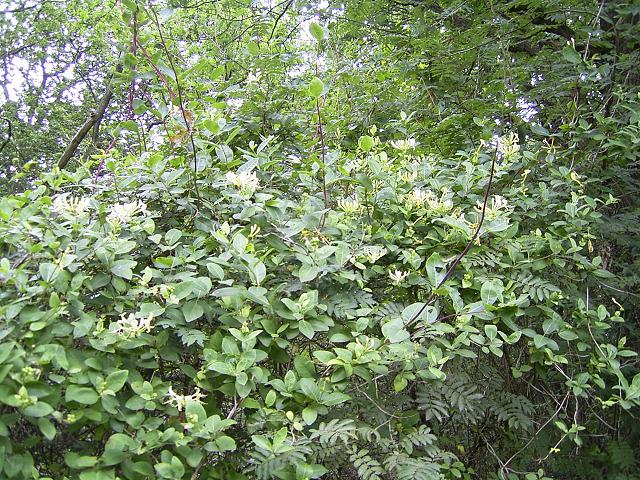


How do you recognise them?
- Perfoliate honeysuckle
- Twining honeysuckle whose top pairs of leaves are fused into a little dish, with the fragrant flowers in the middle.
- Common honeysuckle
- Twining climber with opposite leaves and strongly scented, tubular flowers.
- Compared with perfoliate honeysuckle: all leaf pairs free, flowers in a stalked whorl above the leaves, and flowering until September.
| Perfoliate honeysuckle | Common honeysuckle | |
|---|---|---|
| Leaves | Opposite, oval, 4–10 cm, untoothed, bluish-green underneath; the top 1–3 pairs are fused at the base around the stem. | Opposite, oval, untoothed, 3–7 cm; bluish-green underneath. |
| Flowering | Creamy-white to yellow, often pink-flushed tubular flowers (4–5 cm) in whorls within the fused leaves, May–June; strongly scented in the evening (May–June). | Cream to reddish-yellow tubular flowers in whorls, June–September, strongly scented in the evening (June–September). |
| Fruit | Orange-red berries sitting in the leaf dish, July–August; mildly poisonous. | Glossy red berries, poisonous. |
| Bark | Twining, hairless stems; older stems with peeling bark. | Twining stems; old stems with peeling bark. |
| Shape and height | Climber, twines to 4–6 m | Climber, twines to 6 m |
| Site | Sun or partial shade, any garden soil, normal | Sun or partial shade, any garden soil, normal |
| Native to Belgium | No, planted | Yes |
| Good for bees, butterflies and birds | – | Yes, for bees, butterflies and birds |
| Poisonous to people and pets | Yes, take care with children and pets | Yes, take care with children and pets |
| Pruning months | February–March and July–August | February–March and August–September |
What does it mean for your garden?
- Perfoliate honeysuckle is poisonous to people and pets: take care with children and animals.
- Common honeysuckle is poisonous to people and pets: take care with children and animals.
- Common honeysuckle is native: it feeds more insects and birds than a non-native species. If in doubt, choose this one.
Read on
- Plant profile: Perfoliate honeysuckle
- Plant profile: Common honeysuckle
- Perfoliate honeysuckle: when and how to prune
- Common honeysuckle: when and how to prune
- Identification key
Also looks like
- Common honeysuckle or Japanese honeysuckle
- Japanese honeysuckle or perfoliate honeysuckle
- Weigela or common honeysuckle
Identify by feature
This comparison is compiled from the Bladwijzer species pages.