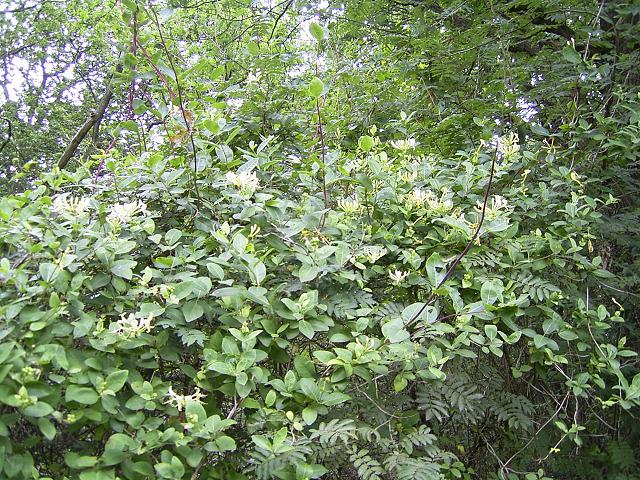
Photo: TeunSpaans at Dutch Wikipedia, CC BY-SA 3.0 · source

Pruning guide · Climber
Honeysuckle: when and how to prune
Lonicera periclymenum
Prune honeysuckle after flowering, in August–September, or at the end of winter, in February–March: cut overlong stems back to a young side shoot, and every few years remove a few old, bare stems.
Wild honeysuckle is a native twining climber that winds up to 6 m high around shrubs, posts and fences, with flowers from June to September that smell wonderful in the evening. Without pruning, after a few years it becomes a tangle of bare stems with all the leaves and flowers at the top. It flowers mainly on side shoots from last year’s wood. Shortening a few flowered stems every year and taking out some old wood now and then keeps it compact and full of flowers.
| Pruning months | February–March and August–September |
|---|---|
| Nesting season (15 March–15 August) | Take care in March and August |
| Flowering | June–September |
| Good for bees, butterflies and birds | Yes, for bees, butterflies and birds |
| Native to Belgium | Yes |
| Poisonous to people and pets | Yes, take care with children and pets |
Honeysuckle: when to prune it?
Prune after flowering, in August–September: shorten the flowered stems then. Leave some of the red berries for the birds.
Do heavier pruning, such as removing old stems or cutting back an overgrown plant, at the end of winter, in February–March, before it starts into growth.
Don’t prune in spring when it is already in full growth: you would cut off the summer’s flower buds.
What else to prune in those months? February · March · August · September
Honeysuckle: how to prune it?
- Cut flowered and overlong stems back to a strong, young side shoot. That way it branches and stays compact.
- Every few years, at the end of winter, remove one or two of the oldest, bare stems at the base. Untangle them carefully from the rest.
- In spring, guide the young shoots to the support and wind them around it, in the direction the plant twines by itself.
- A bare, overgrown plant can be cut right back to 50 cm above the ground in February–March. It regrows well, but flowers less the following year.
- Cut out shoots badly affected by aphids or powdery mildew, and water in dry spells: a plant with dry roots is the most susceptible.
- If it grows through a shrub or hedge, only cut what is smothering the shrub, and let the rest twine freely.
How much to cut, and how often?
- A few flowered stems every year; a few old stems every few years.
- Cutting an overgrown plant back in one go is possible, but costs a year of flowers. If you don’t want that, rejuvenate it over two or three winters.
What does it mean for wildlife?
- Blackbirds, wrens and dunnocks like to nest in a dense honeysuckle. August and March fall in the nesting season (15 March–15 August): ideally prune after mid-August or before mid-March, and otherwise check carefully first.
- The flowers are scented in the evening to attract moths, such as the elephant hawk-moth and other hawk-moths, with their long tongues. By day bumblebees and bees visit.
- Honeysuckle is the food plant of the white admiral, a rare woodland butterfly. The red berries feed thrushes, blackbirds and warblers, but are poisonous to people.
- Feel free to leave old stems with peeling bark in a corner: birds use the fibres as nesting material.
Common mistakes
- Never pruning, so you get a bare tangle of stems with the flowers high up out of sight.
- Shortening all the stems in spring, so the summer flowering is lost.
- Cutting off all the berries when pruning after flowering.
- Pruning a plant in which birds are nesting.
Caution: When pruning after flowering, leave some of the berries for the birds, and don’t prune while birds are still nesting in it. Honeysuckle is poisonous: wear gloves and keep clippings away from children, pets and livestock.
Nearby: related pruning guides
Similar to: Difference from Japanese honeysuckle · Difference from perfoliate honeysuckle · Difference from weigela
Plant profile: Honeysuckle · Pruning calendar and basic rules