Side by side
Common honeysuckle or Japanese honeysuckle? How to tell them apart
Lonicera periclymenum · Lonicera japonica
You can tell a common honeysuckle by its flowers in whorls at the tips of the shoots, its leaves that drop in winter and its red berries; a Japanese honeysuckle is semi-evergreen and has white flowers that turn yellow, in pairs in the leaf axils, and black berries.
Look at where the flowers sit: in a whorl at the end of the stem on the common honeysuckle, in pairs between leaf and stem on the Japanese honeysuckle. In winter the Japanese honeysuckle keeps its leaves, the common honeysuckle loses them.
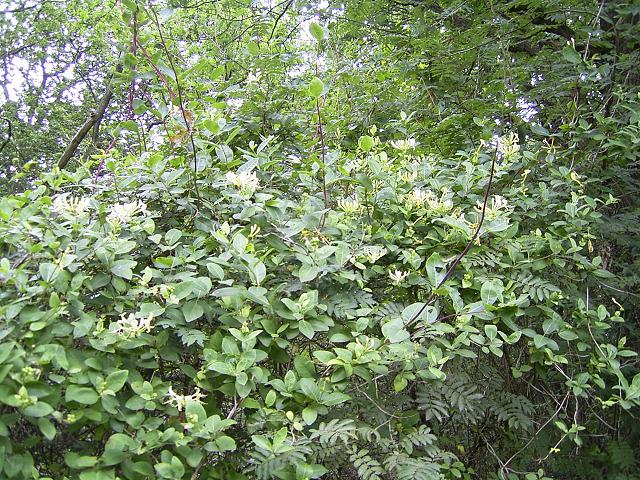


| Common honeysuckle | Japanese honeysuckle | |
|---|---|---|
| Leaves | Opposite, oval, untoothed, 3–7 cm; bluish-green underneath. | Opposite, oval to oblong, 3–8 cm, untoothed and softly hairy; sometimes lobed on young shoots. Stays on the plant in mild winters. |
| Flowering | Cream to reddish-yellow tubular flowers in whorls, June–September, strongly scented in the evening (June–September). | Two-lipped tubular flowers (3–4 cm), white at first and then yellow, in pairs in the leaf axils, June–October; sweetly scented (June–September). |
| Fruit | Glossy red berries, poisonous. | Glossy black berries in pairs, in autumn. |
| Bark | Twining stems; old stems with peeling bark. | Hairy, twining stems that become woody; old stems with flaking bark. |
| Shape and height | Climber, twines to 6 m | Climber, twines to 6–10 m |
| Site | Sun or partial shade, any garden soil, normal | Sun or partial shade, any garden soil, normal |
| Native to Belgium | Yes | No, planted |
| Good for bees, butterflies and birds | Yes, for bees, butterflies and birds | – |
| Poisonous to people and pets | Yes, take care with children and pets | Yes, take care with children and pets |
| Pruning months | February–March and August–September | March–April and July–August |
The best feature in each season
- Spring
- The common honeysuckle comes into leaf very early, often in February; the Japanese honeysuckle usually still carries last year’s leaves then.
- Summer
- Both flower from June to September. The flowers of the common honeysuckle are cream to reddish yellow and strongly scented in the evening; those of the Japanese honeysuckle open white and then turn yellow, so white and yellow flowers hang side by side.
- Autumn
- The berries show the difference: glossy red clusters on the common honeysuckle, glossy black berries in pairs on the Japanese honeysuckle.
- Winter
- The Japanese honeysuckle stays green in mild winters, with softly hairy stems; the common honeysuckle stands bare, with peeling old stems.
Where do they grow?
The common honeysuckle is native and twines up through woodland edges, copses and hedges. The Japanese honeysuckle comes from East Asia and grows here in gardens; it sometimes escapes, and in North America it is a notorious invasive species.
Which one for your garden?
- For wildlife, choose the common honeysuckle: moths such as hawk-moths come to its scent in the evening, and birds eat the berries. Let it twine through a hedge or up a tree.
- The Japanese honeysuckle grows very vigorously: never dump clippings in the countryside and do not plant it near a woodland edge. The berries of both are poisonous to children and pets.
Did you know? In Chinese the Japanese honeysuckle is called gold-and-silver flower, because it carries white and yellow flowers at the same time.
Read on
- Plant profile: Common honeysuckle
- Plant profile: Japanese honeysuckle
- Common honeysuckle: when and how to prune
- Japanese honeysuckle: when and how to prune
- Identification key
Also looks like
- Perfoliate honeysuckle or common honeysuckle
- Weigela or common honeysuckle
- Japanese honeysuckle or perfoliate honeysuckle