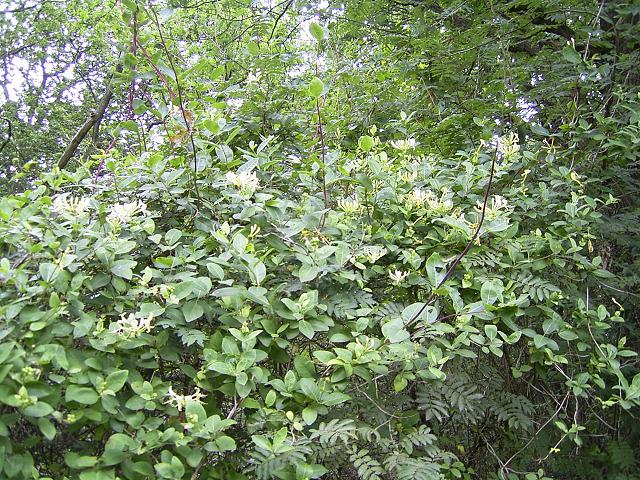
Photo: TeunSpaans at Dutch Wikipedia, CC BY-SA 3.0 · source

Climber · Honeysuckle family (Caprifoliaceae)
Common honeysuckle
Lonicera periclymenum · also: Honeysuckle, Woodbine
Common honeysuckle is a native twining climber that winds its way up to 6 m around shrubs, trees, posts and fences. From June to September it bears cream to reddish-yellow tubular flowers with a wonderful evening scent, to attract moths such as hawk-moths. Glossy red berries follow in late summer for birds; for people they are poisonous. It grows in sun and partial shade, preferably with its roots kept cool, and is a star plant for a wildlife garden.
Caution: The red berries are poisonous: they cause vomiting and stomach ache. Keep them away from small children and pets.
Light
Sun or partial shade
preferably some sun
Moisture
Normal
no wet feet
Legal basis
Any garden soil
any pH
Hardiness
Throughout Belgium
no protection needed
Size
twines to 6 m
tall
Flowering
June–September
| Pruning months | February–March and August–September |
|---|---|
| Height | twines to 6 m |
| Native to Belgium | Yes |
| Good for bees, butterflies and birds | Yes, for bees, butterflies and birds |
| Poisonous to people and pets | Yes, take care with children and pets |
| Flowering | June–September |
Identify
Common honeysuckle: how do you recognise it?
- Habit
- Twining climber up to 6 m that winds around supports; without support it scrambles over the ground or through shrubs.
- Leaf
- Opposite, oval, untoothed, 3–7 cm; bluish-green underneath.
- Stems
- Twining stems; old stems with peeling bark.
- Flower
- Cream to reddish-yellow tubular flowers in whorls, June–September, strongly scented in the evening.
- Fruit
- Glossy red berries, poisonous.
- Difference from Japanese honeysuckle
- Japanese honeysuckle is semi-evergreen, with the flowers in pairs in the leaf axils.
Flowering: June–September · Pruning: February–March and August–September
Identify by feature: Red berries · Twining climbers
Looks like it, but isn’t
- Japanese honeysuckle (Lonicera japonica): evergreen, with the flowers in pairs in the leaf axils.
In your garden
Why grow it?
- One of the most fragrant plants in the garden, especially on summer evenings.
- Flowers for a long time, from June to September.
- Nectar for moths and bumblebees, berries for birds and nesting sites in the dense tangle.
- Native and fully hardy.
- Fits into a small space: it only takes up 1–2 m of width.
Common honeysuckle: where does it grow best?
- Sun to partial shade; ideally with its feet in the shade and its head in the sun.
- Any soil that doesn’t dry out; a fairly humus-rich soil is ideal.
- It twines and needs something to wind around: a pergola, post, fence, mesh or vertical wires. Against a wall, fix wires or a trellis; it does not damage the wall itself.
- Don’t let it twine around a young tree: it winds so tightly around the trunk that it becomes deformed.
- Light
- Sun or partial shade
- Legal basis
- Any garden soil
- Moisture
- Normal
- Size
- 6 m tall, 2 m wide
- Hardiness
- Throughout Belgium, no protection needed
Goes well with
Good and bad companions
Goes well with
- Can climb into old, large trees: english oak, scots pine, sycamore, large-leaved lime
Maintenance
Common honeysuckle: when and how to plant it?
- Plant in autumn or spring; from a pot almost all year, except in frost or drought.
- Plant a little way from the wall or post, where the soil is not too dry, and guide the shoots to the support with a cane.
- Cover the base with leaf mould or a low plant, to keep the roots cool.
- Garden forms such as ‘Belgica’ (early), ‘Serotina’ (late, dark red) and ‘Graham Thomas’ (creamy yellow) are as easy as the wild form.
Care
- Watering
- In dry spells during the first year; later in long dry periods, as drought brings on aphids and mildew.
- Feeding
- Some compost around the base in spring.
- Training
- Guide young shoots in the right direction; after that it twines on by itself.
- Berries
- Leave the berries on the plant: they are for the birds.
Tip: Put a bench or patio near the honeysuckle: you smell it best on a summer evening, and with a bit of luck you will see a hawk-moth hovering in front of the flowers.
Common honeysuckle: when to prune it?
Pruning months: February–March and August–September.
When: After flowering (August–September) or at the end of winter.
How:
- Cut back overgrown stems to a young side shoot, so the plant stays compact.
- Every few years, remove some of the oldest, bare stems to rejuvenate the plant.
- A bare, tangled plant can be cut back to 50 cm above the ground in February–March; it will flower less the following year.
Caution: When pruning after flowering, leave some of the berries for the birds, and don’t prune while birds are still nesting in it.
Propagation
- Layering
- In spring, lay a long shoot on the ground and cover a section with soil; after a year it has roots and you can cut it free.
- Cuttings
- In summer, take 10–15 cm cuttings from non-flowering shoots; they root in a small pot under plastic.
Common honeysuckle: how does it get through the winter?
Hardy throughout Belgium: no protection needed.
- Fully hardy.
- Common honeysuckle comes into leaf very early, often as early as January–February.
Diseases and pests
- Aphids: Grey-green to black aphids on the shoot tips and flower buds, especially in dry weather. Spray with water; ladybirds and tits do the rest.
- Powdery mildew: White, powdery coating on the leaves, especially in dry spots in full sun. Water and cut off affected shoots.
- Bare base: All the leaves and flowers at the top and a bare tangle of stems below. Remove old stems, or cut a tangled plant back hard in late winter.
Through the year
- February: Pruning: rejuvenate or cut back; the first young leaves appear.
- March: Last pruning before growth starts; compost around the base.
- April: Guide young shoots to the support.
- June: Flowering begins: the scent is strongest in the evening.
- July: Full flower; water in dry spells.
- August: Pruning after flowering; the first red berries.
- September: Pruning after flowering; leave berries for the birds.
- October: Planting.
Use
What can you use it for?
- Garden and landscape
- Fragrant climber for pergolas, fences and old trees.
- For wildlife
- Moths and bumblebees visit the flowers; birds eat the berries.
Caution: The berries are poisonous.
Good for wildlife
- Moths
- Nectar for moths, often from flowers that are scented in the evening.
- Bumblebees
- Nectar and pollen for bumblebees, also from deep flowers and early in spring.
- Caterpillars
- Host plant: caterpillars of butterflies or moths eat the leaves.
- Birds
- Berries, seeds or insects as food, or a place to nest.
- Bats
- Attracts insects in the evening that bats hunt.
You and this species
Did you know?
- The scent is strongest in the evening, to attract moths such as hawk-moths.
- The caterpillar of the white admiral feeds on common honeysuckle in shady woodland.
- Honeysuckle winds so tightly around young hazel stems that they grow into spiral-twisted sticks, once prized as walking sticks.
- The Dutch name kamperfoelie comes from the Latin caprifolium, ‘goat leaf’.
- The caterpillars of the white admiral butterfly feed on honeysuckle twining up the trees in shady broadleaved woods.