Side by side
Large-leaved lime or silver lime? How to tell them apart
Tilia platyphyllos · Tilia tomentosa
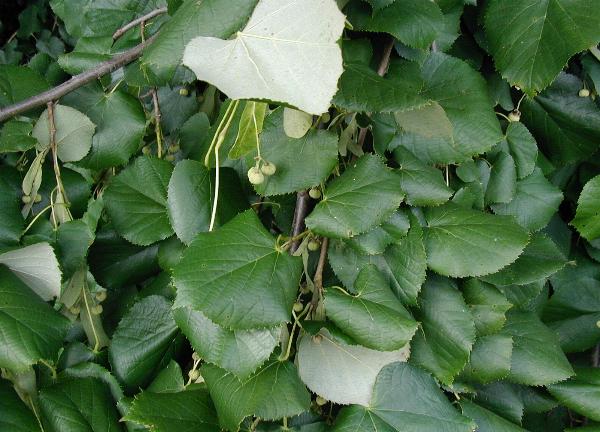
You recognise large-leaved lime by its green, softly hairy leaf with white tufts of hair underneath; silver lime has a leaf with a silvery-white, felted underside that makes the crown shimmer in the wind, and doesn’t flower until late July–August.
Turn a leaf over: silvery white and felted on silver lime, light green and softly hairy on large-leaved lime. From a distance you can already see it when the wind moves through the crown: silver lime seems to glitter. Its leaf is also rounder, with a short pointed tip and a sharply toothed edge, and the leaf stalk is shorter than half the blade.



| Large-leaved lime | Silver lime | |
|---|---|---|
| Leaves | Alternate, lopsided heart-shaped, 6–15 cm, finely toothed. Underside light green and softly hairy all over, with white tufts of hair in the vein axils. | Alternate, 8–12 cm, rounded heart-shaped with a short pointed tip, sharply toothed; dark green above, silvery-white felted below with star-shaped hairs. Leaf stalk shorter than half the blade. |
| Flowering | Clusters of 2–5 fragrant yellow flowers on a tongue-shaped bract, in late June (June). | Hanging clusters of 5–10 strongly scented, yellowish-white flowers, late July–August: the last lime to flower (July–August). |
| Fruit | Hard, globular nutlets with 5 distinct ribs. | Egg-shaped, felted nutlets with five faint ribs. |
| Bark | Grey, finely fissured. Young twigs hairy. | Grey, smooth for a long time, later with a regular network of shallow ridges; young twigs white-felted. |
| Shape and height | Broadleaf tree, 25–35 m | Broadleaf tree, 20–30 m |
| Site | Sun or partial shade, any garden soil, normal | Full sun, any garden soil, dry |
| Native to Belgium | Yes | No, planted |
| Good for bees, butterflies and birds | Yes, for bees and butterflies | – |
| Poisonous to people and pets | Not known to be poisonous | Not known to be poisonous |
| Pruning months | November–March | November–March |
The best feature in each season
- Spring
- The young twigs are white and felted on silver lime, green or reddish and slightly hairy on large-leaved lime. The young leaf of silver lime is already greyish underneath.
- Summer
- Large-leaved lime is the first lime to flower, in late June, silver lime the last, in late July–August. Silver lime flowers are strongly scented, and sometimes many dead bumblebees lie underneath the tree.
- Autumn
- The nutlets of large-leaved lime are hard, round and clearly ribbed; those of silver lime are egg-shaped and felted, with five faint ribs.
- Winter
- Look at the twigs: white and felted on silver lime, almost hairless on large-leaved lime. The bark of silver lime stays smooth for a long time and later develops a regular network of shallow ridges.
Where do they grow?
Large-leaved lime is native to Belgium and the Netherlands, although it is rare in the wild. Silver lime comes from south-eastern Europe and Asia Minor and is planted here as an avenue and park tree, also in towns, because it copes well with drought and heat.
Which one for your garden?
- Both are large trees of 20–35 m for a park, an avenue or a very large garden. Silver lime copes better with a dry, warm site, and it gets fewer aphids.
- For wildlife, choose the native large-leaved lime. If you plant a silver lime, add other summer-flowering plants nearby, so that bumblebees don’t depend on the lime alone in late July.
Did you know? It was long believed that silver lime nectar poisons bumblebees; today it is thought more likely that they starve, because there are so few other flowers so late in summer.
Read on
- Plant profile: Large-leaved lime
- Plant profile: Silver lime
- Large-leaved lime: when and how to prune
- Silver lime: when and how to prune
- Identification key
Also looks like
- Large-leaved lime or common lime
- Large-leaved lime or small-leaved lime
- Hazel or large-leaved lime
- Indian bean tree or large-leaved lime
- Handkerchief tree or large-leaved lime
- Large-leaved lime or black mulberry
- White poplar or silver lime