Side by side
Large-leaved lime or common lime? How to tell them apart
Tilia platyphyllos · Tilia × europaea
You recognise large-leaved lime by its leaf, which is softly hairy all over the underside, and by its nutlets with five clear ribs; common lime has a leaf with a largely hairless underside and only tufts of hair in the vein axils, and a trunk covered in shoots.
Run a finger over the underside of a leaf: soft and hairy all over on large-leaved lime, smooth with only white to pale brown tufts in the vein axils on common lime. Then look at the trunk: on common lime the base and trunk are often covered in epicormic shoots and burrs, much less so on large-leaved lime. Both have a large, lopsided heart-shaped leaf of 6–15 cm.


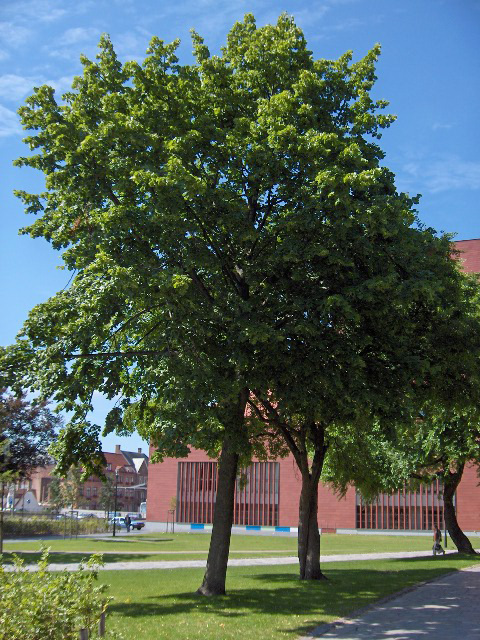
Photo: No machine-readable author provided. JoJan assumed (based on copyright claims)., CC BY-SA 3.0 · source

Common lime Tilia × europaea
| Large-leaved lime | Common lime | |
|---|---|---|
| Leaves | Alternate, lopsided heart-shaped, 6–15 cm, finely toothed. Underside light green and softly hairy all over, with white tufts of hair in the vein axils. | Alternate, 6–12 cm, lopsided heart-shaped, finely toothed; underside light green and largely hairless, with white to pale brown tufts of hair in the vein axils. |
| Flowering | Clusters of 2–5 fragrant yellow flowers on a tongue-shaped bract, in late June (June). | Hanging clusters of 4–10 fragrant, yellowish-white flowers on a tongue-shaped bract, in early July (June–July). |
| Fruit | Hard, globular nutlets with 5 distinct ribs. | Globular nutlets with faint ribs. |
| Bark | Grey, finely fissured. Young twigs hairy. | Grey and finely fissured; the base and trunk are often covered in epicormic shoots and burrs. |
| Shape and height | Broadleaf tree, 25–35 m | Broadleaf tree, 25–35 m |
| Site | Sun or partial shade, any garden soil, normal | Sun or partial shade, any garden soil, normal |
| Native to Belgium | Yes | No, planted |
| Good for bees, butterflies and birds | Yes, for bees and butterflies | – |
| Poisonous to people and pets | Not known to be poisonous | Not known to be poisonous |
| Pruning months | November–March | November–March |
The best feature in each season
- Spring
- Both come into leaf in April–May with fresh green foliage. The young twigs of large-leaved lime are hairy, those of common lime hairless or nearly so.
- Summer
- Large-leaved lime flowers in late June with clusters of 2–5 flowers, common lime about a week later, in early July, with 4–10 flowers per cluster. Under common lime everything becomes sticky with aphid honeydew.
- Autumn
- Squeeze the nutlets: those of large-leaved lime are hard, round and have five clear ribs; those of common lime have only faint ribs.
- Winter
- The buds look very alike. The best clue is then the trunk: a mass of shoots at the base points to common lime, and hairy twig tips to large-leaved lime.
Where do they grow?
Large-leaved lime is native but rare in the wild: you find it in ancient woodland on chalky soil, in parks and as a village tree. Common lime is a natural cross between large-leaved and small-leaved lime, and the most widely planted lime in avenues, squares and streets.
Which one for your garden?
- Both grow 25–35 m tall and are too big for an ordinary garden. As a pleached or pollarded lime, however, they fit into a smaller garden: they tolerate hard pruning very well.
- For wildlife, choose the native large-leaved lime, and don’t plant either over a patio, driveway or parking space: in summer, sticky aphid honeydew drips from them, most of all from common lime.
Did you know? Because common lime produces shoots so readily, it used to be propagated widely from cuttings and layers, which is why old avenues often contain genetically identical trees.
Read on
- Plant profile: Large-leaved lime
- Plant profile: Common lime
- Large-leaved lime: when and how to prune
- Common lime: when and how to prune
- Identification key
Also looks like
- Large-leaved lime or small-leaved lime
- Large-leaved lime or silver lime
- Hazel or large-leaved lime
- Indian bean tree or large-leaved lime
- Handkerchief tree or large-leaved lime
- Large-leaved lime or black mulberry
- Common lime or Caucasian lime
- Common lime or small-leaved lime