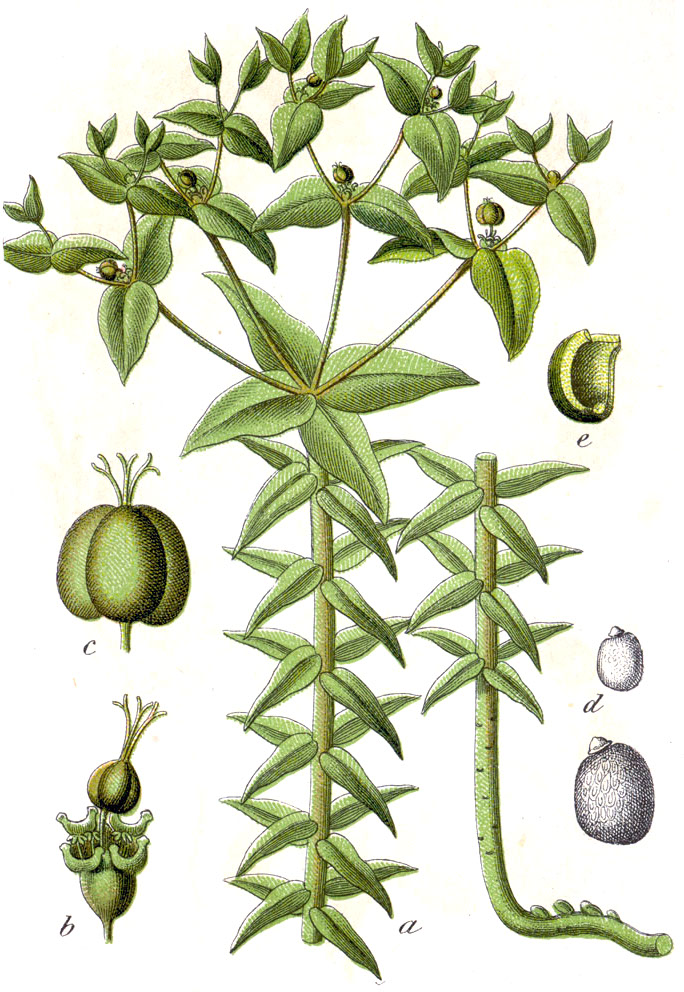
Photo: Johann Georg Sturm (Painter: Jacob Sturm), Public domain · source

Herbaceous plant · Spurge family (Euphorbiaceae)
Caper spurge
Euphorbia lathyris
In other languages: Kruisbladwolfsmelk (Nederlands) · Euphorbe épurge (Français)
Grows wild in Belgium.
Caper spurge is a striking biennial spurge with blue-green leaves arranged in four straight rows along the stem. It is found here and there in Belgium, mainly in gardens and vegetable plots, on waste ground, verges and woodland edges, often near houses. In its first year it is a straight, unbranched stem that forms a cross when seen from above; in its second year it grows to 0.5–1.5 m and branches at the top into yellow-green umbels. These are followed by large, green, three-lobed fruits that look like capers but are highly poisonous. It is known as the ‘mole plant’, although there is no evidence that it drives moles away. The whole plant is full of white, caustic milky sap: so do not plant it where children play.
Caution: Caper spurge is highly poisonous in all its parts. The white milky sap is caustic: it makes the skin red and burning and causes blisters, and in the eyes it can cause serious damage. The fruits and seeds look like capers, but eating them causes severe stomach pain, vomiting and diarrhoea. Children, pets and grazing animals are most at risk. Do not plant it where young children play, wear gloves and goggles when working and wash your hands afterwards. If sap gets into an eye, rinse immediately with plenty of water and see a doctor.
Light
Sun or partial shade
preferably some sun
Moisture
Dry to normal
no wet feet
Hardiness
Fully hardy
down to -20 °C
Size
1 m
tall, 0.4 m wide
Flowering
May–August
| Pruning months | July–August |
|---|---|
| Height | 1 m |
| Native to Belgium | Yes |
| Flowering | May–August |
Identify
How to recognise it
- Growth habit
- Biennial. In the first year a straight, unbranched stem of 20–50 cm; in the second a sturdy stem of 0.5–1.5 m that branches at the top into an umbel. The plant dies after setting seed.
- Leaf
- Linear to lance-shaped, 5–15 cm long, blue-green with a pale midrib, opposite and set crosswise, so that the leaves stand in four straight rows along the stem.
- Flower
- Yellow-green umbels, usually with 2–6 rays and triangular, pointed bracts. The tiny flowers sit in little cups with crescent-shaped glands with short horns. Flowers from May to August.
- Fruit/Seed
- Large, smooth, green, three-lobed capsules of 1–1.5 cm that look like capers. When ripe they burst open audibly and fling the seeds several metres.
- Roots
- A taproot; young plants are easy to pull up, older ones are more firmly anchored.
- Confusion with
- No other spurge has leaves in four such neat rows. Because of its fruits it is sometimes confused with capers, the flower buds of the caper bush: never eat them.
Flowering: May–August · Pruning: July–August
In your garden
Why grow it?
- An architectural plant with a crisp, geometric shape: in its first year a living column with leaves arranged in a cross.
- Blue-green, waxy leaves that stay attractive all year, even in winter.
- The yellow-green umbels in May–August give nectar to flies, wasps, ants and small bees.
- Rabbits and slugs usually leave it alone.
- A plant full of folklore and history: as the ‘mole plant’ and as an old, dangerous purgative, which explains the French name épurge.
Caper spurge: where does it grow best?
- In the wild: gardens, vegetable plots, waste ground, verges, woodland edges and clearings, often near houses.
- Sun to partial shade.
- Almost any free-draining soil, from sand to loam; preferably not too wet.
- In the garden: at the back of a border, in a rough corner or a dry strip along a wall, where children and pets do not go.
Goes well with
- Foxglove: Another biennial for partial shade, with tall purple spikes; also poisonous, so keep it away from children.
- Honesty: A biennial with purple flowers in spring and silvery seed discs.
- Great mullein: Another architectural biennial, with grey, woolly leaves and tall yellow spikes.
- Columbine: Flowers in May–June in the same partial shade.
Maintenance
Caper spurge: when and how to plant it?
- Only plant it if no young children play in the garden and no pets or rabbits roam freely.
- Buy seed or plants from a nursery; do not take plants from the wild.
- Sow in August–September or March–April where it is to grow, 1 cm deep. Move seedlings while young: because of the taproot, transplanting later rarely succeeds.
- Space plants 40–50 cm apart.
- Wear gloves when planting and moving it, and keep the sap away from your eyes.
- Water once after planting; after that it manages on its own.
Care
- Water
- Not needed: it copes well with drought.
- Feeding
- Not needed; on poor soil it stays more compact and sturdy.
- Letting it seed
- Being biennial, it only stays if it sets seed. Let one plant self-seed if you want to keep it.
- Spreading
- It self-seeds freely, even several metres away thanks to its exploding fruits. Pull up unwanted seedlings while young, wearing gloves.
- Support
- In a windy spot the tall second-year stem can topple. Give it a sheltered spot or a cane.
Tip: Cut off the umbels as soon as the fruits form and are still green, and leave at most one if you want to keep it: that way the handsome, crisp plant stays in your garden without popping up everywhere, and nobody is tempted to taste the ‘capers’.
Pruning and mowing
Pruning months: July–August.
When: In July–August, before the fruits are ripe, if you do not want seed.
How:
- Cut off the umbels with fruits while these are still green, before they burst open.
- Pull up the whole plant after flowering: it dies off anyway.
- Do not leave cut stems where children or animals can reach them; they go in the organic waste bin or general waste.
- Wear gloves, long sleeves and ideally goggles: the sap can spurt.
Caution: The milky sap is caustic and highly poisonous. Do not touch your face while working, and wash your hands and tools afterwards.
Propagation
- Seed
- Sow ripe seed in August–September or in spring where it is to grow. In a good spot it self-seeds; the seedlings flower the following year.
Caper spurge: how does it get through the winter?
Hardy to −20 °C.
- The first-year plant overwinters as a straight, evergreen stem with blue-green leaves.
- Hardy to about −20 °C; on wet soil it can rot in winter.
- Second-year plants die after setting seed; clear away the dead stems with gloves on.
Diseases and pests
- Self-seeding: It flings its seeds several metres. Cut off the fruits while green if you do not want seedlings.
- Milky sap: Caustic to skin and eyes. Work with gloves and goggles, and rinse immediately with plenty of water if it splashes.
- Confusion with capers: The fruits look like capers but are highly poisonous. Teach children never to eat any part of this plant.
- Root rot: On wet, heavy soil the base of the stem rots in winter. Choose a dry spot.
Through the year
- March: Sow in place. First-year plants keep growing.
- April: Second-year plants shoot up.
- May: The first yellow-green umbels.
- June: Full bloom: flies and wasps on the glands.
- July: Green fruits appear. Cut them off with gloves on if you do not want seed.
- August: Last flowers. The fruits burst open: if you do not want seedlings, cut them off before then.
- September: Sow. Pull up spent plants with gloves on.
- October: Pull up unwanted seedlings while young.
- December: First-year plants stand evergreen in the garden.
You and this species
Did you know?
- It is known as the ‘mole plant’: moles are said to avoid it, but there is no evidence for this.
- In the past the seed was used as a very powerful and dangerous purgative; the French name épurge is a reminder of this.
- The English name caper spurge refers to the fruits, which look like capers.