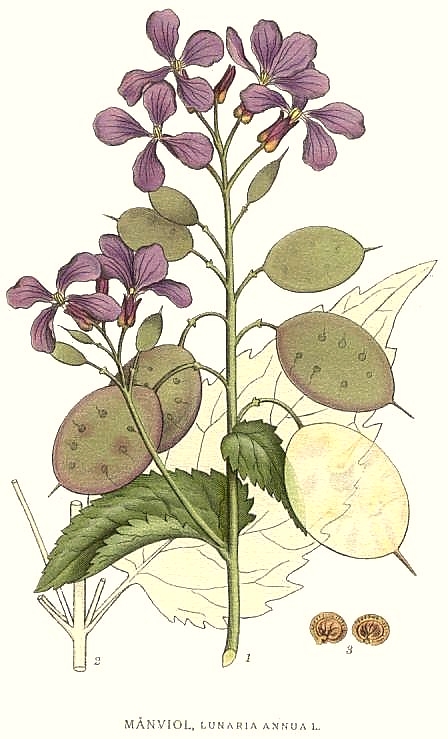
Photo: Carl Axel Magnus Lindman, Public domain · source

Herbaceous plant · Cabbage family (Brassicaceae)
Honesty
Lunaria annua
In other languages: Judaspenning (Nederlands) · Monnaie-du-pape (Français)
Grows wild in Belgium.
Honesty is a biennial of the cabbage family with lightly scented purple flowers in April and May. Originally from south-eastern Europe, it has been grown in gardens for centuries and is naturalised in Belgium: you find it along woodland edges, hedgerows, banks and rough ground near villages and gardens. Recognise it by its large, heart-shaped, coarsely toothed leaves and above all by its flat, round seed pods, which turn silvery and translucent after summer, like coins. It provides early nectar for butterflies and bees and is a food plant for orange-tip caterpillars. Its silver ‘coins’ are a classic in dried arrangements.
Light
Sun or partial shade
preferably some sun
Moisture
Normal
no wet feet
Hardiness
Fully hardy
down to -20 °C
Size
0.8 m
tall, 0.4 m wide
Flowering
April–May
| Pruning months | March and August–September |
|---|---|
| Height | 0.8 m |
| Native to Belgium | No, naturalised |
| Flowering | April–May |
Identify
How to recognise it
- Habit
- Biennial: a rosette of leaves in the first year, branched, hairy flowering stems of 60–100 cm in the second. The plant dies after setting seed.
- Leaves
- Large, heart-shaped to triangular, 5–15 cm, coarsely and irregularly toothed, rough and hairy. The lower leaves are stalked, the upper ones almost stalkless.
- Flowers
- Purple to lilac, sometimes white, with four petals in a cross, about 2 cm across, in loose clusters. Lightly scented, especially in the evening.
- Fruit
- Flat, almost round pods of 3–5 cm. When the two outer walls fall away, the silvery, translucent central partition remains, with the flat seeds pressed against it.
- Roots
- A fleshy, slightly tuberous taproot: young plants move easily, old ones do not.
- Confusion with
- Perennial honesty (Lunaria rediviva) is a perennial with pale lilac flowers and elongated pods pointed at both ends. Dame’s violet has similar purple flowers but narrow leaves and long, thin pods.
Flowering: April–May · Pruning: March and August–September
In your garden
Why grow it?
- Early nectar in April and May for bumblebees, bees and butterflies such as the orange-tip and the brimstone.
- Food plant for orange-tip caterpillars, which feed on the young green seed pods.
- Flowers freely in light shade, where few other plants give as much colour in spring.
- The silvery seed-pod partitions stand well into winter and are a classic for dried arrangements.
- Self-seeds: sow it once and you will have honesty for years in a wildlife garden.
Honesty: where does it grow best?
- In the wild: woodland edges, hedgerows, parks and rough ground near gardens, often on fertile soil.
- In the garden: light shade under trees or shrubs is ideal; full sun works if the soil does not dry out.
- Ordinary, humus-rich garden soil that is not too wet: sand, loam or clay.
- Lovely on a woodland edge, in a shady border or in a wild corner where it can self-seed.
Goes well with
- Foxglove: Another woodland-edge biennial, flowering just as honesty finishes.
- Garlic mustard: Also an orange-tip food plant, in the same light shade.
- Columbine: Flowers alongside in May and self-seeds just as happily.
- Wood forget-me-not: A blue carpet under the purple flowers.
- Tulips: Together a colourful spring picture in the border.
Maintenance
Honesty: when and how to plant it?
- Sow in May–June where it is to grow or in small pots: it forms a rosette this year and flowers next spring.
- Cover the seed with about 1 cm of soil and keep it moist; it germinates within a few weeks, without a cold spell.
- Or buy young plants from a nursery and plant them in September–October or in March.
- Plant or thin to 30–40 cm apart: the rosettes spread wide.
- Water well after planting and again during dry spells in the first year.
- Never dig up plants from the wild: gardens and nurseries have plenty of seed and plants.
Care
- Water
- Only in long dry spells, especially for the young rosettes in summer.
- Feeding
- Not needed. On rich soil the stems grow long and floppy.
- Letting it seed
- Leave some seed stems every year: the plant itself dies after flowering and the seedlings take over.
- Spreading
- Surplus seedlings pull out easily in spring while they are still small.
- Flowers every year
- Sow two years running: you will then have flowering plants next to new rosettes every spring.
Tip: Sow two years running: because the plant is biennial, you will then have flowers every spring and the plant will keep itself going from then on.
Pruning and mowing
Pruning months: March and August–September.
When: In August–September cut seed stems for drying; clear the dead plants in March.
How:
- Cut the stems when the pods start to change colour and hang them upside down in a dry, airy place.
- Then gently rub off the two outer walls to reveal the silver partitions.
- Leave some stems in the garden to self-seed and as a winter silhouette.
- Only clear the dead stems in March: they look good all winter.
Caution: The plant dies after setting seed. For flowers next year, let it seed or sow some more yourself.
Propagation
- Seed
- Sow in May–June outdoors or in pots. No cold spell needed; plants flower the following spring.
- Self-seeding
- Leave the seed stems: the flat seeds drop around the plant and germinate in autumn or spring. Move seedlings while they are small.
Honesty: how does it get through the winter?
Hardy to −20 °C.
- This year’s young plants overwinter as green rosettes and are fully hardy.
- The silver partitions stand well into winter and catch the low light beautifully.
- Seed-eating birds such as finches sometimes pick the seeds from the pods, so leave the stems until March.
Diseases and pests
- Flea beetles: Tiny jumping beetles make small holes in the leaves of young plants, especially in dry weather. Keep the soil moist; bigger plants are hardly bothered.
- White blister: White, powdery pustules on leaves and stems. Cut off affected parts and let next year’s plants come up in a different spot.
- Caterpillars: Orange-tip caterpillars on the pods are welcome: they eat very little. Cabbage white caterpillars can be picked off by hand.
- Too many seedlings: In a small garden it can pop up everywhere. Cut some seed stems before the seed ripens.
Through the year
- January: Silver seed pods decorate the garden. Last year’s rosettes stay green.
- March: Clear old stems. Thin seedlings to 30–40 cm.
- April: Flowering begins. Orange-tips and bumblebees on the flowers.
- May: Full flower. Sow for flowers next year.
- June: Flat green pods. There is still time to sow.
- July: The pods change colour. Water young rosettes in dry spells.
- August: Cut seed stems for drying.
- September: Rub off the outer walls to reveal the silver coins. Plant young plants.
- October: Seed drops. Move rosettes.
- December: Rest. The silver pods still stand in the garden.
You and this species
Did you know?
- The Dutch name judaspenning (Judas penny) refers to the thirty pieces of silver: the round, silvery partitions look like coins. The French name monnaie-du-pape means ‘pope’s money’.
- The name honesty is thought to come from the translucent partitions: you can see right through them.
- Despite its scientific name annua (annual), the plant is usually biennial. Lunaria comes from luna, the moon, after the round, silvery pods.