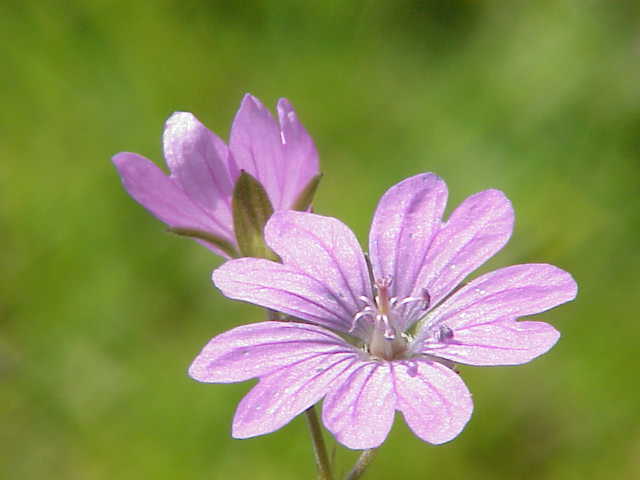
Photo: Kurt Stüber [1], CC BY-SA 3.0 · source

Herbaceous plant · Crane’s-bill family (Geraniaceae)
Hedgerow crane’s-bill
Geranium pyrenaicum
In other languages: Bermooievaarsbek (Nederlands) · Géranium des Pyrénées (Français)
Grows wild in Belgium.
Hedgerow crane’s-bill is a native perennial crane’s-bill of grassy road verges, dykes, hedge banks, woodland edges and rough corners of villages and parks, mainly on fairly rich, loamy or chalky soil. In Belgium it is fairly common, especially along roads and in the loam belt; on poor, acid sand it is scarcer. You can recognise it by its round, softly hairy, palmately cut leaves and its purplish-pink flowers about 1.5 cm across, with deeply notched petals, always borne in pairs. It flowers for an exceptionally long time, from May into October, feeding bees and hoverflies throughout. After flowering come the typical beak-shaped fruits, which fling out their seeds.
Light
Sun or partial shade
preferably some sun
Moisture
Normal
no wet feet
Hardiness
Fully hardy
down to -25 °C
Size
0.5 m
tall, 0.4 m wide
Flowering
May–October
| Pruning months | July and September |
|---|---|
| Height | 0.5 m |
| Native to Belgium | Yes |
| Flowering | May–October |
Identify
How to recognise it
- Habit
- Perennial with a rosette of long-stalked leaves and loose, branched, ascending stems 25–60 cm long. Below ground is a sturdy rootstock with a deep root.
- Leaf
- Round in outline, 3–8 cm across, palmately cut to about two thirds into 5–9 lobes with blunt teeth; softly hairy. The stem leaves are smaller and opposite.
- Flower
- Purplish pink to lilac, 14–18 mm across, with five petals that are deeply notched at the tip and about twice as long as the sepals. The flowers are borne in pairs on a shared stalk.
- Fruit/Seed
- A beak-shaped fruit about 2 cm long, with five smooth, finely hairy segments at the base. When ripe, the segments suddenly curl up and fling out the seeds.
- Stem
- Round, branched and densely covered with short soft hairs and longer glandular hairs; often tinged red.
- Look-alikes
- Dove’s-foot crane’s-bill is annual, lower and has smaller flowers (7–10 mm) with hairless, transversely wrinkled fruit segments. Small-flowered crane’s-bill has tiny, pale lilac flowers. Meadow crane’s-bill has much larger, violet-blue flowers and deeply divided leaves. Herb-Robert has finely divided, strong-smelling leaves and petals without a notch.
Flowering: May–October · Pruning: July and September
In your garden
Why grow it?
- One of the longest-flowering wild plants: from May into October, with a second flush if you cut it back in summer.
- The flowers provide nectar and pollen for honeybees, wild bees and hoverflies, even late in the season when there is less about.
- A tough, easy plant for a flowery verge, a hedge bank or the edge of a border that may look a little wild.
- It tolerates mowing and fairly rich soil, where many other wild flowers struggle.
- The beak-shaped fruits that shoot out their seeds are fun for children to discover too.
Hedgerow crane’s-bill: where does it grow best?
- In the wild: grassy verges, dykes, hedge banks, woodland edges, rough ground, churchyards and neglected corners of villages and towns.
- It likes fairly rich, well-drained soil: loam, sandy loam or clay, preferably a little chalky; on poor, acid sand it grows less well.
- In the garden: sun to partial shade, in ordinary garden soil that is not too wet.
- Lovely in a flowery verge, a hedge bank rich in wild flowers, under a fruit tree or at the edge of a naturalistic border.
Goes well with
- Cow parsley: White umbels in May, as the crane’s-bill starts to flower; together typical of a rich verge.
- Garlic mustard: An early flower for the same partial shade along the hedge, and food plant of the orange-tip.
- Greater stitchwort: White starry flowers at the foot of the hedge in spring.
- Tufted vetch: Violet-blue spikes in summer that scramble up through the crane’s-bill.
- Common knapweed: Purple heads in summer in the same mown verge, much visited by butterflies.
Maintenance
Hedgerow crane’s-bill: when and how to plant it?
- Buy seed or young plants from a nursery specialising in native plants. Never take plants or seed from the wild.
- Sow in September–October or in March–April, in small pots or in place on bare soil. Cover the seed with a thin layer of soil; germination is often uneven, sometimes only after winter.
- Plant young plants in spring or autumn, in groups of 3–5, 30–40 cm apart.
- Set them at the same depth as in the pot, firm the soil well and water straight away.
- Water in dry spells for the first few weeks; after that it manages on its own.
- In an existing grassy verge, plant pot-grown plants rather than sowing: seedlings struggle to establish in dense grass.
Care
- Watering
- Only after planting and, in the first year, during long dry spells. Established plants cope with dry summers thanks to their deep root.
- Feeding
- Not needed. On soil that is too rich it becomes floppy and falls apart; ordinary garden soil is more than enough.
- Mowing
- In a verge, mow twice a year: in early July and in September, removing the cuttings each time. It regrows quickly after mowing.
- Cutting back
- In a border, cut it back in early July, after the first flush, to just above the leaf rosette. This gives fresh leaves and a second flowering into autumn.
- Self-seeding
- It self-seeds readily. To limit this, cut off the faded stems before the fruits ripen, or weed out unwanted seedlings in spring.
Tip: Cut it back hard in early July after the first flush: within a few weeks you will have a fresh, compact plant that flowers again into October.
Pruning and mowing
Pruning months: July and September.
When: In early July, after the first flush, and again in September; in a verge this coincides with the usual mowing.
How:
- Cut or mow the long, sprawling stems back to just above the leaf rosette; it regrows within a few weeks.
- At the second cut, leave some stems with fruits if you want it to self-seed.
- Remove the cuttings so the soil does not become too rich.
- Leave the leaf rosette over winter: in mild winters it often stays green and protects the heart of the plant.
Caution: Do not mow too low: if you damage the rosette and the crown of the root, it regrows less well.
Propagation
- Seed
- Sow fresh seed in September–October in a pot of seed compost and leave it outside over winter, or sow in March–April. Prick out the seedlings once they have a few true leaves.
- Self-sown seedlings
- On bare ground it self-seeds easily. Move young rosettes in autumn or early spring with a good root ball.
- Division
- Older plants can be carefully divided in March–April, each piece with part of the rootstock and a few buds. Sowing is usually easier.
Hedgerow crane’s-bill: how does it get through the winter?
Hardy to −25 °C.
- The flowering stems die back in late autumn; the leaf rosette often stays green in mild winters.
- Hardy to about −25 °C: the sturdy rootstock survives hard frost without protection.
- The low rosette and old stems at the foot of a hedge give shelter to small insects and spiders.
- It starts into growth again very early in spring.
Diseases and pests
- Too many seedlings: In a border it can self-seed freely. Cut off faded stems before the fruits ripen and weed out seedlings while they are small.
- Sprawling plants: In midsummer the stems flop open and the plant looks untidy. Cutting back in early July solves this.
- Powdery mildew: White powder on the leaves in dry, warm weather. Cut back and remove affected leaves; the new foliage is usually healthy.
- Slugs: They sometimes eat seedlings and young plants. Plant sturdy pot-grown plants and let hedgehogs, toads and ground beetles do their work.
Through the year
- March: New leaves appear. Sowing or planting is possible.
- April: Plant out young plants. Weed out unwanted seedlings.
- May: First flowers. Bees and hoverflies arrive.
- June: Full flower.
- July: After the first flush, cut back or mow; remove the cuttings.
- August: New flowers. Water young plants in dry spells.
- September: Second cut in the verge. Collect and sow ripe seed.
- October: Last flowers. Planting and moving plants is possible.
- November: The leaf rosette stays. Rest.
You and this species
Did you know?
- The name crane’s-bill and the genus name Geranium (from the Greek geranos, crane) both refer to the long, beak-shaped fruit.
- The ‘geraniums’ in window boxes are not true crane’s-bills but pelargoniums, a related genus that comes mainly from southern Africa.
- The species name pyrenaicum means ‘of the Pyrenees’, although the plant grows across much of Europe.